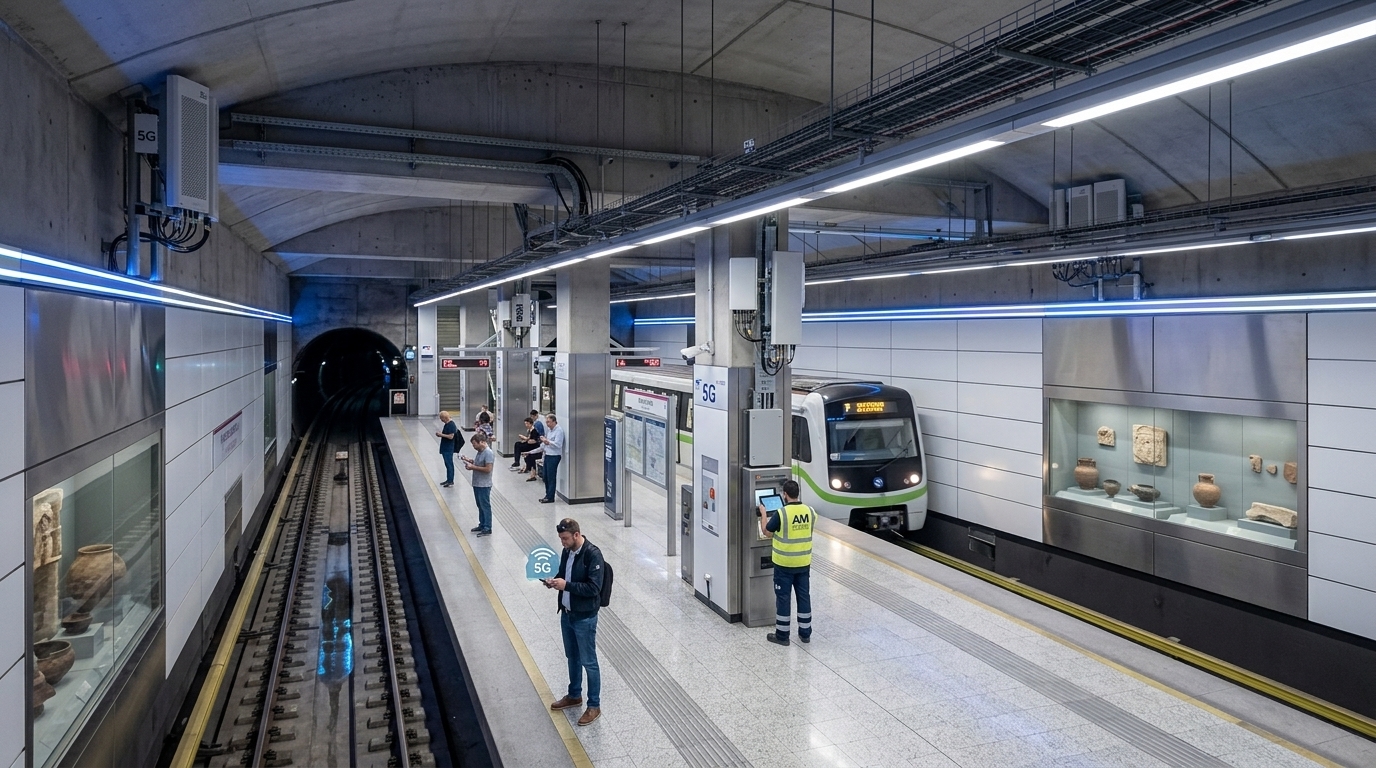
Athens, a city balancing its ancient heritage with the demands of the digital age, is facing a necessary, albeit inconvenient, evolution. STASY (Urban Rail Transport S.A.) has announced the early closure of five stations on Metro Line 2 to facilitate the installation of 5G network infrastructure. The stations—Anthoupoli, Peristeri, Agios Antonios, Sepolia, and Attiki—will shut down earlier than usual, forcing commuters to adapt to alternative solutions, such as the emergency bus line X18.
This move is not merely a technical maintenance issue; it is a symptom of a broader effort to transform the Athens Metro from a simple transport system into a fully connected digital hub. In an era where connectivity is considered almost a basic human right, the existence of "dead zones" in underground tunnels feels anachronistic. However, realizing this vision requires sacrifices in the daily commute of thousands.
The Technical Challenge and Timetable
Installing antennas and fiber optics in a network that operates nearly 20 hours a day is a logistical challenge of significant proportions. The work must be performed with surgical precision during the few hours when the power to the rails is cut. The decision to close stations at 9:00 PM or 10:00 PM instead of midnight provides technicians with the necessary "window" to install equipment without risking worker safety or the smooth start of service the following morning.
The project involves a partnership between STASY and the country's major telecommunications providers. The goal is full 4G and 5G coverage throughout the tunnels and stations. To date, the user experience in the Athens Metro has been characterized by constant disconnections as soon as a train enters a tunnel, affecting not only passenger entertainment but also productivity and safety in emergencies.
The Social Cost of Progress
For the employee finishing a late shift in the city center or the student returning home to Peristeri, the suspension of Metro service is a significant hurdle. While the X18 bus line is meant to fill the gap, traffic on Athens' streets, even in the evening, cannot compete with the speed and reliability of rail transport. This highlights the classic conflict between long-term benefits and immediate inconvenience.
Criticism often centers on the communication of these projects. Many passengers are informed at the last minute, and alternative bus lines often suffer from understaffing or poor coordination. It is essential that digital upgrades are accompanied by a corresponding upgrade in citizen service during the transition period.
Athens on the European Map
Compared to other European capitals, Athens has been slow to introduce 5G into its underground. In Paris, London, and Berlin, connectivity in the metro has been a given for years, with authorities investing heavily to ensure that a citizen's "digital life" remains uninterrupted. The delay in Greece has been attributed to bureaucratic hurdles and complex negotiations between the public sector and private telecom companies regarding cost and profit sharing.
However, the completion of this project will bring Athens closer to the "Smart City" model. The ability for passengers to use real-time data, and for STASY to utilize IoT (Internet of Things) sensors to monitor the condition of trains and tracks, will significantly improve network efficiency.
Conclusions and Outlook
The closure of the five Line 2 stations is a reminder that progress requires infrastructure that is often invisible but essential. 5G in the Metro is not a luxury; it is the foundation for future services, from contactless mobile ticketing to augmented reality for tourists navigating the city. While the patience of citizens is being tested, the result is expected to radically change how we experience urban mobility in the Greek capital.
- Affected stations: Anthoupoli, Peristeri, Agios Antonios, Sepolia, and Attiki.
- The X18 bus line will operate during the closure periods.
- The project is part of the national strategy for digital infrastructure upgrades.
- 5G coverage will gradually expand across the entire Metro network.