The climate crisis is no longer a distant threat but a daily reality testing the resilience of infrastructure and civil protection in Greece. From the catastrophic floods of Storm Daniel in Thessaly to the suffocating clouds of Saharan dust periodically blanketing urban centers, the need for more accurate and faster forecasting is imperative. In this context, Artificial Intelligence (AI) is emerging as the most valuable ally of meteorological science, transforming how we perceive and prepare for extreme weather events.
The Paradigm Shift: From Physics-Based Models to Machine Learning
For decades, weather forecasting has relied on Numerical Weather Prediction (NWP), which utilizes complex mathematical equations of atmospheric physics executed on supercomputers. While effective, these models require immense computational power and time. The advent of AI, specifically deep learning, now allows for the analysis of decades of historical data in seconds. Models such as Google DeepMind’s GraphCast and Huawei’s Pangu-Weather have already demonstrated their ability to outperform traditional systems in accuracy while using a fraction of the energy.
In Greece, the National Observatory of Athens (Meteo.gr) is at the forefront of this effort. The use of AI does not replace meteorologists; rather, it provides them with tools to "train" algorithms that recognize patterns that the human eye or traditional equations might overlook. This is particularly critical for Greek geography, where the rugged terrain and proximity to the sea create complex microclimates that traditional global models often fail to capture with precision.
Floods: Moving from Reaction to Prevention
Flooding represents perhaps the greatest challenge for Civil Protection. Traditional forecasting can warn of high precipitation volumes, but AI can go a step further: predicting water runoff in real-time. By combining rainfall data with topographical maps, soil saturation levels, and river stages, new AI systems can predict exactly which city blocks are at risk of flooding several hours before the event peaks.
- Real-time analysis of satellite imagery to identify water accumulation.
- Modeling the behavior of drainage basins under extreme atmospheric pressure.
- Integration with the 112 emergency system for hyper-local, targeted warnings.
This "hyper-local" forecasting is what makes the difference between a timely evacuation and a tragedy. AI enables the creation of "digital twins" of high-risk areas, where thousands of rainfall scenarios are simulated, allowing authorities to know in advance the weak points of the drainage network and deploy resources proactively.
The Saharan Dust Enigma
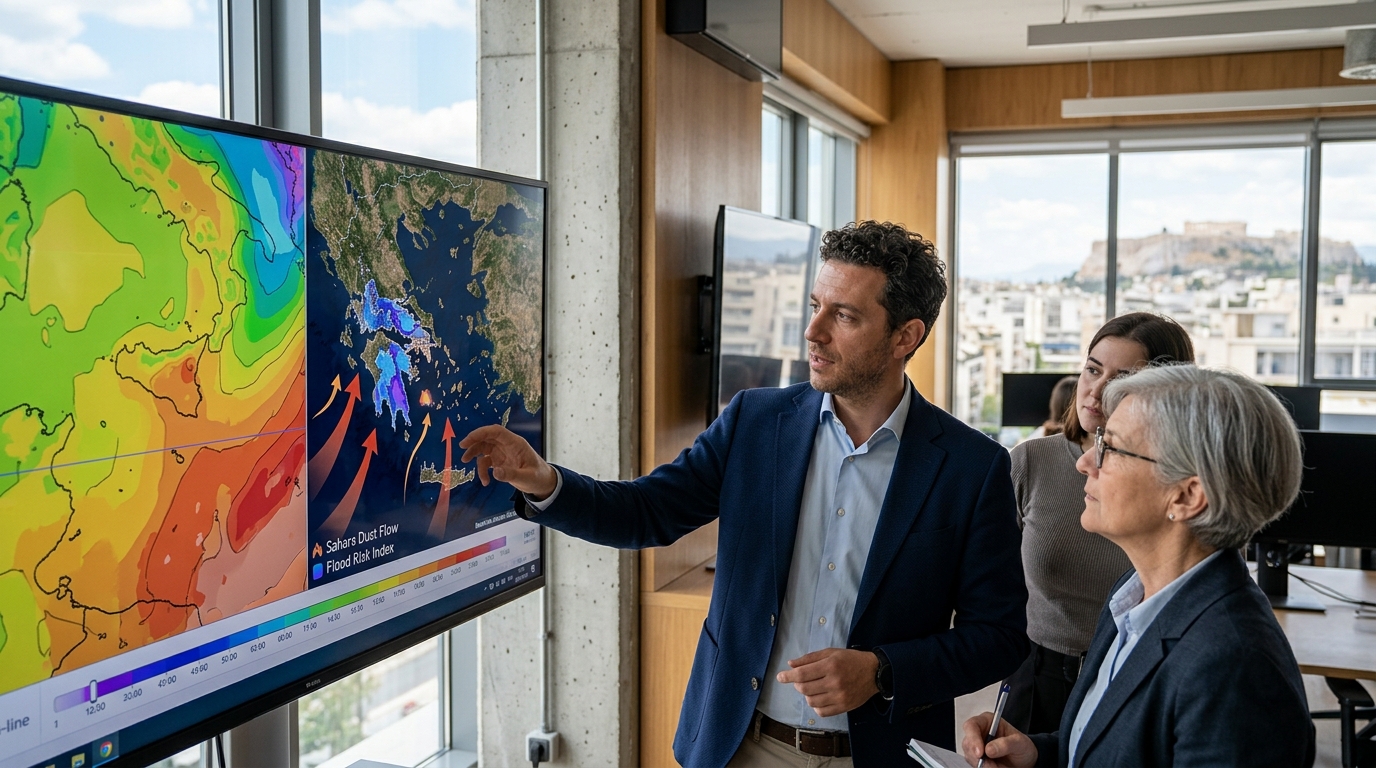
The transport of dust from the Sahara has become more frequent and intense in recent years, causing serious health issues and disrupting daily life. Predicting dust episodes is exceptionally difficult, as it depends on wind conditions in the desert, humidity levels, and high-altitude atmospheric currents. AI assists in processing data from lidar sensors and satellites to map the three-dimensional movement of particles.
"Artificial Intelligence allows us to see the 'big picture' of atmospheric circulation, connecting phenomena occurring thousands of kilometers away with the air quality in Athens or Heraklion," state experts from Meteo.
With the help of AI, forecasts for dust density and arrival times are now becoming accurate to the minute. This is vital for vulnerable populations, who can receive mobile notifications to avoid unnecessary exposure. Furthermore, accurate forecasting assists the energy sector, as dust dramatically reduces the efficiency of solar farms, allowing grid operators to schedule alternative energy sources in advance.
Toward a Resilient Future
Investing in AI for meteorology is not a luxury but a necessity. As we move into the latter half of the 2020s, Greece must further strengthen the collaboration between research centers, universities, and the state apparatus. The technology is here, but its success depends on data quality and the speed of decision-making. AI can provide the critical minutes needed to save lives, but human leadership is required to translate that information into effective action on the ground.