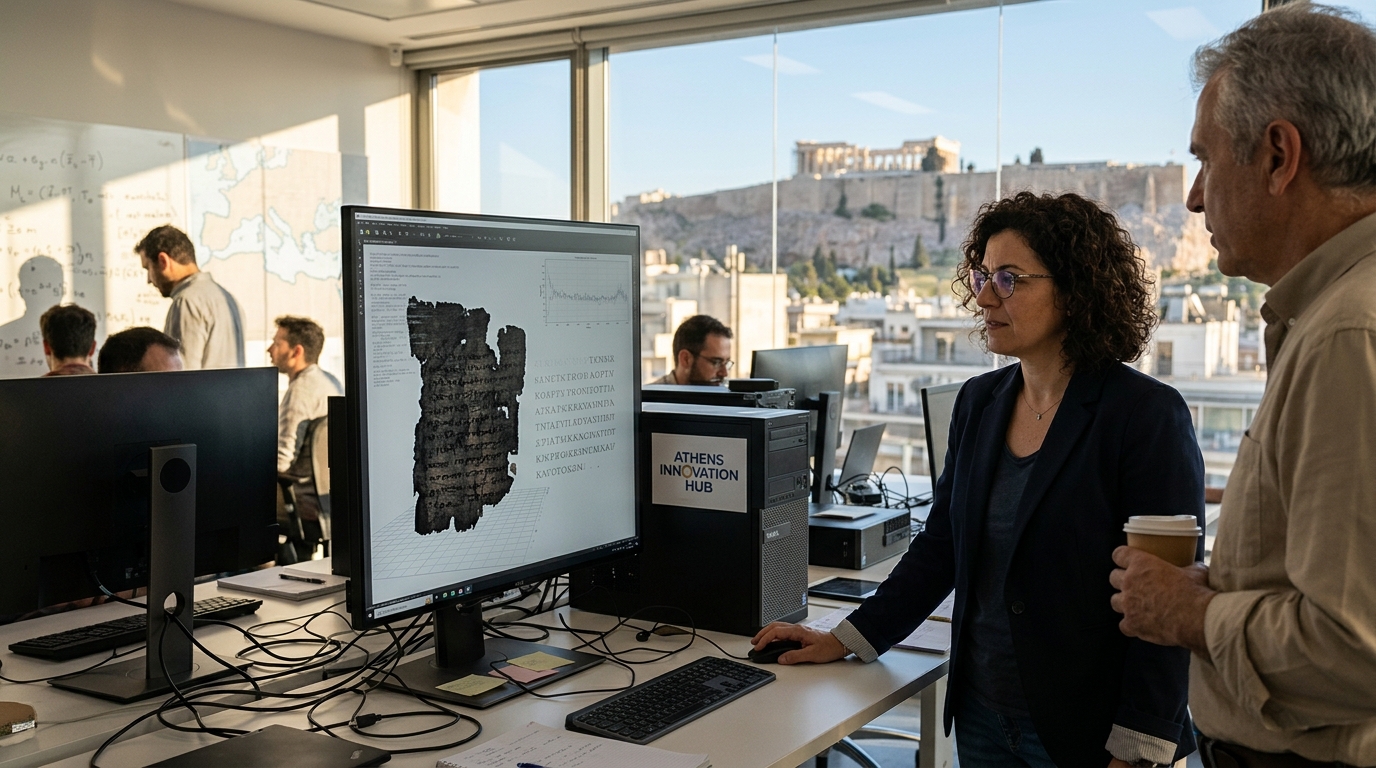
The history of humanity is riddled with gaps—libraries burned, knowledge lost to the dust of time. However, modern technology is beginning to act as a "time machine," allowing us to peer through the ashes. The recent success of the "Vesuvius Challenge" represents one of the most staggering achievements in the history of digital archaeology: Artificial Intelligence has successfully "read" carbonized scrolls from Herculaneum that had remained unreadable for two millennia following the catastrophic eruption of Mount Vesuvius in 79 AD.
This achievement is not merely a technical victory; it is the recovery of an intellectual heritage once thought lost forever. These scrolls, found in the so-called "Villa of the Papyri," were so fragile that any attempt to physically unroll them would have turned them into dust. The solution emerged through a combination of high-resolution X-ray CT scans and sophisticated machine learning algorithms trained to recognize the subtle texture differences left by ink on charred papyrus.
The Chronicle of a Scientific Revolution
The story began in the 18th century when the only surviving library from antiquity was discovered in Herculaneum. Hundreds of scrolls were found carbonized, resembling lumps of coal. For decades, archaeologists attempted to open them, often with disastrous results. The "Vesuvius Challenge," launched by Professor Brent Seales and funded by Silicon Valley entrepreneurs, set an ambitious goal: to use computational power for the virtual reconstruction of the texts.
The winning team, consisting of three young researchers, managed to read more than 2,000 Greek words. The process involved "virtual unrolling" of the papyrus via 3D tomography and then using neural networks to detect ink traces. The carbon-based ink was nearly impossible to distinguish from the carbonized papyrus with the naked eye, but the AI identified patterns that human vision simply could not perceive.
Philodemus and the Philosophy of Pleasure
The revealed text belongs to the Epicurean philosopher Philodemus of Gadara. In the pages "read" by the AI, Philodemus discusses themes that remain profoundly relevant: music, food, and how sensory pleasure affects human happiness. This is not a dry academic treatise but a deep analysis of the human experience. The philosopher questions whether things available in smaller quantities provide greater pleasure than those found in abundance—a query that echoes modern economic and psychological theories.
This discovery reshapes our understanding of the ancient library. It confirms that the Villa of the Papyri was a hub of Epicurean thought, likely under the patronage of Julius Caesar’s father-in-law. The ability to now read the entire library means we could potentially double the volume of surviving ancient Greek literature within the coming years.
Implications for the Future of Humanities
This success marks a new era for Classical Studies. Artificial Intelligence is no longer just a tool for weather forecasting or image generation; it is a beacon illuminating the past. The methodology developed can now be applied to thousands of other papyrus fragments held in museums worldwide, which were previously considered indecipherable.
- Democratization of Research: The challenge was open to the world, proving that collaboration between software engineers and papyrologists can yield fruits that traditional academia could not achieve alone.
- Preservation of Cultural Heritage: At a time when the humanities are under pressure, technology provides a renewed interest in studying the ancient world.
- Ethical Considerations: The use of AI in archaeology raises questions about interpretation. How certain can we be that the algorithm is "reading" correctly and not "hallucinating" text based on statistical probabilities?
In conclusion, the resurrection of the Herculaneum scrolls is a reminder that the past is never truly locked away. With the help of AI, the voices of ancient philosophers are being heard once again, clear and relevant, reminding us that the search for happiness and meaning remains unchanged through the centuries.