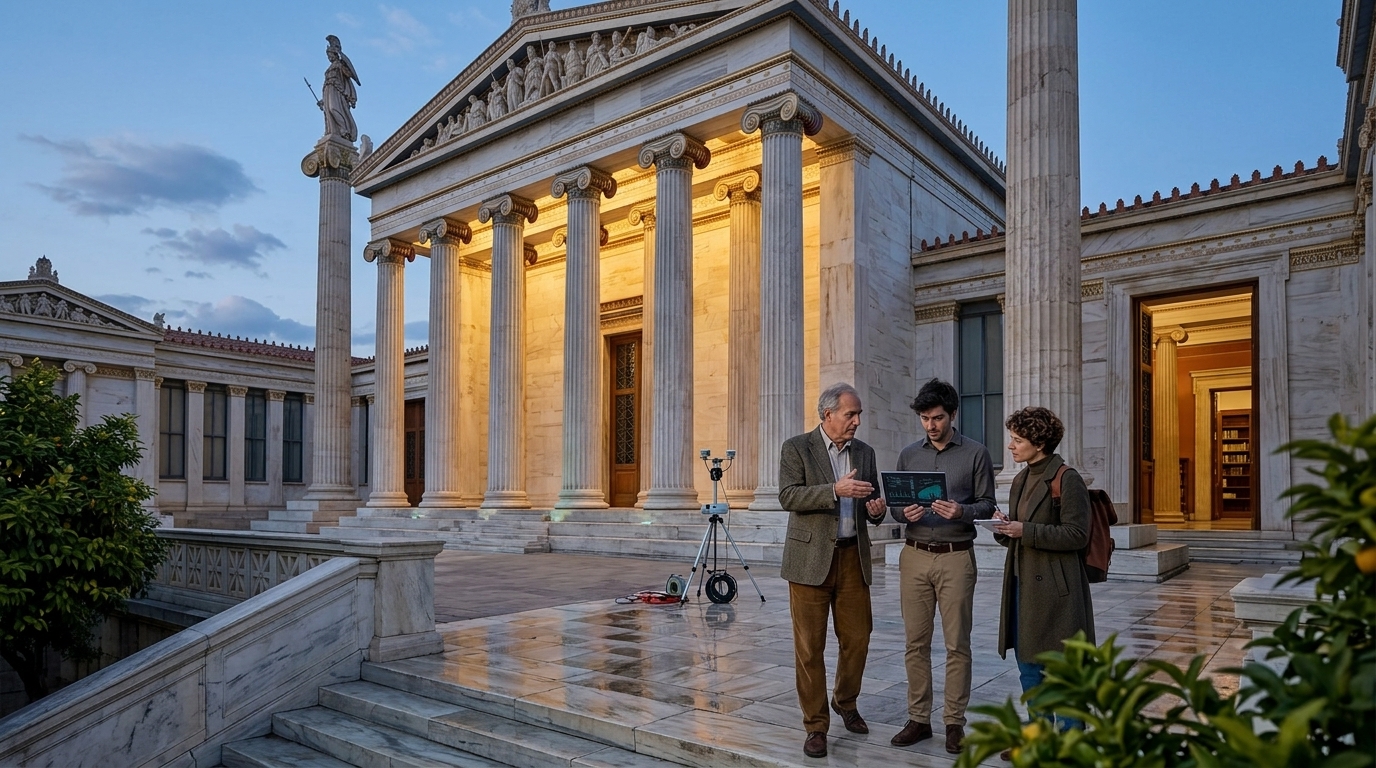
In the heart of Athens, where neoclassical architecture meets historical memory, the Academy of Athens is preparing to host one of the most critical discussions of the modern era. On the occasion of celebrating 100 years since its foundation, the country's highest intellectual institution is not merely looking back at its past but is casting its gaze toward the future, organizing the second in a series of five conferences on Artificial Intelligence (AI) on Friday, May 15, 2026.
A Century of Wisdom vs. The Algorithm
The Academy of Athens, since its establishment in 1926, has been the guardian of sciences, letters, and fine arts in Greece. Its decision to dedicate a series of five conferences to Artificial Intelligence is a clear recognition that this technology is no longer just a tool but an existential challenge redefining the very concept of humanity. The conference on May 15 comes at a time when the global community is struggling to set rules for the rapid evolution of Large Language Models (LLMs) and Generative AI.
The conference's themes extend far beyond technical specifications. Academics and guest speakers are expected to analyze how AI affects the structure of society, the functioning of democracy, and the very process of scientific discovery. In a space that honors Plato and Aristotle, the discussion on algorithmic ethics carries a particular weight, connecting ancient Greek ethical philosophy with modern dilemmas of AI alignment.
The Interdisciplinary Approach as the Only Way Forward
One of the main characteristics of this initiative is its interdisciplinary nature. The Academy of Athens, through its three classes (Sciences, Letters and Fine Arts, Moral and Political Sciences), provides the ideal framework for a holistic examination of AI. It is not just about computer science; it is about law, linguistics, art, and geopolitics.
- Ethics and Law: How the European framework (AI Act) is being integrated into the Greek reality and what is the role of justice when decisions are made by algorithmic 'black boxes'?
- Language and Culture: Protecting the Greek language in the digital world and the risk of cultural homogenization by dominant English-speaking models.
- Scientific Research: The use of AI in medicine, archaeology, and climate change—fields where Greece possesses strong research capital.
The conference aims not only to inform experts but also to formulate proposals for the State. In a period where Greece is attempting to position itself on the global map of innovation, the Academy's voice acts as a compass for balanced development that does not sacrifice human rights on the altar of efficiency.
Towards a National AI Strategy
The timing of the conference is extremely significant. As we approach mid-2026, the implementation of the first stages of the European Union's AI Act is in full swing. Greece is called to decide whether it will be a mere consumer of technology or if it will actively participate in shaping Europe's digital future. The Academy of Athens, with its prestige, can serve as a bridge between the academic community and the business world, promoting a model of 'human-centric' artificial intelligence.
"Technology without an intellectual foundation risks becoming tyrannical. Our mission is to ensure that the algorithm remains in the service of Reason (Logos)," noted members of the Academy during preliminary discussions.
In conclusion, the second Academy of Athens conference on Artificial Intelligence represents a milestone for the country's intellectual life. It underscores the need for critical thinking against technological determinism and reminds us that progress, to be true, must embody the value of humanity. The participation of leading scientists and the public dissemination of conclusions are expected to fuel the national dialogue for years to come.