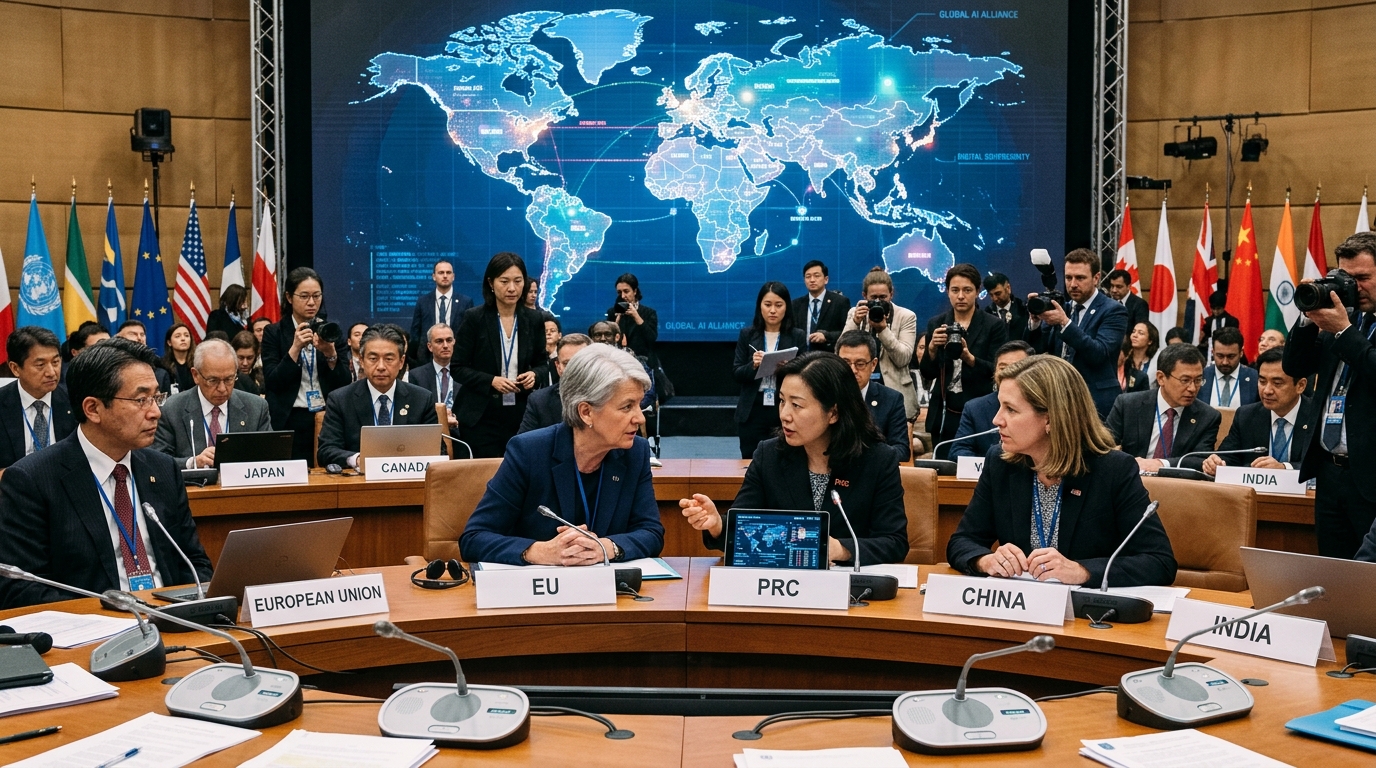
In the high-stakes geopolitical chessboard of the 21st century, Artificial Intelligence (AI) is no longer merely a catalyst for economic growth; it is the vanguard of a new arms race. According to recent reports by the Wall Street Journal, the world’s two preeminent superpowers, the United States and China, are in preliminary discussions to launch a formal bilateral dialogue focused on AI governance and safety. This move, if realized, would mark a rare moment of diplomatic convergence amidst a backdrop of trade sanctions, export controls, and technological protectionism.
Managing the Digital 'Red Lines'
The impetus for such a dialogue stems from a shared realization: the unchecked proliferation of AI could lead to catastrophic miscalculations, particularly in the military domain. Washington is deeply concerned about Beijing's integration of AI into autonomous weapons systems and influence operations. Conversely, China views U.S. export restrictions on high-end semiconductors as a strategic attempt to stifle its technological ascent. Yet, a common denominator exists—the existential threat of AI systems operating outside of human control, especially regarding critical infrastructure and nuclear command-and-control chains.
The proposed talks are not expected to bridge the profound ideological chasm between the two nations. Instead, they aim to establish "guardrails." Just as the Cold War necessitated the installation of a "hotline" between Moscow and Washington following the Cuban Missile Crisis, the current era demands a mechanism to prevent digital accidents from escalating into kinetic warfare. The Thucydides Trap—the structural stress that occurs when a rising power challenges a ruling one—now finds its most volatile expression in code and algorithms.
Conflicting Models of Governance
While the objective is safety, the philosophical approaches of Washington and Beijing remain diametrically opposed. The U.S. advocates for a model rooted in "responsible innovation," heavily involving the private sector and democratic oversight. China, in contrast, enforces a state-centric model, ensuring that AI development is strictly aligned with the values and stability of the Communist Party. Beijing has already introduced its "Global AI Governance Initiative," emphasizing national sovereignty and non-interference—a thinly veiled critique of Western-led norms.
- Military Application: The urgency of regulating lethal autonomous weapons systems (LAWS).
- Ethical Standards: Disagreements over AI-driven surveillance and civil liberties.
- Economic Competition: The role of advanced GPUs and data access as strategic assets.
The challenge for diplomats lies in finding a common vocabulary that transcends zero-sum rhetoric. Without a consensus on the necessity of "human-in-the-loop" protocols for high-stakes decision-making, the risk of an algorithmic glitch triggering a global crisis remains uncomfortably high. The dialogue represents an attempt to move from "strategic ambiguity" to "strategic stability."
Semiconductors: The Hardware of Diplomacy
One cannot discuss AI without addressing the physical silicon that powers it. The U.S. has weaponized supply chains by restricting NVIDIA’s advanced chips and lithography equipment, citing national security. China is retaliating by pouring billions into domestic semiconductor self-sufficiency. This upcoming dialogue might serve as the first step toward a "technological detente," where export controls become more predictable, thereby reducing volatility in global markets and supply chains.
Ultimately, this initiative underscores that despite the intensity of their rivalry, the complexity of AI is such that no single nation can manage its risks in isolation. The success of these talks will determine whether the world enters an era of collaborative safety or descends into a "splinternet"—a fractured reality where two distinct intelligences stare each other down across a digital Iron Curtain.