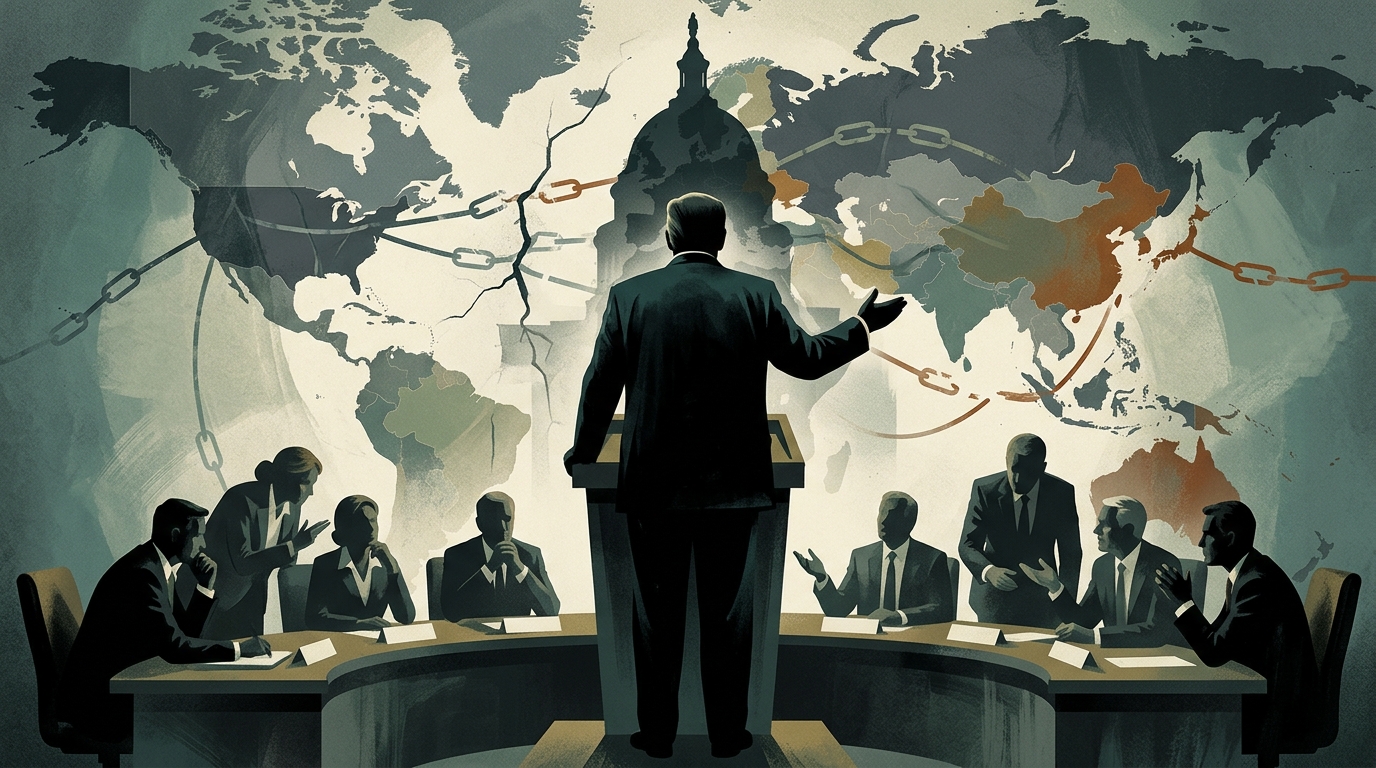
The shadow of Donald Trump continues to loom large over NATO headquarters in Brussels, as the former U.S. President’s recent remarks reignite a debate that many had hoped was settled. By labeling the fact that the United States bears the lion's share of the alliance's financial and military support as "ridiculous," Trump is not merely offering a critique; he is calling into question the very foundations of the post-war Western security architecture.
Transactional Diplomacy and the 'America First' Doctrine
For Donald Trump, international alliances are not viewed as sacred pacts based on shared values, but as business transactions. His rhetoric, which has remained consistent since his first term, focuses squarely on "burden sharing." From his perspective, European allies are exploiting American military might to maintain their own welfare states while the U.S. spends billions to protect the Old Continent.
The use of the word "ridiculous" is calculated. It speaks directly to a domestic U.S. audience—a voting base weary of "forever wars" and foreign expenditures. Trump argues that if Europe wants protection, it must pay the price, implying that the U.S. commitment to Article 5—the principle of collective defense—is no longer a given but a conditional agreement.
The European Response and Strategic Autonomy
In European capitals, these statements provoke a mixture of indignation and existential dread. Although many countries have significantly increased their defense spending following the Russian invasion of Ukraine, dependence on American logistics, intelligence, and the nuclear umbrella remains absolute. The concept of "Strategic Autonomy," championed by Emmanuel Macron, is no longer a theoretical exercise but an urgent necessity.
- Increasing defense budgets to a minimum of 2% of GDP.
- Strengthening the European defense industry to reduce reliance on American systems.
- Creating new cooperation frameworks within the EU that could function independently of NATO if necessary.
However, Europe remains divided. Eastern European nations, feeling the immediate threat of Russia, consider the American presence irreplaceable and view any move that could give Trump a pretext for withdrawal with deep suspicion.
The Stakes for Global Stability
The weakening of NATO is not just a Transatlantic issue. It sends a clear signal to Moscow and Beijing that the West is fragmented. Trump’s critics argue that his stance emboldens Russian revisionism, as Vladimir Putin is betting precisely on the erosion of Western unity. Conversely, proponents of "America First" believe this pressure is the only way to force Europe to take responsibility for its own security.
"NATO is an alliance, not a protection racket where you pay a subscription fee to avoid being attacked," diplomatic circles in Brussels remarked, indirectly responding to Trump's narrative.
In conclusion, Trump's rhetoric has already fundamentally altered NATO, regardless of whether he returns to the White House. Trust has been shaken, and Europe is realizing—perhaps too late—that the era of "free security" is over. The question is no longer whether the U.S. will unilaterally support the alliance, but whether the alliance can survive in a world where its primary partner views it as a liability.