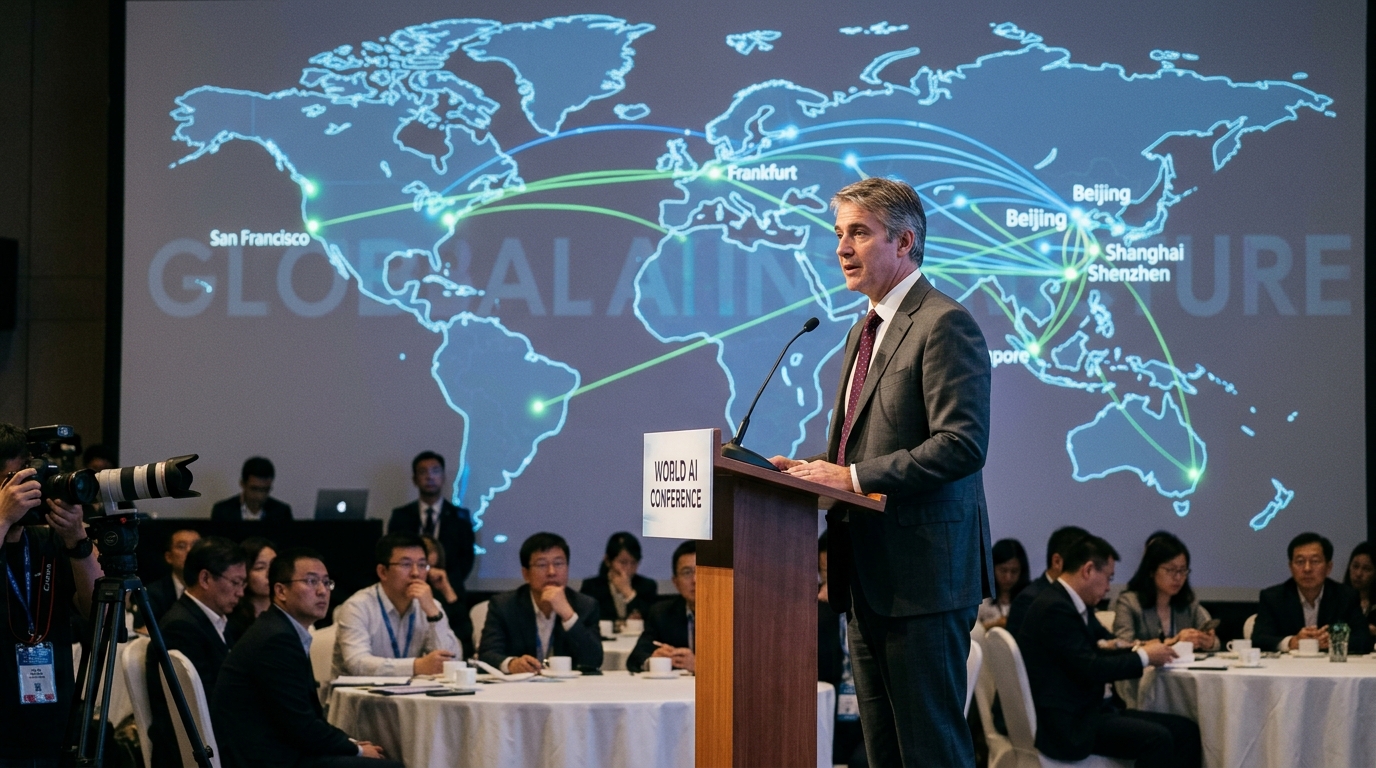
In the modern world of technology, where Artificial Intelligence (AI) is often hailed as the new "electricity," public discourse frequently centers on algorithms and large language models. However, the reality of AI is profoundly physical. Without servers, Graphics Processing Units (GPUs), advanced cooling systems, and intricate fiber-optic networks, AI remains a theoretical exercise. In this material realm, China is not merely a participant; it is the central pillar stabilizing the global supply chain, despite intense pressure and trade restrictions from the West.
The Geopolitics of Infrastructure
The recent stabilization of Chinese supply chains presents a paradox to many analysts. While the United States has imposed strict restrictions on exporting advanced semiconductors to China, Beijing has responded with a strategy of "vertical integration" and the strengthening of mid-to-low tier infrastructure. This means that while China may face hurdles in acquiring the most cutting-edge 2nm chips, it maintains absolute dominance in manufacturing the peripheral systems that allow these chips to function at data center scale.
The stability offered by Chinese industry is not just about cost; it is about the velocity of production. In an era where demand for AI compute is growing exponentially, the ability of Chinese factories to pivot their production lines within weeks is critical to preventing a global "chokepoint" in infrastructure. Major tech corporations, even as they attempt to diversify their sources via "China Plus One" strategies, are finding that complete decoupling is currently an economic and technical impossibility.
Dominance in Rare Earths and Materials
One of the less publicized but vital sectors is the processing of raw materials. AI infrastructure production requires specialized metals and rare earths for cooling system magnets and server capacitors. China controls over 80% of the global processing of these materials. Its ability to maintain stable prices and the flow of these materials acts as a "shock absorber" for the global tech market.
- Control of 90% of gallium and germanium production, essential for next-generation semiconductors.
- Vertical production of motherboards and power supply units.
- A specialized workforce that does not exist at such a scale in any other nation.
According to market sources in Shanghai, the Chinese government has invested billions into the "Big Fund" (National Integrated Circuit Industry Investment Fund), which now focuses not only on domestic consumption but also on export dominance for the hardware that "houses" AI.
The Challenge of Autonomy and the Future
Despite its stabilizing role, China faces its own challenge: the need for complete autonomy in photolithography tools. However, its strategy seems to be bearing fruit. Rather than merely attempting to copy Western designs, China is innovating in interconnect architectures and liquid cooling systems—essential for energy-intensive AI clusters.
"Global AI infrastructure is not a race, but a complex ecosystem. If you remove the Chinese component, the ecosystem collapses under the weight of costs and component shortages," says a leading supply chain analyst.
In conclusion, the Chinese supply chain is not just a supplier; it is the regulator that allows the AI revolution to proceed without catastrophic interruptions. Geopolitical tensions will persist, but the economic reality of interdependence remains the most powerful tool for stability in the 21st century. As we move further into 2026, the focus will likely shift from "decoupling" to "managed dependency," as the cost of total separation becomes too high for any global power to bear.