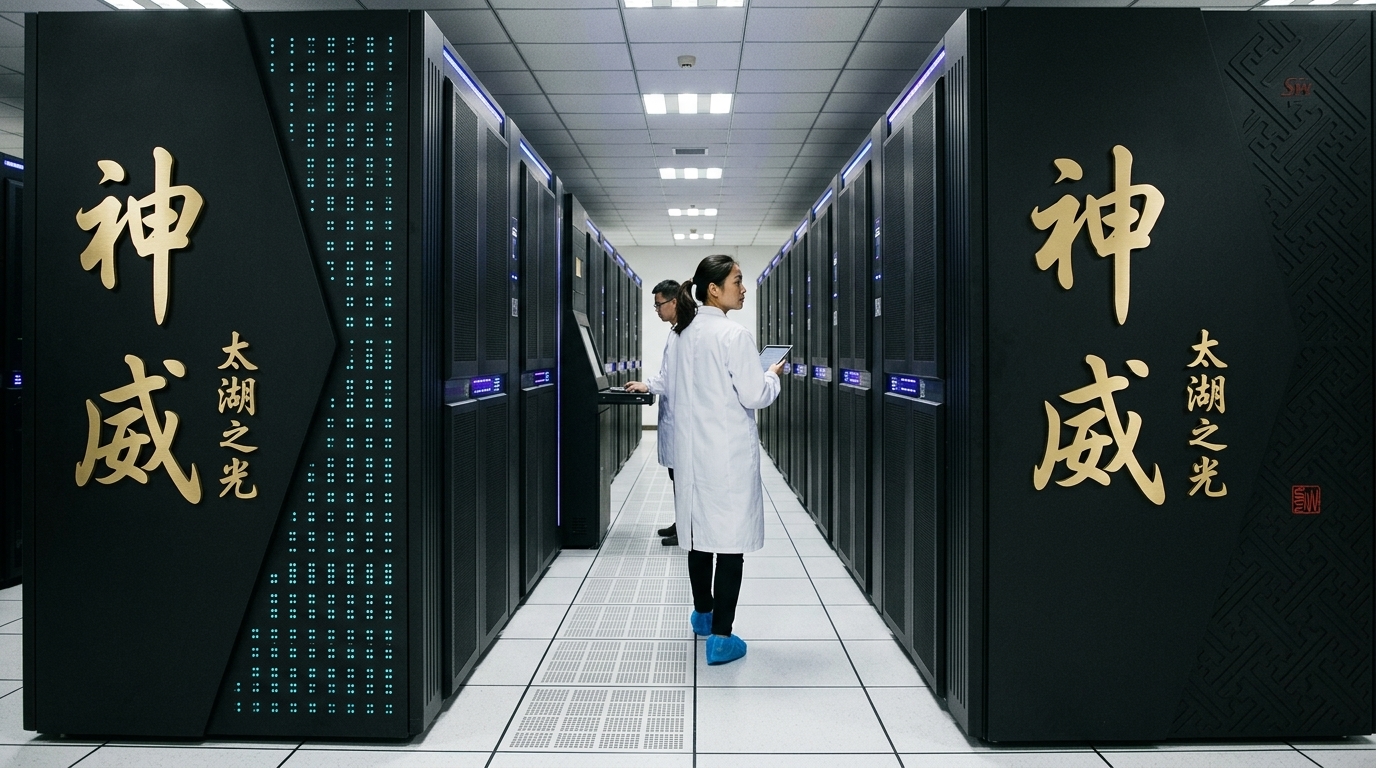
In a development that fundamentally shifts the global technological balance, the new Chinese supercomputer, LineShine, has emerged as the fastest in the world. Shattering previous benchmarks, its ascent has sent shockwaves through Western capitals. The most striking aspect of this achievement is not merely its raw processing power, but the revelation that the system achieves these heights without utilizing a single Graphics Processing Unit (GPU) from firms like Nvidia or AMD—the primary targets of stringent US export restrictions.
Engineering Around the Blockade
LineShine is built upon a domestic architecture developed at China’s National Supercomputing Center. While the rest of the world has pivoted toward GPUs to fuel the AI revolution and complex scientific simulations, Chinese engineers took a more arduous path: optimizing massively parallel central processing units (CPUs) featuring millions of interconnected cores. This approach requires sophisticated software and interconnect fabrics, areas where China was historically perceived to lag behind Western standards.
The success of LineShine serves as a definitive rebuttal to the US government’s "Small Yard, High Fence" policy. Washington’s restrictions aimed to deny Beijing the tools necessary for advanced military hardware and cutting-edge AI. However, LineShine’s existence suggests that these sanctions acted as a catalyst for Chinese self-reliance. Rather than being paralyzed, the Chinese semiconductor industry was forced to innovate within alternative architectures that bypass US controls entirely.
Geopolitical and Military Implications
Supercomputing power is not just a matter of prestige; it is the bedrock of modern national security. Systems like LineShine are utilized for simulating nuclear tests, designing hypersonic flight vehicles, and breaking advanced encryption. China’s ability to construct such systems using indigenous technology means its military development can no longer be throttled through trade embargoes. Furthermore, LineShine’s architecture appears highly efficient for specific machine learning algorithms, suggesting that China is carving out a parallel path for training Large Language Models (LLMs) that does not depend on Nvidia’s dominant CUDA ecosystem.
- Total decoupling from American semiconductor supply chains for high-end computing.
- Achievement of exascale performance (exceeding one exaflop) with domestic design.
- Capacity to support critical military and research programs without external interference.
Washington’s response is expected to be aggressive, likely involving further tightening of rules regarding the transfer of technical know-how and Electronic Design Automation (EDA) tools. However, many analysts warn that the sanctions strategy may have reached its point of diminishing returns. When a nation with China’s resources and scientific talent is backed into a corner, its only recourse is to invent an entirely new technological paradigm.
"LineShine is not just a computer; it is proof that the era of American technological hegemony is facing its first true existential challenge," noted a senior official at the Chinese Academy of Sciences.
The Future of Global Competition
As we move into the latter half of the 2020s, the race for computational supremacy will only intensify. While the West bets on quantum computing and next-generation GPUs, China has demonstrated that the intelligent optimization of existing technologies can yield results just as rapidly. The question is no longer whether China can catch up to the West, but whether the West can remain relevant in a multipolar technological world. The case of LineShine will likely be remembered as the turning point where technological globalization finally gave way to technological nationalism.