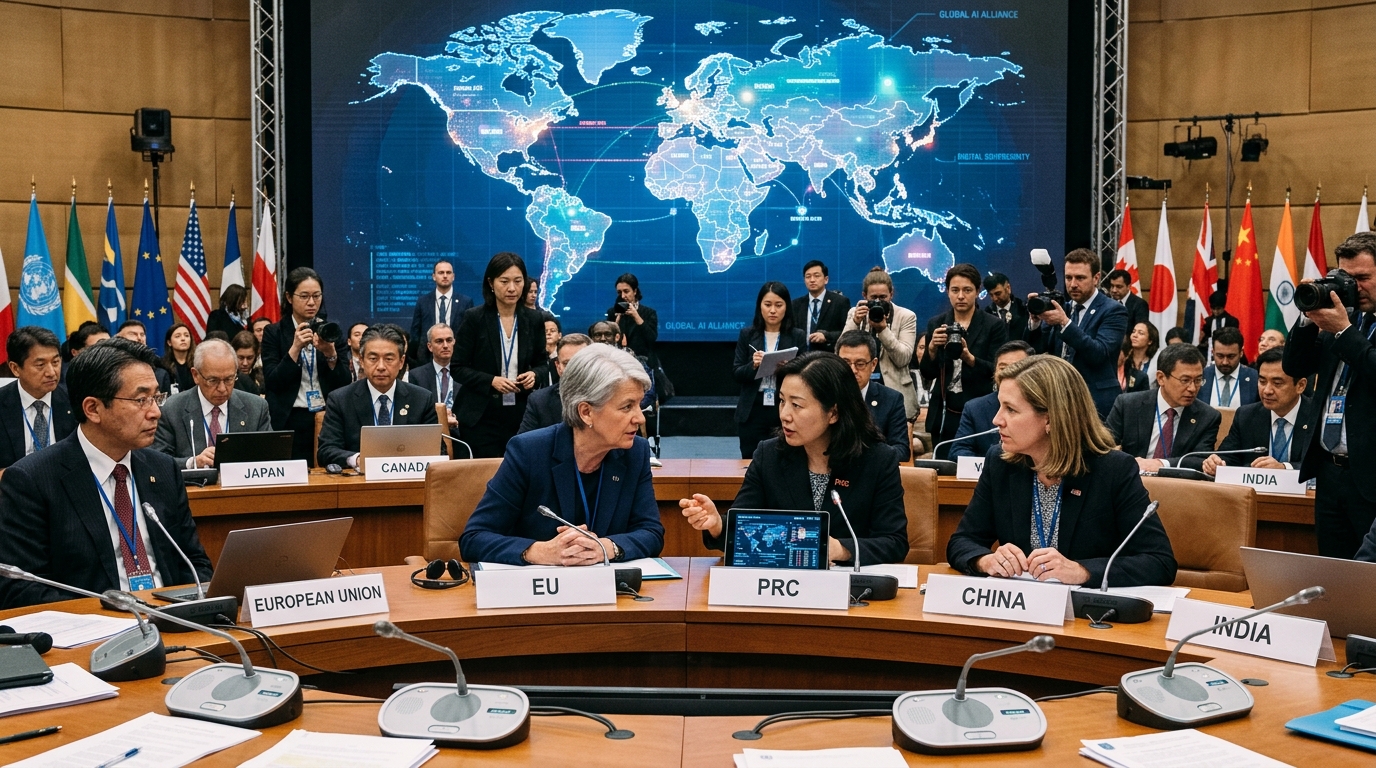
The news struck like a lightning bolt in a clear sky, though whispers in the corridors of Silicon Valley and Hangzhou had been circulating for months. Alibaba, the Chinese giant that for years stood as the primary symbol of China’s technological ascent, has admitted through its top leadership that it is struggling to keep pace with the world’s leading chipmakers and AI laboratories. This admission is not merely a corporate setback; it is a profound reflection of the new geopolitical reality forged by the ongoing 'semiconductor wars.'
The Silicon Chokehold and the Sanctions Wall
At the heart of Alibaba’s crisis lies a fundamental lack of access to cutting-edge hardware. US export controls have effectively starved the Chinese firm—and by extension, the entire Chinese AI ecosystem—of the essential 'fuel' required to train Large Language Models (LLMs). Nvidia’s H100 and A100 chips, the gold standard for AI development, are now virtually out of reach for Chinese entities due to tightening trade restrictions aimed at limiting Beijing's military and technological capabilities.
Joe Tsai, Alibaba’s chairman, recently conceded that China is approximately two years behind leading US firms like OpenAI. This lag is not a result of a deficit in talent or vision but a sheer lack of raw compute power. Without the latest generation of GPUs, training models that can compete with GPT-5 or Anthropic's Claude 3 becomes an exercise in mathematical futility. Alibaba is forced to rely on older hardware or domestic alternatives that, despite rapid progress, have yet to match Nvidia’s performance and energy efficiency.
Domestic Rivalry and the Rise of Huawei
While Alibaba grapples with external constraints, it faces a ruthless internal battlefield. Huawei, having survived its own existential crisis following US sanctions years ago, is emerging as China’s new 'national champion' in hardware. Huawei’s Ascend series of AI chips is becoming the de facto choice for Chinese companies seeking to decouple from Western technology. However, for Alibaba, transitioning to a new hardware ecosystem requires massive investments in software optimization and compiler development, further delaying the rollout of its AI services.
Furthermore, Alibaba’s internal restructuring—splitting into six independent business units—appears to have introduced significant friction. The Cloud Intelligence Group, which was supposed to lead the AI charge, has been at the center of strategic reversals, including the cancellation of its highly anticipated IPO. In a world where speed is the ultimate currency, Alibaba seems entangled in its own corporate bureaucracy and the shifting sands of geopolitical policy.
The Strategy of 'Architecture Over Power'
Left with few alternatives, Alibaba and its Chinese peers are pivoting to a new strategy: software optimization. If you cannot have the fastest chips, you must build the smartest architectures. Alibaba is heavily investing in techniques such as model pruning, quantization, and distributed training to squeeze more performance out of less capable hardware. This necessity-driven approach could lead to innovations that Western firms—spoiled by an abundance of compute power—might overlook.
"AI is not just about chips; it is about data and applications. In China, we have the data and the market demand to drive innovation differently," company sources suggest.
However, the market reality remains harsh. In the cloud services sector, Alibaba is losing ground to international players who can offer their clients seamless access to the latest Nvidia and Microsoft innovations. Alibaba’s admission serves as a warning to the entire Chinese tech sector: the era of unfettered globalization is over, and the new era demands a painful and uncertain journey toward self-reliance.
Conclusion: A New Cold War Reality
Alibaba’s struggle to keep up is more than a business problem; it is a geopolitical statement. It demonstrates that US export controls are working, at least in the short term, by creating an 'intelligence gap' between East and West. The remaining question is whether this gap will spur China into a total technological counter-offensive or relegate it to a regional player in the global AI landscape. For Alibaba, the path back to the summit has never been steeper or more fraught with peril.