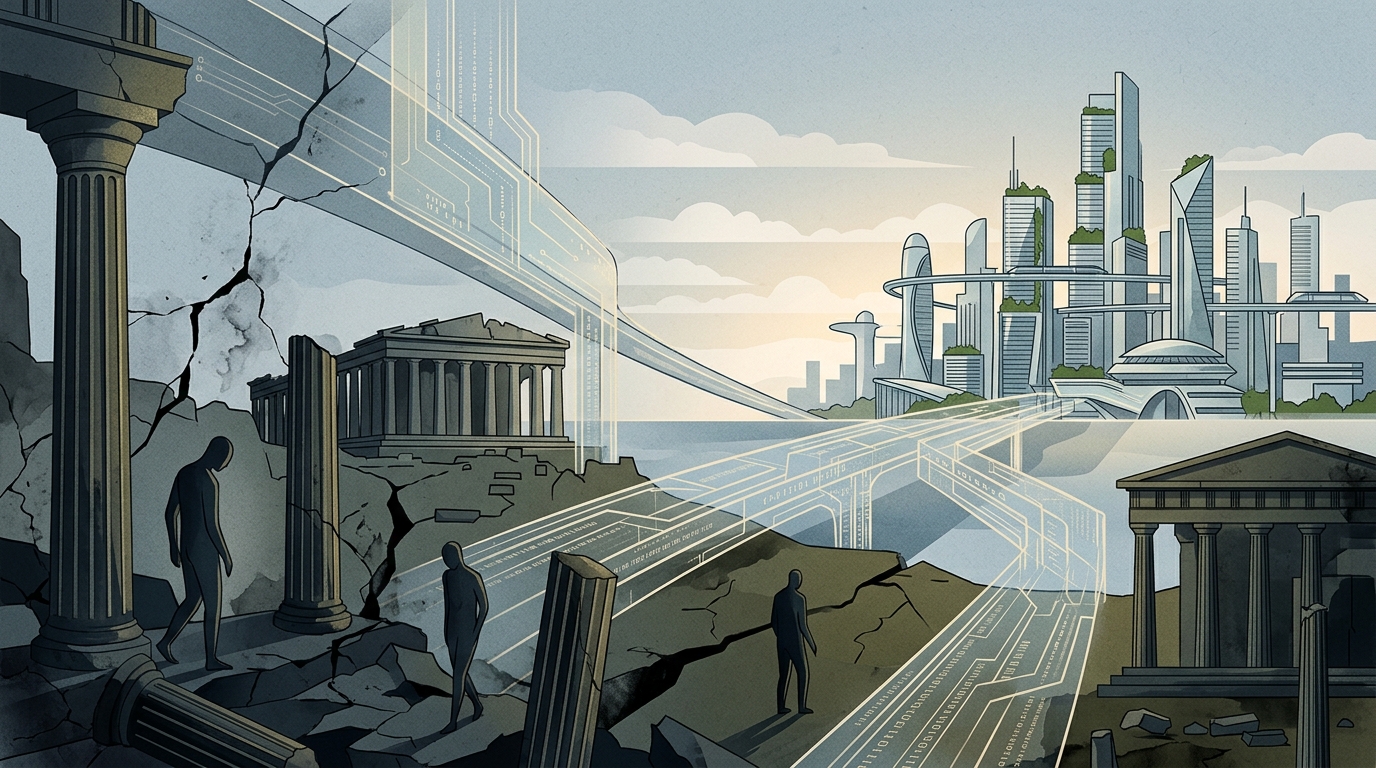
The presentation of Michalis Sallas' new book, titled "What Went Wrong in Greece," at the National Gallery of Athens, was far more than a literary event; it was a high-stakes gathering of the country's political and business elite seeking answers to decades-old questions. The man whose name became synonymous with the expansion of the Greek banking system and the ascent of Piraeus Bank now attempts a courageous dissection of the failures that led to the prolonged debt crisis, while simultaneously offering a visionary proposal for Greece’s economic trajectory leading to 2040.
Historical Retrospective and Structural Bottlenecks
The book does not limit itself to the recent era of bailouts. Sallas traces the major turning points of the Greek economy since the restoration of democracy in 1974, focusing particularly on the period following the adoption of the Euro. His central thesis is that Greece failed to leverage "cheap credit" and the stability of the common currency to transform its productive base. Instead of investing in innovation and export-oriented growth, the nation succumbed to a development model fueled by consumption and excessive borrowing.
According to Sallas' analysis, successive Greek governments neglected industrial production and agricultural restructuring, over-relying on services and tourism. This economic monoculture left the country vulnerable to external shocks. Sallas emphatically points out that the lack of a national strategic plan allowed statism and bureaucracy to stifle private initiative, creating an environment hostile to significant foreign direct investment.
The 2040 Challenge: A New Productive Paradigm
Looking toward the future, Michalis Sallas moves beyond mere criticism. He proposes a roadmap for 2040 based on four pillars: digital transition, green energy, education aligned with labor market needs, and the preservation of social cohesion. He argues that Greece has a unique opportunity to become an energy hub for Europe by harnessing its vast potential in renewable energy sources.
- Energy Autonomy: Moving toward clean energy is not just an environmental necessity but a strategic economic move to lower production costs.
- Technological Revolution: Adopting Artificial Intelligence and automation within public administration and private enterprises is the only way to boost productivity.
- Demographic Crisis: Sallas sounds the alarm regarding the aging population, proposing incentives for the return of young professionals from abroad (the "brain gain").
Particular emphasis is placed on the role of banks. As a veteran banker, Sallas argues that the banking system must move past its focus on balance sheet cleanup and return to its core mission: financing the real economy and the small-to-medium enterprises (SMEs) that form the country's backbone.
Political Dimensions and National Consensus
The book concludes with a call for national consensus. Sallas highlights that the major reforms required for 2040 cannot be implemented in an environment of toxic political polarization. He calls for a "national task force" that transcends party lines to guarantee the continuity of state policy and long-term investment projects.
"Greece in 2040 will not be judged by how much money we receive from the Recovery Fund, but by how effectively we use it to change the DNA of our economy," he writes.
Sallas' analysis arrives at a critical juncture as Greece seeks to solidify its position in the post-bailout era while facing the challenges of climate change and geopolitical instability in the Eastern Mediterranean. The question remains: will the political system dare to implement the radical shifts proposed by one of the key protagonists of its economic history over the last 40 years?