The automotive industry stands at a pivotal crossroads, and Tesla, under Elon Musk's leadership, appears to be betting everything on a vehicle that defies every traditional convention. The Cybercab, the company’s long-awaited two-seater robotaxi, is not just another electric vehicle (EV). According to recent filings with the U.S. Environmental Protection Agency (EPA), the Cybercab is emerging as the lightest and most efficient vehicle Tesla has ever produced, marking a radical shift in the company’s design philosophy.
The Revolution of Weight Reduction
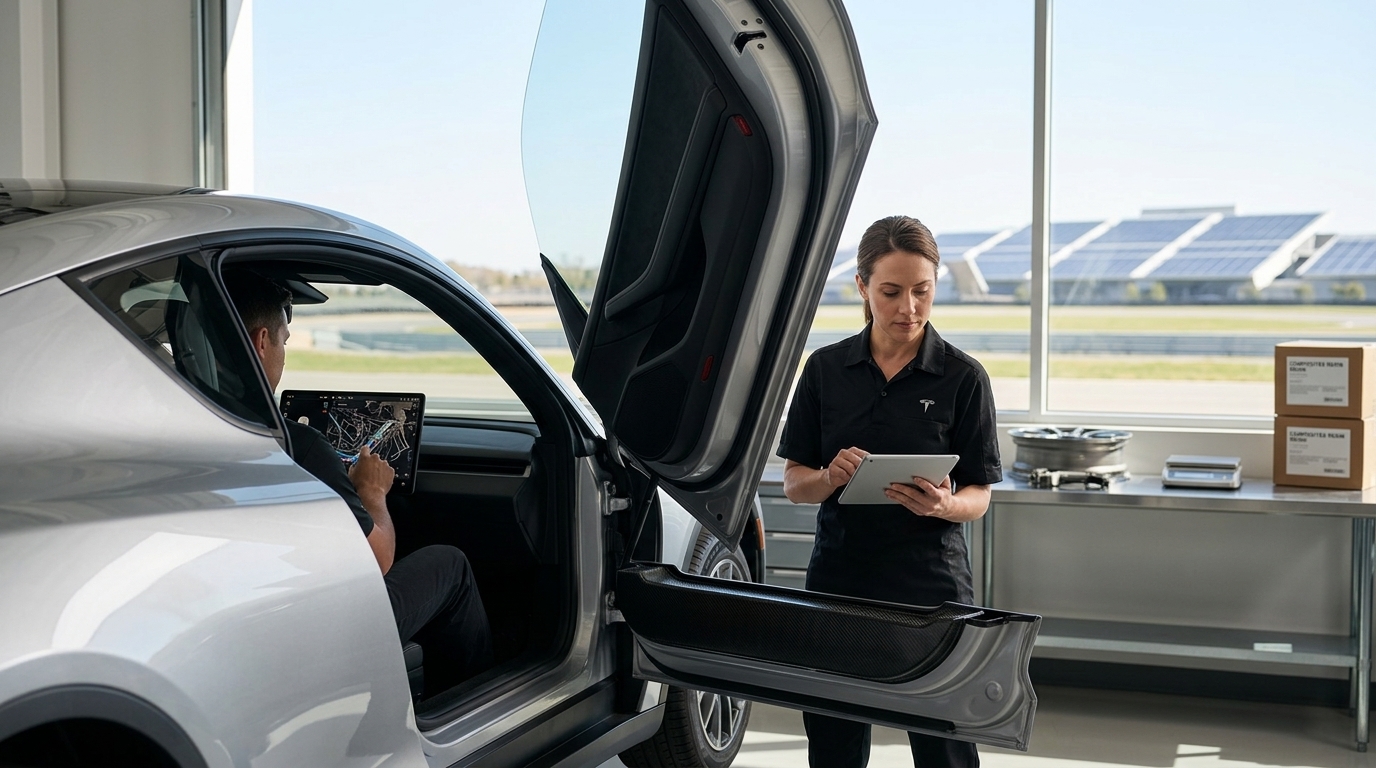
For years, the trend in EVs has been "bigger battery for longer range." This, however, led to behemoths like the Cybertruck or Model X, which weigh several tons. The Cybercab breaks this cycle. With an estimated weight of just 2,500 to 2,700 lbs (approx. 1,100 - 1,200 kg), it is nearly 1,000 lbs lighter than the Model 3, previously Tesla's most accessible model. This weight reduction is no accident. Tesla has stripped away everything: the steering wheel, pedals, mirrors, and, most notably, the charging port. The Cybercab relies exclusively on inductive (wireless) charging, a move that reduces complexity and the weight of internal high-voltage cabling.
Staggering Efficiency Metrics
The real news lies in the efficiency figures. EPA documents suggest the Cybercab can achieve an astonishing 5.5 miles per kilowatt-hour (kWh). To put this in perspective, it is roughly 30% more efficient than the Model 3 Long Range. High efficiency allows Tesla to use a much smaller battery pack—likely around 30-35 kWh—while maintaining a respectable range for urban environments. This strategy drastically lowers manufacturing costs, enabling the company to aim for the $30,000 price point Musk has promised.
“The Cybercab wasn’t designed to be a car you buy, but a transport unit that optimizes cost per mile,” industry analysts note.
The 'Unboxed' Manufacturing Paradigm
Beyond technical specs, the Cybercab introduces Tesla’s new production method, known as the "Unboxed Process." Unlike a traditional assembly line where the chassis moves and parts are added, this method involves assembling separate sections of the vehicle simultaneously, which are then joined at the end. This reduces the factory footprint by 40% and production costs by 50%. It is a necessity for Tesla if it wishes to compete with the flood of inexpensive Chinese EVs entering the global market.
Regulatory Hurdles and Social Acceptance
Despite its technological prowess, the Cybercab faces a mountain of challenges. The absence of a steering wheel and pedals means the vehicle does not comply with current Federal Motor Vehicle Safety Standards (FMVSS). Tesla will need specific exemptions from the NHTSA to deploy the vehicle in significant numbers. Furthermore, Full Self-Driving (Level 5) remains a goal the company has promised "next year" for over a decade. Without proof that FSD software can operate without any human intervention, the Cybercab risks remaining an impressive prototype rather than a functional mobility tool.
Conclusion: The Future of Cities
The Cybercab represents Musk's vision for cities without parking lots, where vehicles are in constant motion, reducing congestion and lowering transport costs to bus-fare levels. It is a high-stakes gamble. If it succeeds, it will redefine urban mobility. If it fails, it will serve as a reminder that engineering excellence cannot always overcome regulatory and social barriers. What is certain is that with the Cybercab, Tesla has proven it can still innovate where others merely follow.