Humanity stands at a paradoxical crossroads in the early 21st century: we are more technologically advanced than ever, yet uniquely vulnerable to celestial phenomena that operate on scales far beyond our control. Our greatest existential threat is not a distant supernova, but the very star that sustains us. The Sun periodically releases massive bursts of charged particles known as Coronal Mass Ejections (CMEs). If a high-intensity solar storm were to strike Earth directly, the consequences for our power grids, telecommunications, and the global internet could be catastrophic. In this context, the proposal for the "StormWall" system emerges as a vital, albeit ambitious, planetary seatbelt.
The Anatomy of a Solar Threat
To grasp the necessity of StormWall, one must understand the scale of the danger. In 1859, the world witnessed the "Carrington Event," the most powerful geomagnetic storm on record. At the time, the only widespread electrical infrastructure was the telegraph system. The storm caused telegraph lines to spark, setting offices on fire and giving operators electric shocks. In today’s hyper-connected world, a Carrington-level event would plunge entire continents into darkness for months, destroy GPS satellites, and paralyze global supply chains. Economic damages are estimated in the trillions of dollars, and the resulting social upheaval would be unprecedented.
Earth’s natural magnetic field, the magnetosphere, protects us from routine solar wind. However, a massive CME can compress the magnetosphere, inducing geomagnetically induced currents (GICs) in our power lines. These currents can melt the internal components of high-voltage transformers, which are difficult and slow to replace. StormWall seeks to address this by creating a synthetic buffer in deep space, intercepting the solar onslaught before it ever reaches our atmosphere.
StormWall: Engineering a Space Airbag
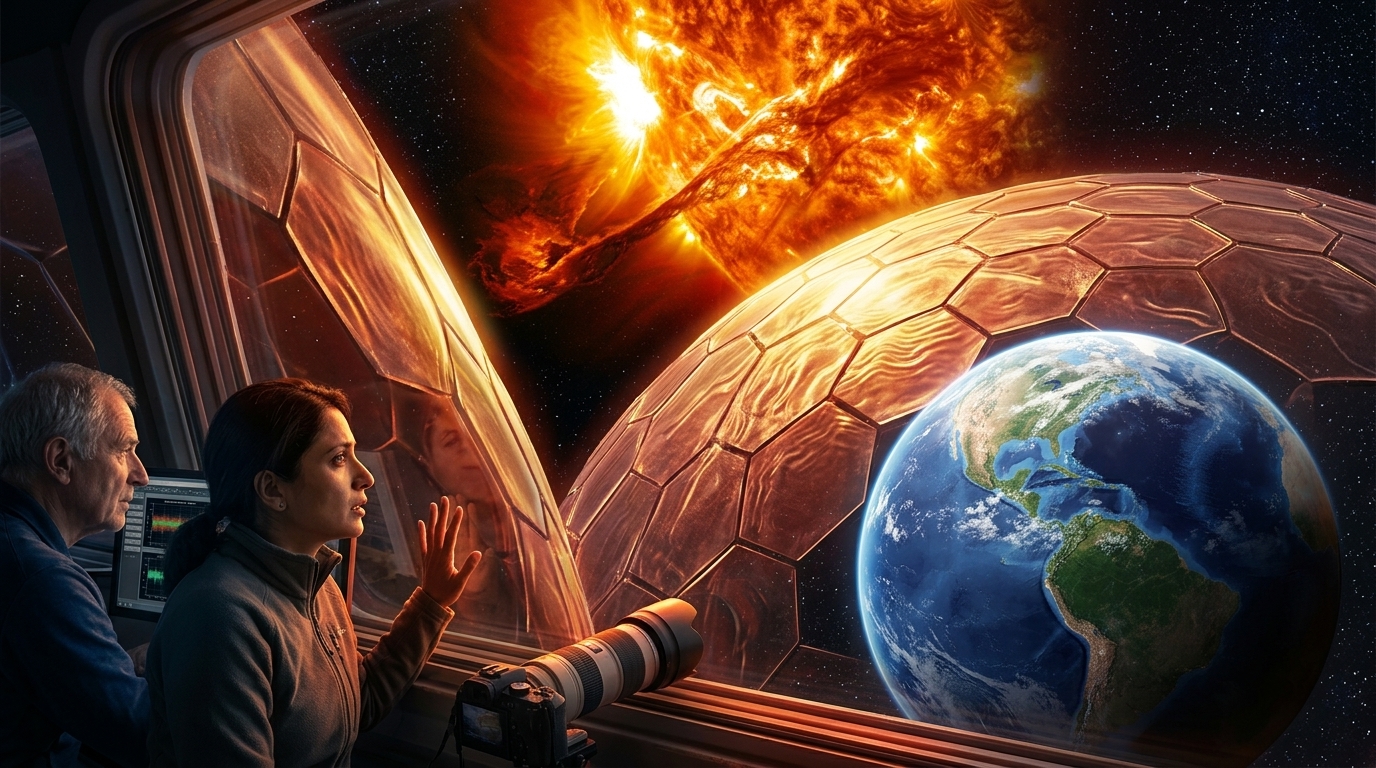
The StormWall concept is not a physical barrier but a constellation of specialized satellites positioned at the Lagrange Point L1—a gravitationally stable spot approximately 1.5 million kilometers from Earth toward the Sun. By sitting at this vantage point, the system can act as an early warning and mitigation hub. The core technology involves deploying artificial magnetic fields or dense particle clouds to deflect or dissipate the energy of an incoming CME.
Researchers liken the system to a car’s airbag. It doesn't prevent the "accident" (the solar eruption), but it drastically reduces the force of the impact on the passenger (Earth). The proposal suggests using superconducting coils on the satellites to generate a magnetic bubble. When sensors detect a high-energy CME, the system would activate, creating a "magnetic shadow" over Earth. This would provide terrestrial infrastructure the critical time needed to adjust loads or enter a protective shutdown state, significantly lightening the burden on Earth’s natural defenses.
Geopolitical and Technical Hurdles
Despite its scientific merit, StormWall faces monumental hurdles. Maintaining superconducting systems in the harsh environment of space requires advanced cooling technologies and immense power sources. Furthermore, the cost of building, launching, and maintaining such a network is beyond the reach of any single nation. It necessitates a level of international cooperation seen only in projects like the International Space Station, but on a far more expensive and strategically sensitive scale.
There is also a geopolitical dimension to consider. Who controls the "on/off" switch of such a shield? If a single nation or a private corporation holds the keys to planetary protection, it gains immense leverage over the rest of the world. Moreover, there are liability concerns: if the system fails or if deflecting a storm causes unforeseen damage to other space assets (like commercial satellite constellations), who is held responsible? The debate over StormWall is as much about international law and ethics as it is about physics and engineering.
Conclusion: An Insurance Policy for Civilization
As the Sun enters more active phases of its 11-year cycle, the probability of a major solar event increases. While StormWall might currently sound like science fiction, it is a pragmatic response to a quantifiable risk. Our dependence on digital systems is now absolute; a forced return to a pre-electric era, even for a few weeks, would lead to the collapse of modern society. Investing in space-based shielding is no longer a luxury—it is a necessary insurance policy to ensure that our digital civilization survives the volatile moods of our parent star.