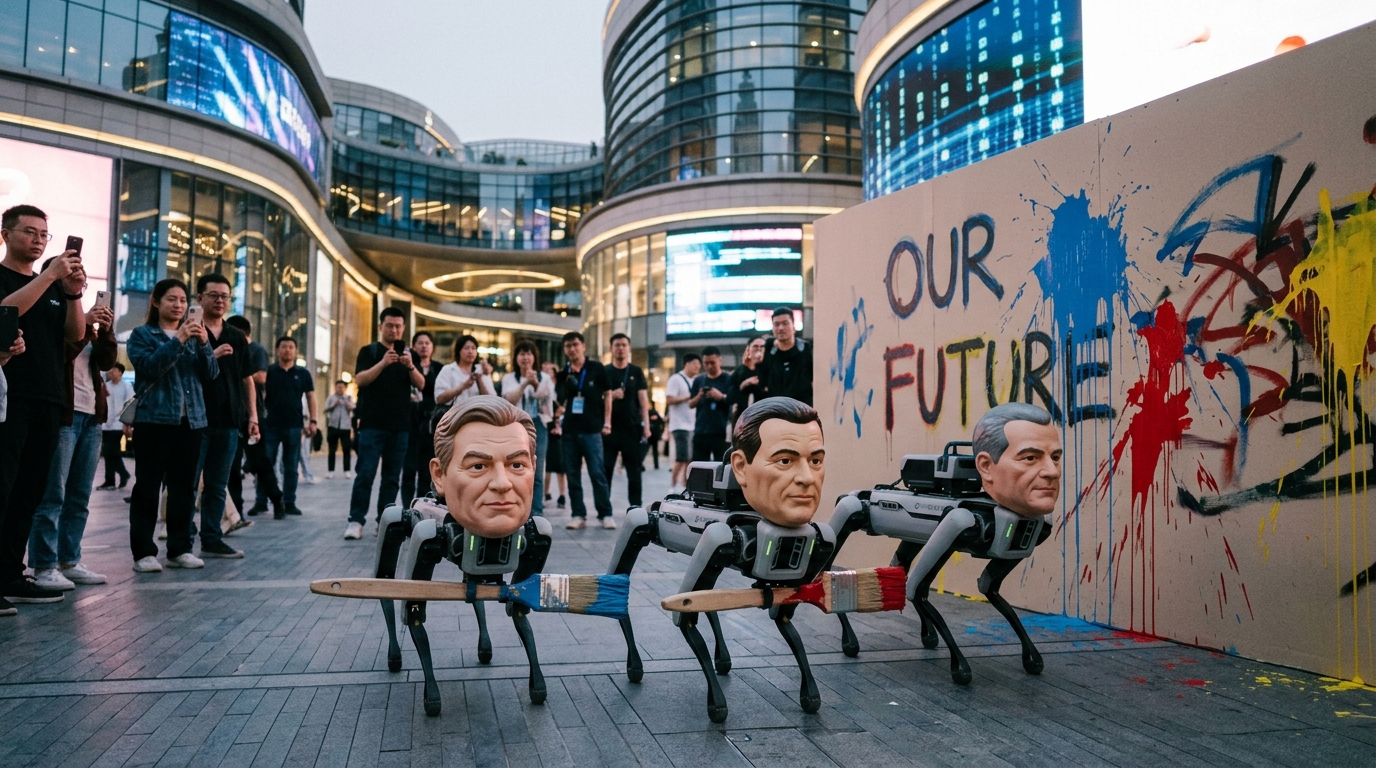
The visual is simultaneously comical and deeply unsettling: three robotic quadrupeds from Unitree, fitted with hyper-realistic 3D masks representing the faces of Elon Musk, Mark Zuckerberg, and Jeff Bezos, prowl a sterile gallery space. This is not a scene from a dystopian sci-fi flick, but a daring artistic intervention that highlights the complex intersection of power, technology, and human creativity. These "robot dogs," driven by sophisticated Artificial Intelligence, do not merely perform pre-programmed routines; they generate art in real-time, forcing us to ask: who is the true creator in the age of automation?
The Uncanny Valley of Tech Oligarchy
The choice of these specific faces is anything but accidental. Musk, Zuckerberg, and Bezos represent the triumvirate of modern technological might—the individuals who control the very infrastructure of our digital existence. By placing their likenesses onto robotic dogs—symbols frequently associated with surveillance and tactical enforcement—the artist crafts a potent visual metaphor. The art these robots produce is the output of a "black box" process, mirroring how social media algorithms or global supply chains operate far from the public's inquisitive gaze.
The installation challenges the viewer to reflect on the quasi-divine status these billionaires have attained. In the popular imagination, they are the architects of the future, yet here they are presented as mechanical beasts of burden performing an endless, almost Sisyphean task. The juxtaposition between high-tech engineering and the raw, often chaotic nature of the abstract paintings they produce underscores the gap between the promise of total control and the unpredictable reality of AI systems.
Technical Synergy: From Sensors to the Canvas
From a technical standpoint, the project is a masterpiece of robotics and software engineering. The robots utilize LiDAR sensors and depth cameras to perceive their environment, while a central processing unit interprets data through generative AI models. These models translate kinetic energy and environmental stimuli into visual commands, directing mechanical arms attached to the robots to apply paint to the canvas.
- Utilization of Diffusion Models to conceptualize visual patterns in real-time.
- Integration of advanced kinematics to coordinate quadrupedal movement with artistic expression.
- Real-time spatial analysis to prevent collisions between the "billionaire" entities.
This technological convergence demonstrates that AI is no longer confined to the screen. It has entered the physical realm, acquiring a body and interacting with matter. The fact that the robots "decide" on the next brushstroke based on stochastic processes challenges the myth that art requires exclusive human intentionality. Or does it? Many critics argue that the intention remains with the programmer and the artist who staged the scene, rendering the robots as nothing more than sophisticated brushes.
The Socio-Economic Satire of Silicon Valley
Beyond aesthetics, the installation touches on burning political issues. AI and robotics are often marketed as tools for democratization, yet reality suggests a massive concentration of power. The faces of Musk, Zuckerberg, and Bezos atop these machines serve as a reminder that machine "autonomy" is often an illusion serving corporate interests.
"Technology is not neutral. It carries the biases, ambitions, and aesthetics of those who fund its development," notes a critical analysis of the exhibition.
In an era where artists worldwide fear being replaced by AI, seeing the world's wealthiest men (even as masks) "stealing" the painter's job constitutes sharp social commentary. It is a protest against the commodification of creativity and the reduction of human labor into mere data points for processing.
Conclusion: The Future as Performance Art
This project forces us to look the future in the eye. If robots can produce art, if they can wear the faces of our leaders, and if they can operate with perceived autonomy, then our own place in the world must be redefined. The art of the robot dogs is not about the beauty of the resulting canvases, but about the discomfort we feel watching them. It is a mirror held up to a society racing toward automation without having answered the fundamental question: who is holding the remote control?