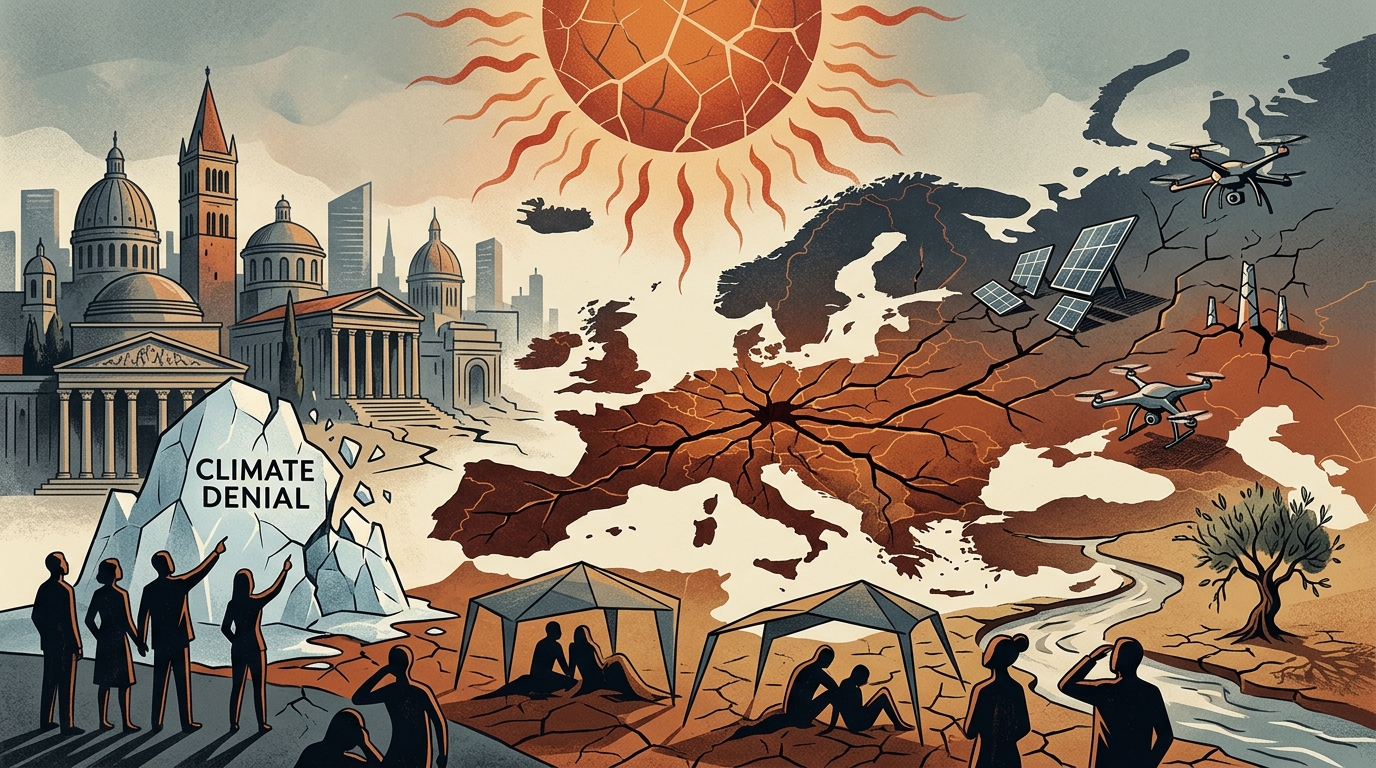
Europe in June 2026 bears no resemblance to the continent of previous decades. From the coasts of Andalusia to the plains of Poland, a veil of suffocating heat has blanketed the territory, shattering every previous record and testing infrastructure, the economy, and human endurance itself. According to a recent report by the World Weather Attribution group, the temperatures recorded over the last two weeks—with anomalies of up to 12 degrees Celsius above the seasonal average—would have been "virtually impossible" in a world without human-induced climate change.
The Science of Attribution: Why It’s Not "Just Summer"
For years, climate change skeptics resorted to the argument of natural cycles. However, attribution science has now matured to the point where it can precisely quantify the footprint of human activity on specific weather events. Analysis of data from Copernicus satellites and ground stations shows that the concentration of greenhouse gases has made such extreme heatwaves at least 100 times more likely than in the pre-industrial era.
The "Heat Dome" phenomenon, which trapped warm air masses over Central and Southern Europe, was amplified by soil drought. As the ground lacked moisture to evaporate and cool the atmosphere, all solar energy was converted into sensible heat. In Greece, Italy, and Spain, the mercury soared past 45°C in areas where June was traditionally considered a mild month, shocking ecosystems and agricultural production.
Infrastructure Under Siege
This crisis is not just environmental; it is deeply structural. European power grids have been pushed to their limits as demand for air conditioning skyrocketed to levels typically seen in late July. In France, several nuclear reactors were forced to reduce power because the river water used for cooling became too warm, making it dangerous for the local ecosystem if returned to the flow at even higher temperatures.
- Collapse of rail transport due to track buckling from thermal expansion.
- Increased mortality in urban areas, particularly among the elderly and vulnerable groups.
- Massive losses in grain and olive oil production, signaling a new wave of food inflation.
- Early onset of the wildfire season, with fire departments on permanent high alert.
The cost of adaptation is now beginning to exceed the cost of prevention. Our cities, designed for a climate that no longer exists, are turning into "urban heat islands." The need for radical redevelopment using cool materials, tree planting, and the creation of "cooling shelters" is now a matter of survival rather than mere aesthetic upgrade.
Political Inertia and the Wall of Reality
Despite grand declarations at COPs and the European Green Deal, the pace of transition remains agonizingly slow. Political leadership finds itself trapped between the need for immediate emission reductions and the fear of the political cost associated with changing the consumer model. However, nature does not negotiate. The 2026 heatwave serves as a violent reminder that the "future" scientists warned about is already here.
"We are no longer at the warning stage. We are at the stage of managing an ongoing disaster," said a leading climatologist from the National Observatory of Athens.
The geopolitical dimension of the crisis is also evident. Southern Europe is threatened with desertification, a fact that could trigger internal migration flows within the EU and upset the continent's economic balances. Tourism, Greece's heavy industry, is forced to redefine its product as summer months gradually become prohibitive for the average visitor.
Conclusion: A New Social Contract
Addressing this new reality requires more than just technological solutions. It requires a new social contract that places planetary health at the center of all economic activity. Europe, as the fastest-warming continent, must lead not only by the example of its emissions but also by its ingenuity in adaptation. The 2026 heatwave is not an "extreme event"; it is the new baseline. If we do not act now, the 12-degree anomaly will soon seem like a "cool" memory of a lost paradise.