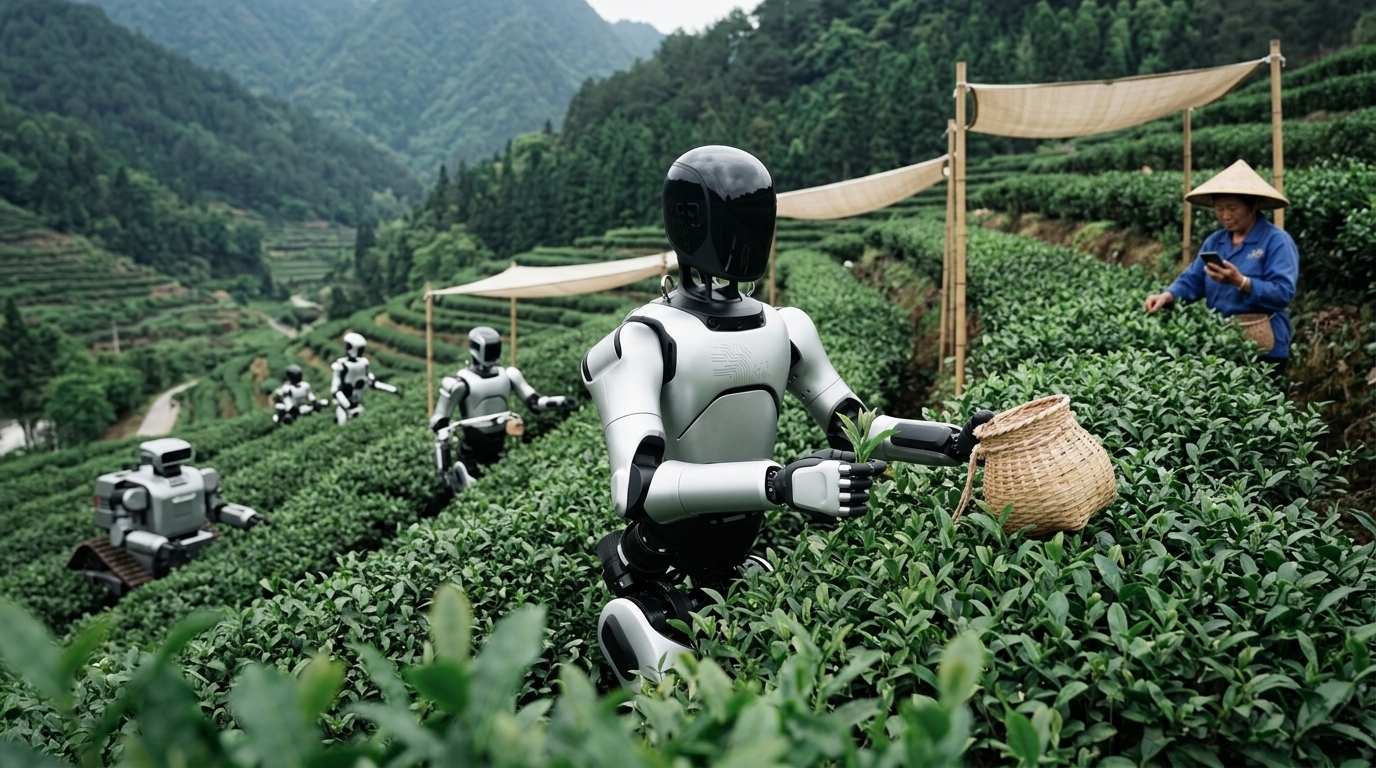
In the misty slopes of Zhejiang province, where tea cultivation has been a sacred tradition for centuries, a new silhouette is appearing among the bushes. It doesn't wear the traditional straw hat, but is instead equipped with LiDAR sensors, high-definition cameras, and articulated fingers that move with surgical precision. This is China's new generation of humanoid robots, leaving sterile laboratories to be tested in the harshest and most unpredictable real-world conditions.
The Great Trial of the 2026 World Games
This move is no coincidence. As we move through May 2026, the global robotics community is focusing its attention on China, which is feverishly preparing for the World Humanoid Robot Games. These games are not merely a display of technological prowess, but a testing ground for the ability of machines to replace or assist human labor in tasks requiring fine motor skills and adaptability.
Tea picking, especially for high-quality varieties like Longjing, is considered one of the most difficult agricultural tasks. It requires selecting only the most tender leaves ("one bud, two leaves") without damaging the plant. Until recently, this task was considered "immune" to automation. However, the integration of advanced computer vision models and tactile sensors now allows robots to recognize the correct shade of green and the exact texture of the leaf, even under shifting sunlight.
The Demographic Deadlock and the Need for Automation
Behind the technological allure lies a harsh socio-economic reality. China is facing one of the fastest-aging populations in the world. In rural areas, the labor shortage is now structural. Young people are migrating to major cities for work in the service or technology sectors, leaving behind elderly farmers who struggle to meet the demands of the harvest.
- Labor Force Decline: China's rural population has decreased by 25% over the last decade.
- Production Costs: Wages for experienced tea pickers have tripled, making the product less internationally competitive.
- Technological Hegemony: Beijing has set a national goal for the mass production of humanoid robots by the end of 2026, viewing them as the "new engine" of industry.
Using robots in plantations is not just about increasing productivity. It is about the survival of an entire industry that is part of the country's cultural heritage. If humanoids can work on steep slopes and muddy terrain, they can work anywhere.
The Technical Challenge of Uneven Terrain
One of the biggest hurdles engineers face is balance. While a robot in a factory moves on a flat floor, a tea plantation is a nightmare for motion algorithms. The robots currently being tested use reinforcement learning to adjust their center of gravity in real-time.
"We are not just training a robot to pick tea. We are training an artificial intelligence to understand the geometry of nature and the fragility of life," says a leading researcher from Zhejiang University.
The success of these trials will signal the beginning of a new era for "Smart Agriculture." If a robot can handle a delicate tea leaf, it can handle the harvesting of other fruits and vegetables that require delicacy, such as strawberries or grapes, opening a multi-billion dollar market.
Geopolitical Implications and Global Competition
The humanoid race is not limited to China's borders. Tesla with Optimus and American companies like Figure AI are closely monitoring developments. However, China possesses a unique advantage: the ability to test these technologies on a mass scale with full state support. Tea plantations are the ideal "living laboratory."
In conclusion, the image of a robot picking tea in the mist may look like a scene from a science fiction movie, but it is China's response to the challenges of the 21st century. It is a combination of necessity, ambition, and technological maturity that promises to forever change how we interact with the land and the production of our food.