The history of computing is at a critical crossroads. While Artificial Intelligence dominates current headlines, a deeper, more fundamental shift is being prepared in the laboratories of tech giants. Amazon, through its head of AI and quantum technologies, has issued a prediction that is shaking the industry: "useful" quantum computers—those capable of solving problems that today's supercomputers would take thousands of years to process—are just five years away. The milestone year is 2031, and its implications could only be compared to the discovery of electricity or the digital revolution itself.
From Theory to Practical Application
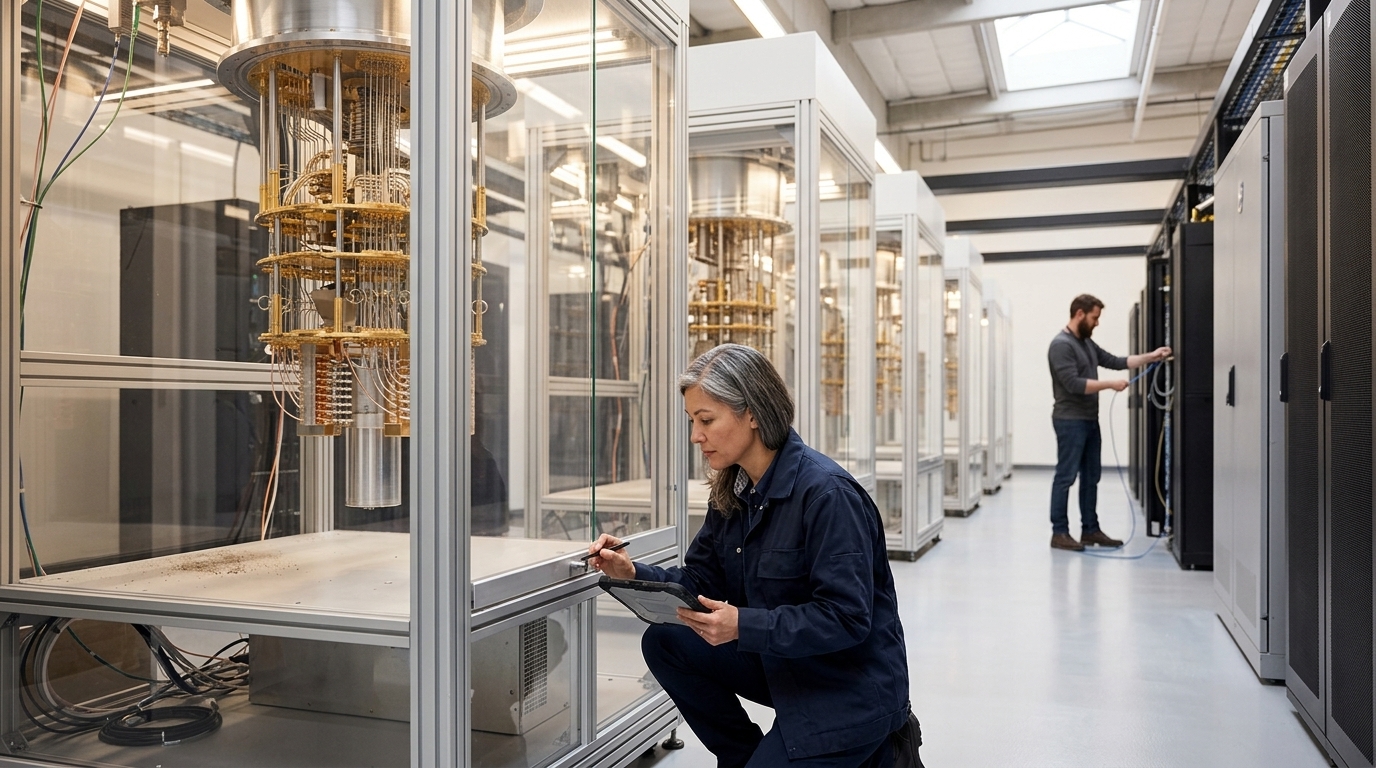
For decades, quantum computing remained a field full of promise but plagued by massive technical hurdles. Traditional computers operate with bits (0 or 1), while quantum computers use qubits, which, thanks to quantum superposition, can exist in multiple states simultaneously. However, the problem has always been the "instability" of these systems. Qubits are extremely sensitive to external interference, leading to errors that rendered calculations unreliable. Amazon now argues that progress in error correction is so rapid that the transition from experimental to functional computers is a matter of when, not if.
Amazon Web Services' (AWS) strategy focuses not just on building a "large" computer, but a "stable" one. The use of so-called "cat qubits"—a technology Amazon is actively developing—promises to drastically reduce the number of physical qubits required to create a single logical, error-corrected qubit. This architectural approach is what allows the company to view 2031 as the year of commercial maturity.
The Materials and Pharmaceutical Revolution
But why do Amazon and the world need quantum power? The answer doesn't lie in faster web browsing or better game graphics, but in the simulation of nature itself. Today, simulating a simple molecule at the atomic level is impossible for classical computers due to the complexity of quantum interactions. Quantum computers will allow scientists to "design" new drugs with atomic precision, reducing development time from decades to months.
- Materials Science: Creating room-temperature superconductors and new battery materials that could charge in seconds.
- Climate Change: Discovering new catalysts for carbon capture and more efficient fertilizer production methods, which currently consume 2% of global energy.
- Logistics: Optimizing global supply chains in real-time, a field where Amazon has a direct economic interest.
The ability to model chemistry with absolute accuracy will unlock solutions to problems we once thought unsolvable. For instance, the Haber-Bosch process for ammonia production has remained largely unchanged for a century. A quantum computer could find a biologically inspired way to achieve this with minimal energy, transforming global agriculture.
Geopolitical Competition and Security
Amazon's prediction does not come in a vacuum. It is part of a global quantum race between the US, China, and the European Union. Whoever achieves quantum supremacy first will hold the key to breaking current encryption methods (like RSA), raising massive national security concerns. Amazon, however, focuses on "utility" rather than "threat," promoting a Quantum-as-a-Service model through AWS Braket, where businesses can rent quantum power via the cloud.
"We are no longer talking about if it will happen, but how businesses will prepare for the day classical computing reaches its limits," Amazon executives state.
In conclusion, if Amazon's prediction holds true, 2031 will be the year humanity stops trying to understand nature through approximations and begins to mimic it with absolute precision. This transition will require not only new hardware but also a new generation of developers thinking in terms of quantum probability rather than binary logic. The road to 2031 is paved with challenges, but the finish line is now in sight.