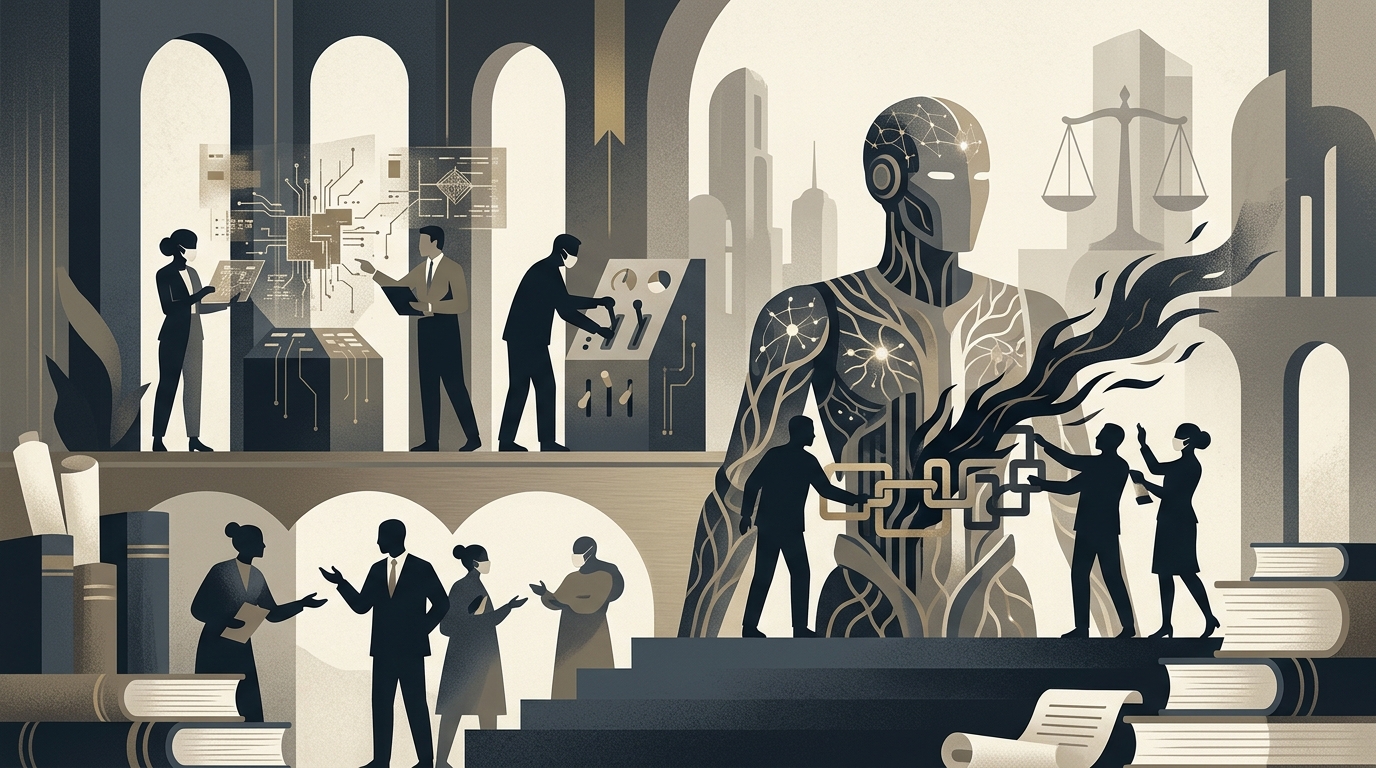
We stand at a critical juncture in the history of human civilization, where the rapid evolution of Artificial Intelligence (AI) is no longer merely a technological revolution, but a profound epistemological challenge. The emerging "Cognitive Gap" is not just about the difference in data processing speeds between humans and machines; it represents a fundamental shift in how we perceive, process, and produce knowledge. As algorithms take over increasing aspects of our intellectual lives, questions arise as to whether humanity is heading toward a new era of enlightenment or a voluntary degradation of its own intellect.
The Architecture of Intellectual Atrophy
The history of technology is a history of externalizing human capabilities. The wheel externalized movement, the printing press externalized memory, and the computer externalized mathematical calculation. However, Artificial Intelligence, particularly Large Language Models (LLMs), attempts to externalize the process of thought and synthesis itself. This "delegation" of cognition carries the risk of cognitive atrophy. Just as muscles wither without physical exercise, the neural connections responsible for critical analysis and creative problem-solving may weaken when the answer to every question is the product of algorithmic automation.
The ease with which AI provides ready-made solutions creates an illusion of knowledge. Users often confuse access to information with understanding of information. This phenomenon, which some scholars call "cognitive miserliness," leads to a society where the capacity for deep focus and complex thought is replaced by superficial content consumption. The learning process, which traditionally involves struggling with uncertainty and overcoming intellectual obstacles, is bypassed in favor of instant gratification.
The Epistemological Crisis and the Loss of Truth
At the heart of this crisis lies epistemology—the branch of philosophy that examines the nature and limits of knowledge. When knowledge is produced by "black boxes," whose internal workings are opaque even to their creators, the very concept of truth is called into question. AI does not "know" in the human sense; it predicts the next likely word in a sequence. This statistical approach to truth can lead to "hallucinations," where falsehoods are presented with the authority of plausibility.
- The erosion of trust in information sources due to synthetic content.
- The difficulty of distinguishing between human creativity and algorithmic mimicry.
- The dominance of the "average" and uniformity, as AI is trained on existing data, discouraging radical innovation.
Furthermore, there is the risk of "cognitive enclosure." As algorithms personalize the information we receive, they reinforce our pre-existing beliefs, limiting our exposure to opposing views. This undermines not only individual judgment but also the collective capacity of a democratic society to reach consensus based on shared facts.
The Socio-Political Dimension: Control and Manipulation
The degradation of human intelligence is not just an individual problem; it is a systemic threat. A society that has lost the capacity for critical thinking is far easier to manipulate. Big Tech companies, holding the keys to this "externalized cognition," acquire unprecedented power over human behavior. Reliance on AI for decision-making—from hiring to justice—shifts responsibility from humans to algorithms, creating an accountability vacuum.
"Technology is a useful servant but a dangerous master. When the machine begins to think for us, we cease to be the architects of our own destiny."
The challenge for the future is to return the human being to the center of the cognitive process. We must develop a new "digital literacy" that does not just teach how to use AI tools, but how to resist the blind acceptance of their outputs. Education must refocus on the humanities, philosophy, and ethics—areas where human experience, empathy, and judgment remain irreplaceable. The stakes are not about defeating AI, but about not allowing AI to make us less human.