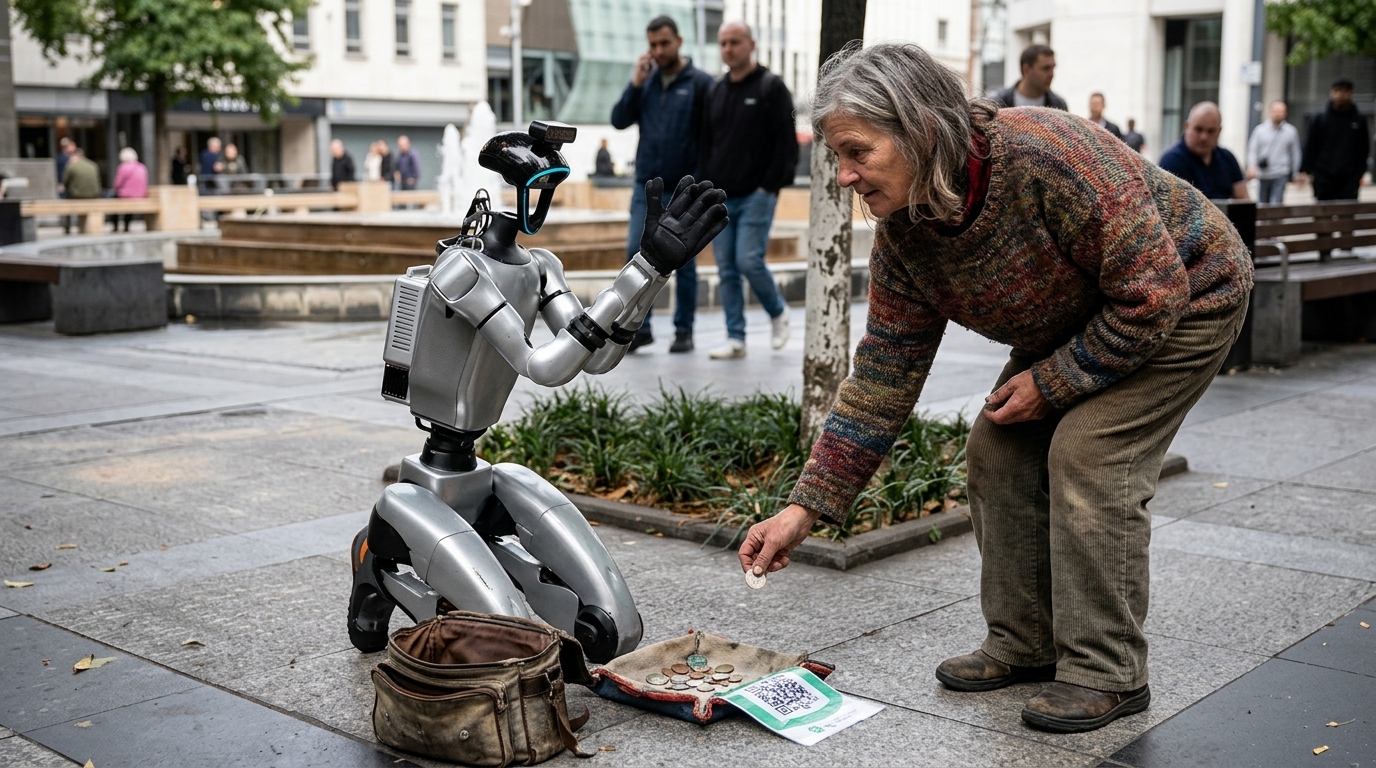
In an era where artificial intelligence promises to solve humanity's greatest challenges, from climate change to curing incurable diseases, a single image has emerged to shake our foundations. An android, with a human-like form but with exposed metal and wires, was spotted sitting on the sidewalk of a modern metropolis, holding a cup and asking for "help." The video, which immediately went viral, is not just a technological curiosity; it is a powerful cultural statement that forces us to look the future in the eye.
The Social Provocation Behind the Metal
This specific android is not the result of a malfunction or a robot that "lost its job." According to analysts and sociologists, it is an advanced form of social experiment or performance art designed to highlight the contradictions of our time. On one hand, trillions of dollars are invested in the development of robotic systems, while on the other, poverty and social marginalization remain unresolved issues. The image of an expensive machine mimicking the most desperate human condition creates a sense of profound unease.
This phenomenon touches upon what scientists call the "Uncanny Valley." When a robot looks too human but not perfectly so, it provokes fear and aversion. However, when that robot adopts the posture of a beggar, the aversion turns into an ethical dilemma. Passersby in the video appear torn: some laugh, others walk by in awkwardness, and a few, surprisingly, drop coins into the robot's cup. This reaction raises the question: can we feel empathy for a machine that simulates pain?
Automation and the Threat of Displacement
Behind the irony of a begging robot lies the existential fear of the working class. For decades, science fiction warned us of the moment robots would take our jobs. Today, in July 2026, this prediction is no longer fiction but a daily reality in many sectors. The beggar-android serves as a macabre reminder: if technology renders human labor redundant, who will ensure that humans do not end up in the state the robot is merely portraying?
The economic implications are vast. If a machine can perform social roles, even that of the "outcast," then the value of the human experience is called into question. Critics argue that such experiments are insulting to the actual homeless and people in need, as they turn human misery into a high-tech spectacle. However, the creators of such actions often respond that only through such shocks can society wake up to the consequences of unchecked technological progress.
The Ethics of Simulation: Can a Robot "Suffer"?
The central question posed by the viral footage is ethical. Artificial intelligence today can synthesize speech, recognize emotions, and react to them. The begging android uses algorithms to adjust its movements and words to elicit the maximum possible compassion. But is this "compassion" authentic, or is it an advanced form of manipulation?
- Using robots to represent social problems may lead to desensitization.
- There is a risk that resources meant for social welfare will be wasted on technological "fireworks."
- The legal status of androids remains a gray area: if a robot "collects" money, who does it belong to and how is it taxed?
As we move deeper into the third decade of the 21st century, the line between human and machine becomes increasingly blurred. The android on the sidewalk is not just a news story; it is a symbol of our need to redefine what humanity means in a world governed by code and silicon. Perhaps the robot isn't asking for money for itself, but asking us to notice what we are losing on the path to perfection.