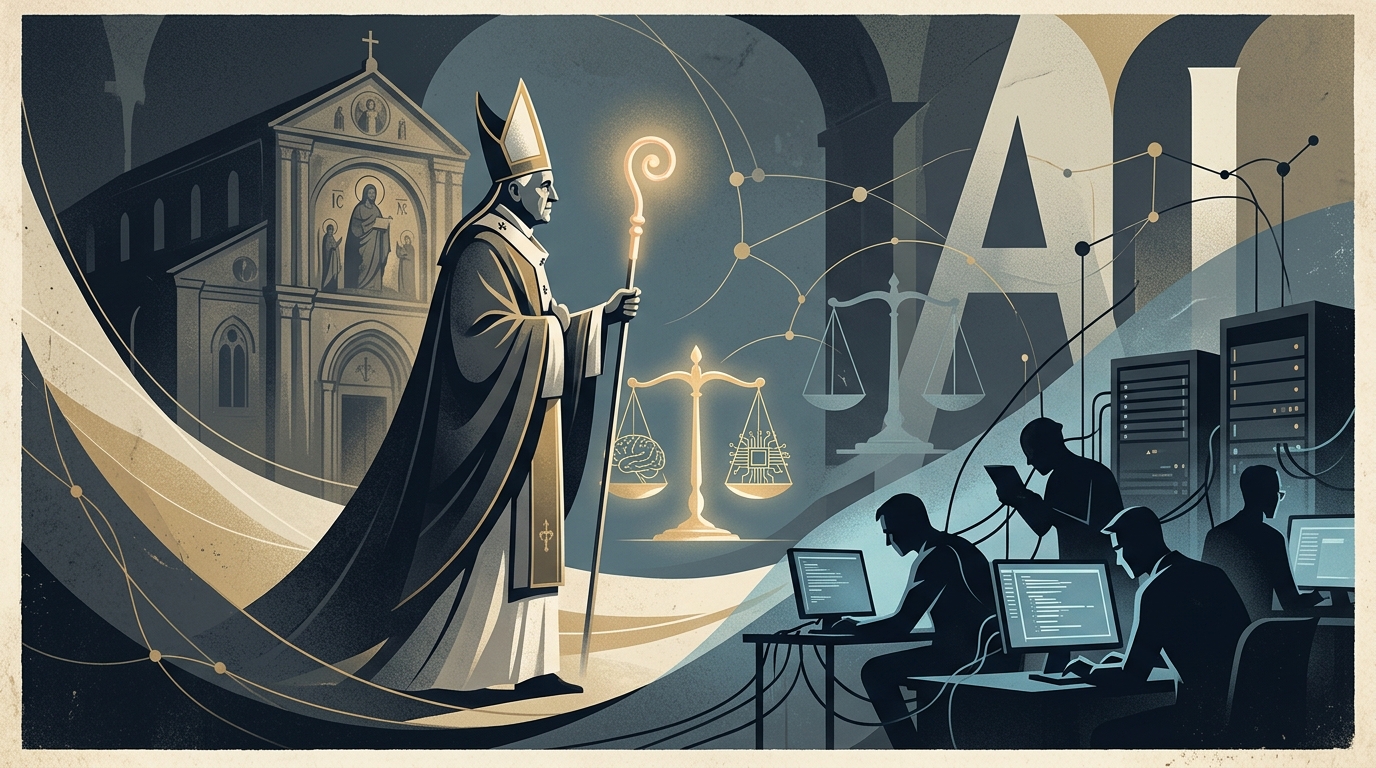
In a world increasingly governed by algorithms and the relentless pursuit of financial gain, the Vatican's voice resonates with an unexpected yet vital urgency. As we navigate mid-2026, Artificial Intelligence (AI) is no longer a distant promise but the central nervous system of the global economy and social fabric. However, Pope Francis, through his persistent advocacy, poses a fundamental question: Who truly benefits from this revolution, and at what moral cost?
The Emergence of 'Algor-ethics'
The term 'algorethics,' coined and championed by the Vatican, has moved from the fringes of theological debate to the center of global tech governance. The Pontiff does not oppose progress; on the contrary, he recognizes AI's potential to solve age-old human problems. Yet, he warns that technology devoid of a moral compass becomes a sophisticated tool of marginalization. His critique is pointed directly at the 'profiteers'—those corporate entities that prioritize shareholder dividends over the dignity and rights of the individual user.
According to the Vatican's analysis, the concentration of power within a handful of Silicon Valley giants and other global tech hubs is giving rise to a new form of 'digital feudalism.' Algorithms that decide creditworthiness, employment opportunities, or healthcare access often harbor biases that entrench existing social inequalities. For Francis, the monetization of the raw data of human experience is not just a business model; it is a profound affront to the sanctity of the person.
The Exploitation of the Global South
A particularly sharp dimension of the Pope’s critique involves the impact of AI on developing nations. While the benefits of AI are largely reaped in the global North, the costs—in terms of low-wage labor for data labeling and the massive environmental footprint of data centers—are frequently offloaded to the global South.
"We cannot allow algorithms to determine the value of a human life based solely on its profitability,"he remarked in a recent address to global leaders.
The 'AI profiteers,' as highlighted in recent reports from the Bangkok Post and other international outlets, often use the complexity of their systems as a 'black box' shield to evade accountability. This lack of transparency allows for profit maximization through the manipulation of public opinion and the erosion of privacy. The Pope is calling for an international treaty that binds corporations to treat human dignity as a non-negotiable prerequisite at every stage of software development.
Regulatory Frameworks vs. Spiritual Responsibility
While the European Union has moved forward with the full implementation of the AI Act by 2026, the Vatican argues that legislation alone is insufficient. What is required is a profound spiritual and cultural shift. 'Algor-ethics' proposes seven pillars: transparency, inclusion, responsibility, impartiality, reliability, security, and privacy. These principles, the Vatican argues, must be hard-coded into the systems themselves rather than added as an afterthought.
In 2026, the pressure on Big Tech is mounting. Investors are beginning to weigh ethical performance indicators, fearing not only legal repercussions but also a loss of social license to operate. The Pope's intervention has acted as a catalyst for a new alliance between religious leaders, academics, and grassroots activists demanding a 'democratization' of AI. The objective is clear: technology must serve humanity, not the other way around.
The Future of Humanity in the Digital Arena
Ultimately, Pope Francis’s stance serves as a reminder that the struggle over AI is a struggle over the definition of what it means to be human. If we allow profiteering to be the sole driver of technological evolution, we risk losing the essence of social solidarity. The challenge for world leaders and tech CEOs alike is to prove that innovation can coexist with compassion and justice, ensuring that the digital future does not leave the most vulnerable behind.