In the heart of the Croisette, where the glamour of cinema meets the most pressing social and technological anxieties, Japanese director Koji Fukada raised a voice of resistance that resonated far beyond the screening rooms. During the 79th Cannes Film Festival, the creator of 'Harmonium' and 'Love Life' did not limit himself to presenting his new work; instead, he performed a deep dissection of the impact of Artificial Intelligence (AI) on the seventh art. For Fukada, AI is not merely a new tool in a director's arsenal, but an existential threat to the very nature of creativity.
Physicality and the 'Accident' as a Source of Art
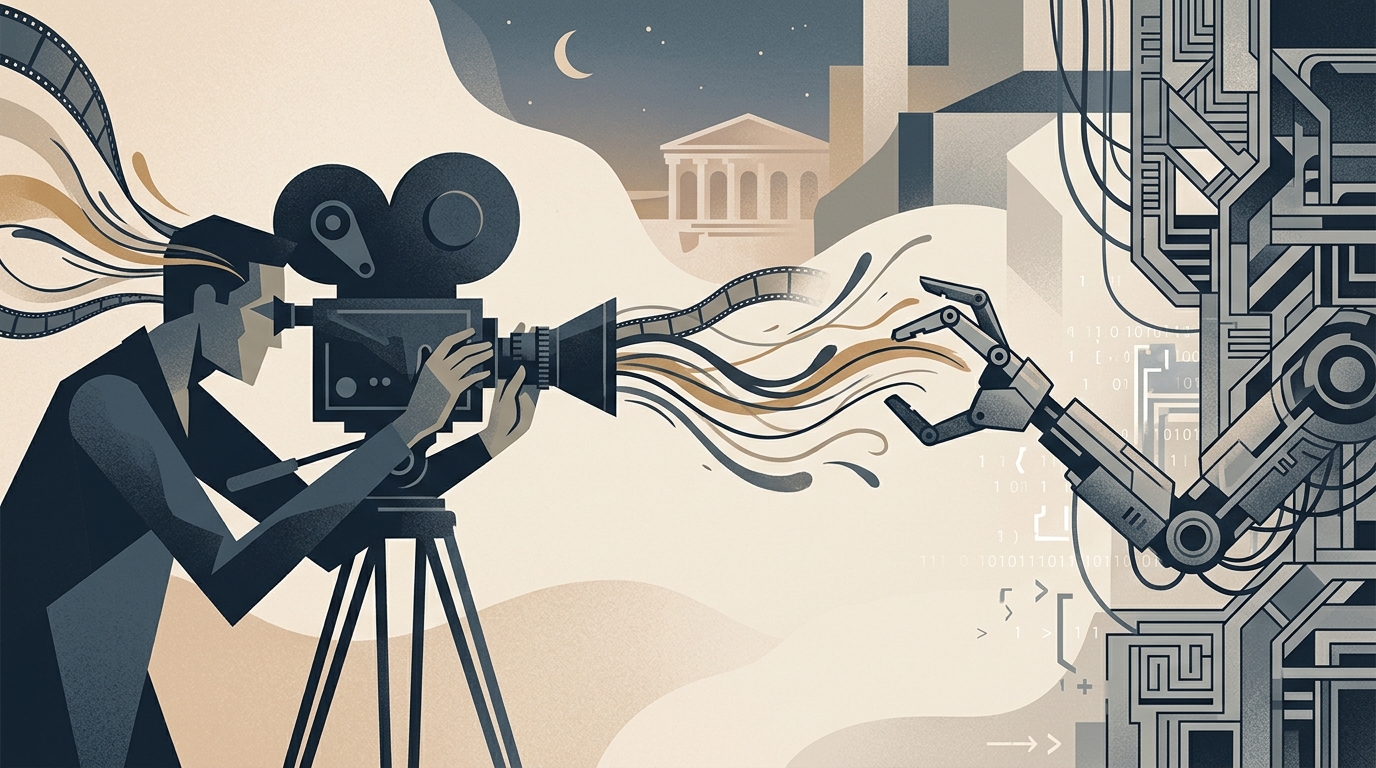
Fukada’s central argument is rooted in the belief that art is inextricably linked to human physicality and its inherent limitations. In an era where large language models and image generators can produce visually polished results in seconds, the Japanese auteur reminds us that cinema is born out of difficulty, friction, and the unpredictable. "The creative process is a struggle with reality," he stated. "When you remove the body and the experience of time from this process, what remains is a hollow shell, a simulation without a soul."
According to Fukada, AI operates on statistical probabilities, seeking optimization and perfection. However, art often thrives on mistakes, dissonance, and the subjective gaze that deviates from the norm. The automation of creation risks homogenizing global film production, turning movies into "consumer products" designed to satisfy algorithms rather than challenge the human spirit. The "accident"—the unexpected rain during a shoot, the nuanced tremor in an actor's voice—is what gives a film its humanity, elements that AI seeks to smooth over or synthesize without context.
Labor Rights and the Ethics of Production
Beyond the philosophical level, Fukada raised the burning issue of labor relations. As one of the leaders of the movement to improve working conditions in the Japanese film industry, the director sees AI as a tool that could be used by major studios to further devalue human labor. His concern is not just for screenwriters or actors, but for the entire ecosystem of technicians and assistants who form the backbone of any production.
"If we allow AI to replace creative thinking in the name of efficiency, then we undermine the right of creators to make a living from their art," he emphasized. The discussion at Cannes highlighted the gap between the technological euphoria of Silicon Valley and the raw reality of independent filmmakers, who see their intellectual property becoming "fodder" for training AI models without their consent or fair compensation. Fukada argues that the industry must resist the temptation of "fast-food cinema" enabled by generative tools.
The Danger of 'Cultural Automation'
Another point Fukada touched upon is the loss of cultural specificity. AI, trained on massive datasets often dominated by Western culture, tends to reproduce stereotypes and smooth out cultural differences. For a director working in Japan, a country with a deep and distinct cinematic tradition, the risk of global "cultural automation" is palpable. Art must be a mirror of society, with all its contradictions and local particularities—something a machine, no matter how sophisticated, fails to grasp organically.
The Japanese film industry, already struggling with systemic issues like low pay and long hours, faces a unique threat. Fukada fears that studios might use AI as a "quick fix" to avoid addressing these structural problems, leading to a sterile output that mimics Japanese aesthetics without understanding the underlying cultural pulse. He advocates for a cinema that remains grounded in the specific, the local, and the lived experience.
In conclusion, Fukada called on the global film community to establish strict ethical frameworks for the use of AI. This is not a blind rejection of technology, but a demand that the human remain at the center. "Technology must serve the vision, not dictate it," he concluded, leaving the Cannes audience with a profound reflection on the future of the image in a world increasingly dominated by data and automated synthesis.