

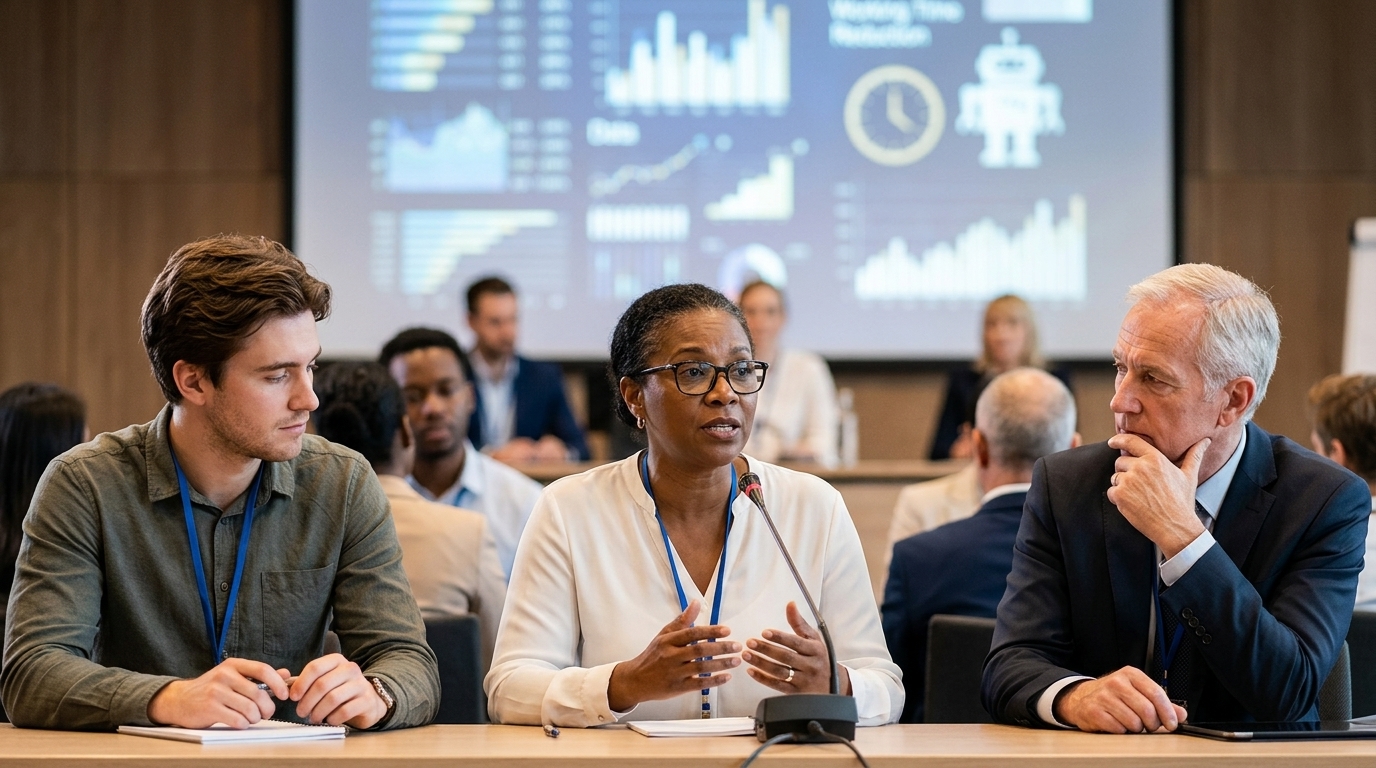
The debate over working hours is not merely a technical detail of labor relations; it is a profound political and social statement about the value of human life and the role of technology in our daily existence. As Georgios Argitis, Professor at NKUA and Scientific Director of INE GSEE, points out, working time constitutes the fundamental dimension of social and economic organization. Today, as we stand on the threshold of the Fifth Industrial Revolution, the question of whether reducing working hours is an empty political slogan or a necessary social reform acquires unprecedented urgency.
The Historical Perspective and the Productivity Trap
Historically, the reduction of working hours was the result of fierce social struggles and technological progress. From the establishment of the eight-hour day in the early 20th century to the institutionalization of the five-day week, the trajectory has always been toward liberating humanity from toil. However, in recent decades, this progress seems to have stalled. Despite the explosive rise in productivity brought about by computers and the internet, the average worker has not seen their working hours decrease proportionally. On the contrary, the 'always-on culture' imposed by smartphones has made the boundaries between work and private life extremely blurred.
Artificial Intelligence (AI) now promises a new leap in productivity. If algorithms can perform in seconds tasks that previously took hours, then the moral and economic justification for the 40-hour week is called into question. Professor Argitis emphasizes that working time determines not only the duration of employment but also the quality of social cohesion. If the benefits of AI are reaped solely by capital owners, social inequality will skyrocket. The reduction of working hours, therefore, emerges as a mechanism for the fair redistribution of the fruits of technological progress.
The Greek Paradox: The 6-Day Week vs. Global Trends
In Greece, the discussion takes a peculiar, almost ironic turn. While countries like Iceland, Spain, and the UK are successfully piloting the four-day workweek—showing improvements in mental health and maintained productivity—Greek legislation has recently moved in the opposite direction with the introduction of the six-day workweek for specific sectors. This divergence highlights a structural weakness in the Greek economy: an attachment to a low-labor-cost model rather than one based on high added value.
Resistance to reducing working hours in Greece is often cloaked in the mantle of 'competitiveness.' However, international experience shows that exhausted workers are less creative and more prone to errors. Reforming working time is not just a social demand; it is an economic strategy for modernizing businesses. Adopting a 35-hour week or a four-day schedule could act as a catalyst for business digitalization, forcing companies to improve processes rather than relying on labor intensification.
Ethics, Mental Health, and the Future of Work
Beyond numbers and GDP, the reduction of working hours touches the core of human existence. The global rise in burnout cases constitutes a silent epidemic. AI, if utilized correctly, can take over repetitive and tedious tasks, allowing humans to focus on creativity, strategic thinking, and, most importantly, leisure. Leisure is not 'lost time'; it is the time for democratic participation, family, art, and self-improvement.
"Reducing working hours is not a concession to the worker, but a necessary adjustment to a world where human labor is changing its very nature," industry analysts suggest.
In conclusion, the transition to fewer working hours cannot be achieved by a simple decree. It requires a comprehensive overhaul of the social contract. It must be accompanied by wage protection, training in new technologies, and a new management culture that focuses on outcomes rather than physical presence in the office. If political leadership treats this issue merely as a slogan, it will miss the opportunity to lead one of the most significant social reforms of the 21st century.





