

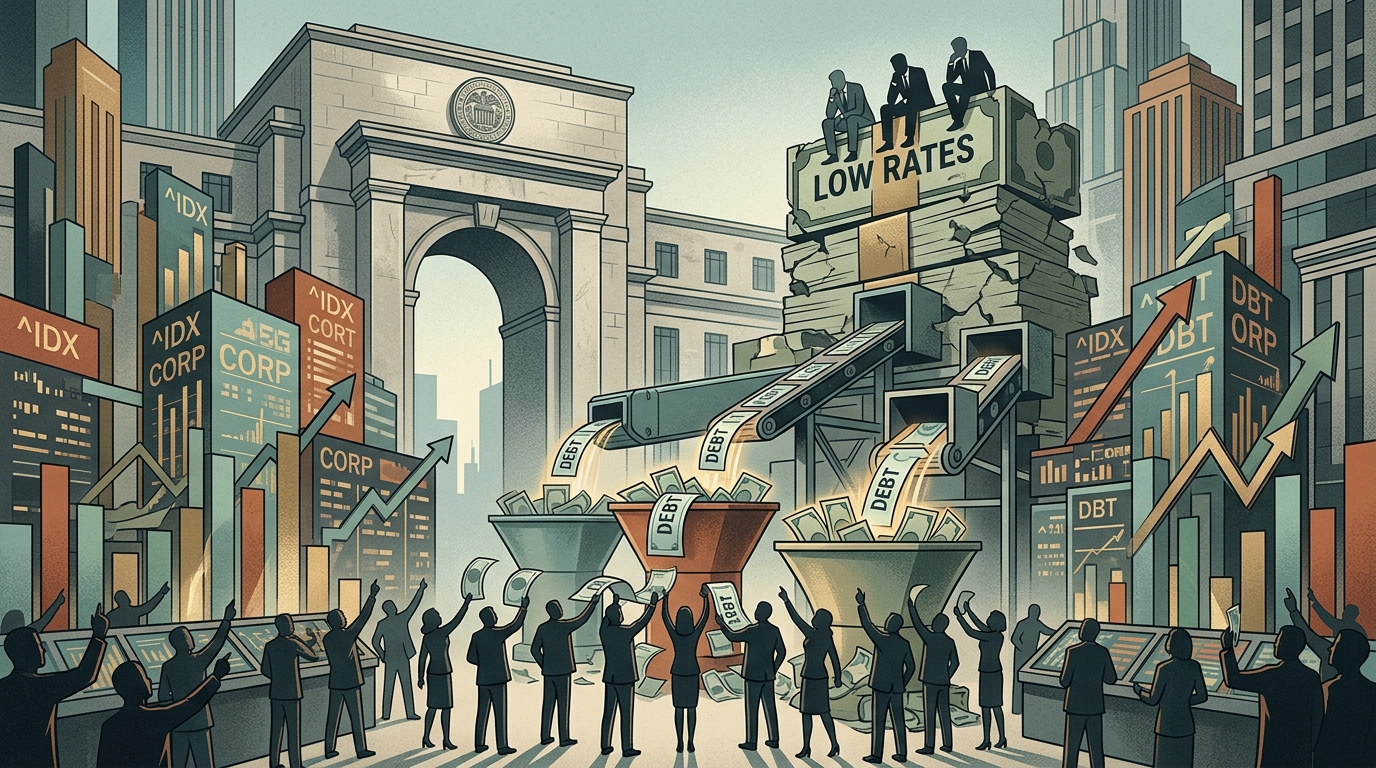
As we move through the summer of 2026, the economic landscape in the United States, and by extension across global markets, presents a picture that would have seemed inconceivable two years ago. Despite persistent predictions of recession and frantic cries over "higher for longer" interest rates, the American corporate machine has not only refused to stall but appears to be operating at record speeds. The new Federal Reserve Chair, Kevin Warsh, in his recent addresses, has admitted a truth that many analysts tried to ignore: large corporations are no longer waiting for the Fed to provide "relief." Instead, they are raising capital at rates reminiscent of the golden eras of cheap money.
The Explosive Surge in Corporate Bonds
The data is revealing. Corporate bond issuance for the first five months of 2026 reached a staggering $1.23 trillion, marking a 21% increase compared to the same period last year. This wave of liquidity is not originating from central banks but from private initiative and investor confidence. Companies, ranging from Silicon Valley tech giants to traditional Midwestern industrial firms, are rushing to lock in financing, taking advantage of the market's hunger for yield.
The paradox here is the decoupling of monetary policy from actual access to capital. While the benchmark interest rate remains at levels that theoretically should be "stifling" growth, capital markets are functioning as a self-regulating parallel mechanism. Investors, having accepted that inflation might remain structurally higher due to the energy transition and Artificial Intelligence, are willing to lend to companies that demonstrate strong balance sheets and clear growth strategies.
Kevin Warsh and the 'New Normal'
Kevin Warsh’s ascension to the helm of the Fed has signaled a shift in the central bank’s rhetoric. Warsh, known for his deep ties to the financial sector and the real economy, seems to be adopting a more pragmatic approach. In his latest speech, he emphasized that the Fed cannot ignore the fact that financial conditions are actually much looser than the nominal federal funds rate suggests.
"When companies can raise a trillion dollars in a few months, the question isn't whether rates are too high, but whether the market has already adjusted to a new equilibrium," he stated.
This admission changes the game for Wall Street. If the Fed does not feel the pressure to cut rates to "save" the economy, then the scenario of rate cuts within 2026 becomes increasingly remote. Markets, instead of reacting negatively to this prospect, seem to welcome it as a sign of strength. The rise in IPOs (Initial Public Offerings) and intense activity in Mergers and Acquisitions (M&A) confirm that capital is seeking an outlet, regardless of the central bank's decisions.
Risks Behind the Binge
However, every coin has two sides. The ease with which large corporations are raising debt carries risks for long-term financial stability. A significant portion of this bond issuance is being used to refinance older debt that was contracted at near-zero rates. Although companies are managing to secure liquidity, the cost of servicing this debt is gradually increasing, which could squeeze profit margins in the future.
Furthermore, there is the risk of a "bubble" in the corporate debt market. If economic activity slows down abruptly, companies with lower credit ratings (junk bonds) might find themselves in default. The Fed is in a delicate balance: on one hand, it doesn't want to cause market asphyxiation, and on the other, it doesn't want to allow unbridled credit expansion that would refuel inflation.
The AI Impact
We cannot analyze today's market robustness without mentioning Artificial Intelligence (AI). A significant portion of the raised capital is being directed toward AI infrastructure investments. Investors view AI not just as a technological trend but as a productivity catalyst that can justify higher borrowing costs. If a company can increase its efficiency by 20% through automation, then a borrowing rate of 6% or 7% is perfectly manageable.
In conclusion, the era where the Fed was the sole arbiter of America's economic fate seems to be receding. The market has developed its own mechanisms of resilience. Kevin Warsh recognizes it, and investors are celebrating it. The big question remains: how much longer can the real economy ignore the laws of interest rate gravity?





