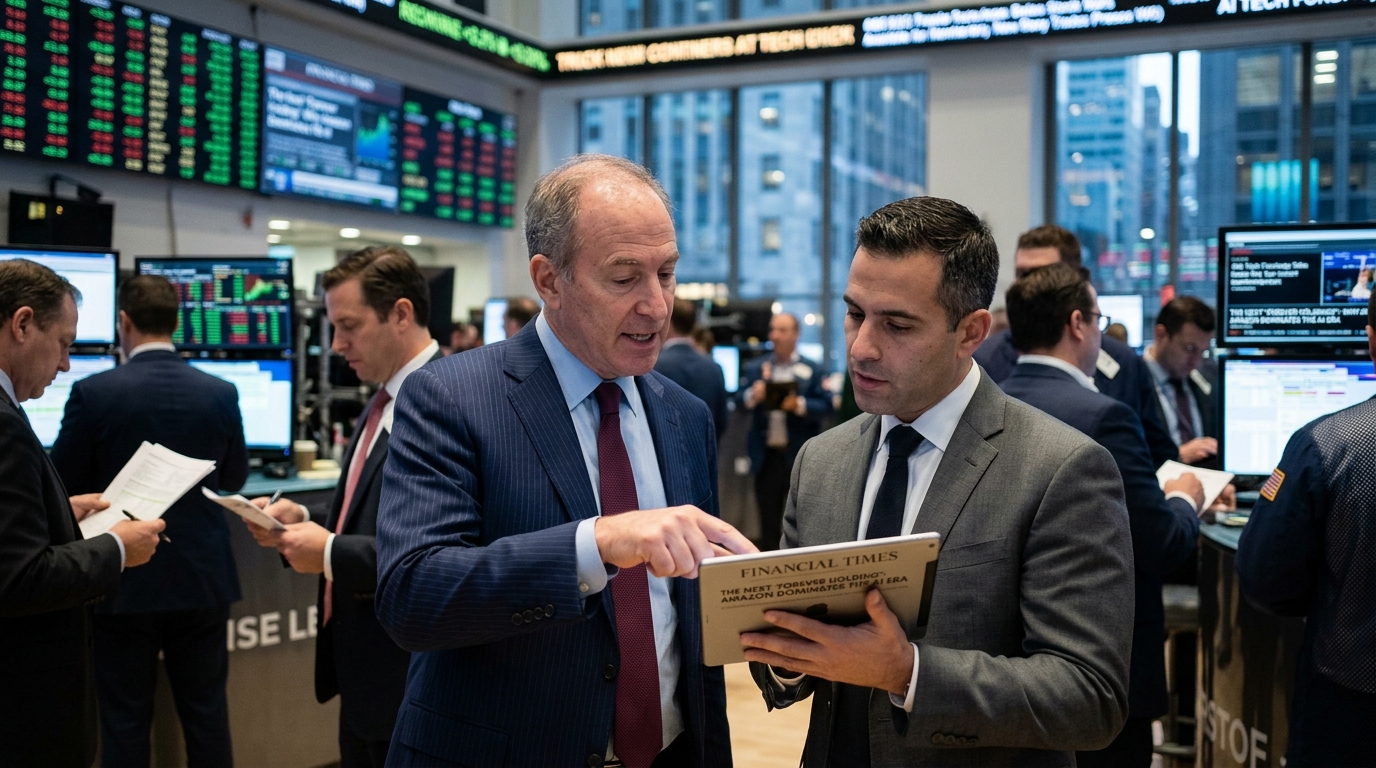
In the high-stakes world of global finance, few institutional moves are scrutinized with as much intensity as those of Warren Buffett. The 'Oracle of Omaha,' legendary for his adherence to value investing and businesses protected by wide 'moats,' stands at a historical crossroads in July 2026. With Berkshire Hathaway’s cash pile reaching unprecedented levels, a singular question dominates market discourse: which Magnificent AI stock will join the ranks of Coca-Cola and American Express as a 'forever holding'? The evidence increasingly points toward Amazon.
Amazon’s Metamorphosis into AI Infrastructure
For decades, Amazon was pigeonholed as a retail disruptor. However, by 2026, that perception has been completely overhauled. Amazon Web Services (AWS) is no longer merely a cloud provider; it has become the central nervous system of the global AI ecosystem. Buffett has long favored 'toll bridge' businesses—enterprises that are essential to the functioning of an industry. AWS has evolved into the ultimate digital toll bridge: any entity seeking to train or deploy Large Language Models (LLMs) must inevitably utilize its infrastructure.
A critical component of this dominance is Amazon’s aggressive pivot to custom silicon. By developing its own AI chips, such as Trainium and Inferentia, Amazon has achieved a level of vertical integration that provides a massive cost advantage over its competitors. This is precisely the kind of 'durable competitive advantage' that Buffett has spent six decades hunting. The ability to offer AI solutions at scale while insulating itself from the supply chain volatilities of third-party hardware makes Amazon a financial fortress.
Why Berkshire is Doubling Down Now
While Berkshire already holds a stake in Amazon, analysts are predicting a massive expansion of this position into a cornerstone holding. The rationale is clear: AI has transitioned from a speculative frenzy into a fundamental productivity tool embedded in every sector of the economy. Amazon utilizes AI to optimize its vast logistics network, personalize high-margin advertising, and maintain its e-commerce hegemony, generating cash flows that are nearly impossible for any competitor to replicate.
- Cloud Dominance: AWS maintains the largest market share, providing high-margin, recurring revenue.
- Vertical Integration: In-house chip production significantly lowers operational overhead.
- Operational Efficiency: AI integration in logistics continues to expand profit margins.
- Advertising Growth: AI-driven ad targeting has created a multi-billion dollar high-margin revenue stream.
Buffett has famously admitted he was 'an idiot' for not buying Amazon during its early growth phase. As Greg Abel takes on more leadership at Berkshire, the shift toward tech-centric monopolies is accelerating. Amazon, with its gargantuan data sets and physical infrastructure, offers the stability of a utility combined with the growth trajectory of a cutting-edge tech firm.
AI as the New 'Consumer Staple'
In the Buffett philosophy, the ideal investment is a product or service that remains essential regardless of the economic cycle. In the 20th century, this was the Gillette razor or a bottle of Coke. In the mid-2020s, access to AI compute and data storage has become just as vital. Through its Prime subscription model and AWS enterprise contracts, Amazon has engineered an ecosystem with incredibly high switching costs.
"Artificial Intelligence is not just a sector; it is the new infrastructure of humanity, and Amazon owns the real estate upon which this infrastructure is being built," notes a prominent Wall Street strategist.
In conclusion, the prediction that Amazon will become Berkshire’s next 'forever holding' rests on the convergence of traditional value metrics and future-proof technology. As the global economy shifts toward a data-driven paradigm, Buffett and his successors are betting on the player that controls the pipelines. For the individual investor, Berkshire’s potential move into Amazon as a permanent fixture serves as the ultimate validation of AI’s long-term economic viability.