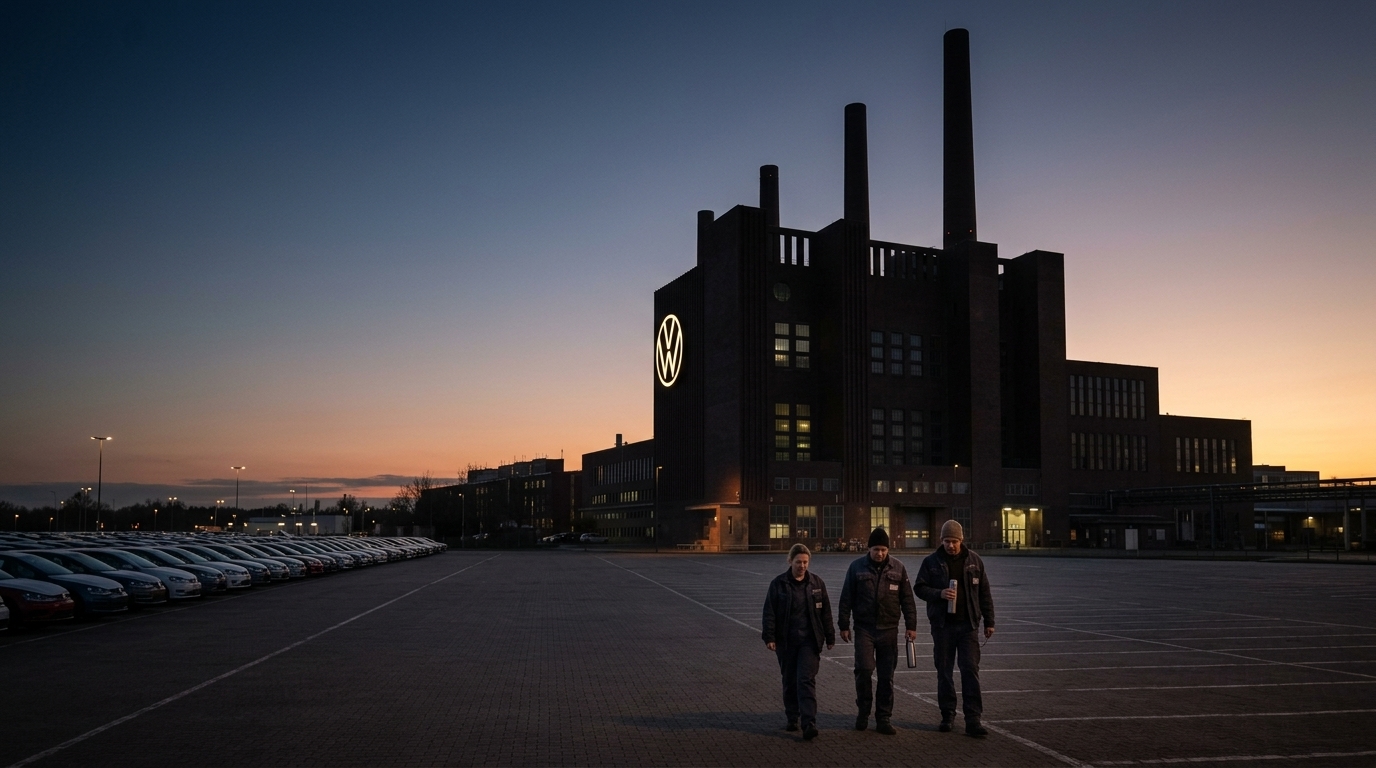
The news hit like a thunderbolt, though the warning shots had been echoing for months. Volkswagen, Europe’s largest automaker and Germany’s biggest private-sector employer, is preparing a restructuring plan that could lead to the elimination of up to 100,000 jobs and the closure of at least three factories on German soil. For a company that has never shuttered a plant in Germany in its 87-year history, this move signifies more than a mere business decision; it is the official admission that the old model of "Deutschland AG" has finally collapsed.
The Perfect Storm: Costs, China, and Energy
The crisis at Volkswagen is not the result of a single factor but a "perfect storm" of challenges that have accumulated over the past five years. Firstly, production costs in Germany have skyrocketed. Following Russia’s invasion of Ukraine and the subsequent loss of cheap natural gas, energy costs for heavy industry became unbearable. Combined with high wages secured by powerful unions (IG Metall), VW’s German plants are now considered 25% to 50% more expensive compared to rival units in Southern Europe or Asia.
Secondly, China, which for decades served as VW’s "cash cow," has transformed into a formidable rival. Chinese automakers like BYD and Xiaomi are not just producing cheaper electric vehicles (EVs); they are producing technologically superior ones in areas like software and connectivity. VW found itself chasing shadows, with its own software division, Cariad, facing constant setbacks and delays. The loss of market share in China means fewer profits to fund the expensive transition to electromobility in Europe.
- High Energy Costs: The loss of Russian gas rendered German production uncompetitive.
- Chinese Competition: Chinese consumers shifting to domestic EV models drastically reduced VW's sales.
- Software Failure: Delays in developing digital systems left German cars lagging behind Tesla and BYD.
Union Clashes and Political Pressure
CEO Oliver Blume’s plan for 10 billion euros in savings by 2026 is hitting a wall of resistance. Daniela Cavallo, head of the works council, has already stated that workers will fight "to the end" to prevent factory closures. In Germany’s co-determination system, workers hold half the seats on the supervisory board, while the state of Lower Saxony holds 20% of the voting rights, making every major decision a high-stakes political chess match.
Olaf Scholz’s government is in a bind. On one hand, the need for fiscal discipline and the green transition demand change. On the other, the prospect of 100,000 layoffs during a period of economic stagnation could be the "final blow" for the ruling coalition and further bolster the far-right (AfD) in the country’s industrial heartlands. Volkswagen is not just a company; it is Germany’s social contract with its middle class. If this contract breaks, the consequences will be social and political, not just economic.
"This is no longer a profitability crisis; it is a survival crisis. If we do not adapt now, Volkswagen will become the Nokia of the automotive world," says a high-ranking company official speaking on condition of anonymity.
The Future of the European Automotive Industry
The situation at Volkswagen reflects a broader European Union malaise. While Brussels mandates strict targets for phasing out internal combustion engines by 2035, European industry lacks the battery supply chain and raw materials to compete on equal terms. Recently imposed tariffs on Chinese EVs may provide a temporary reprieve, but they do not solve the underlying issues of low productivity and high costs.
VW’s restructuring will serve as a blueprint for the entire sector. If the company manages to push through the cuts and invest effectively in the next generation of electric platforms (SSP), it might retain its dominance. However, if it remains bogged down in years of legal and labor disputes, the void will be rapidly filled by new players. The stakes are not just the future of Wolfsburg, but Europe’s place on the global innovation map. The era when German engineering alone was enough to conquer the world is gone forever. Today, the battle is fought in code, batteries, and speed of adaptation.