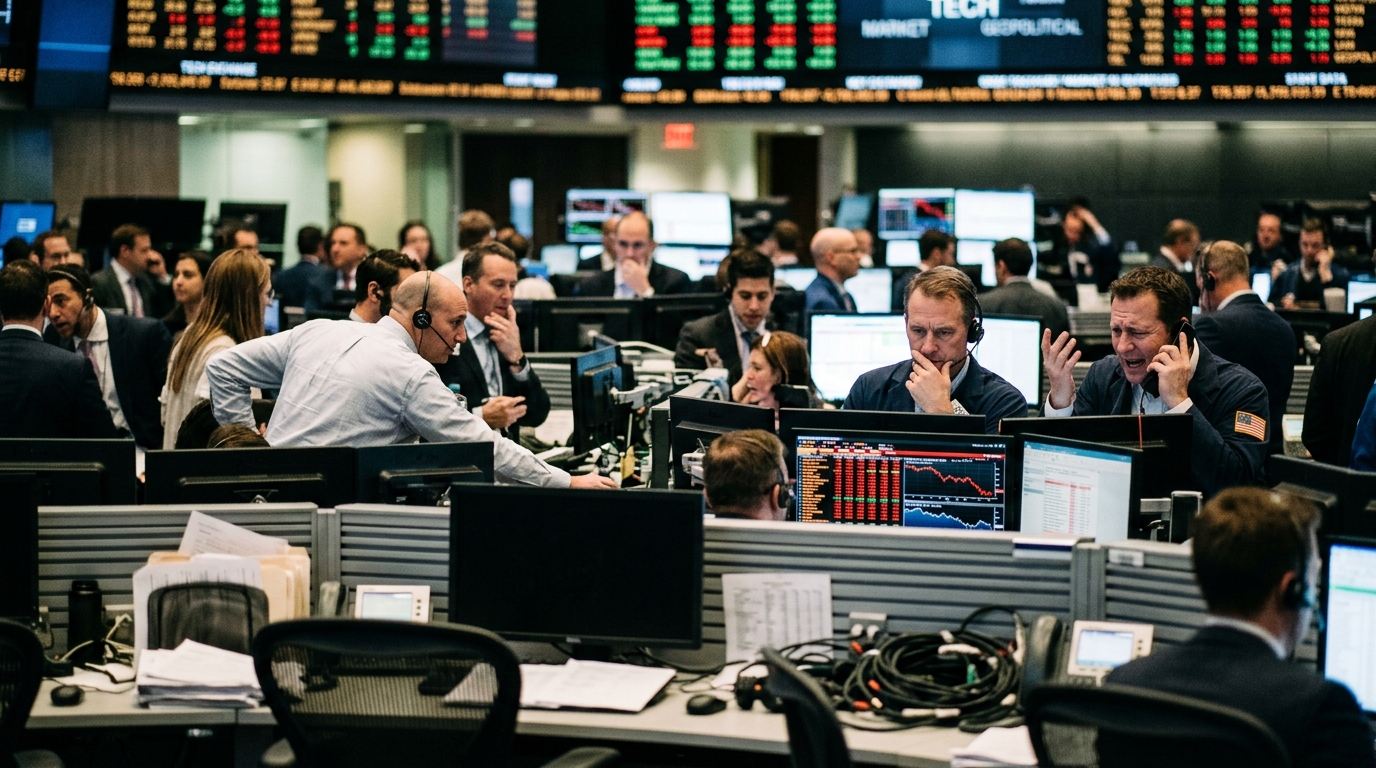
Wall Street faced a wave of liquidations on Monday as the artificial intelligence (AI) euphoria that had been driving markets to successive record highs appeared to be giving way to a more skeptical realism. The S&P 500 and Nasdaq recorded significant losses, primarily driven by the retreat of the so-called "Megacaps" — the tech giants that form the backbone of the modern U.S. economy. Simultaneously, the geopolitical chessboard is becoming increasingly complex, with developments in Iran keeping the investment community on high alert.
The Retrenchment of Tech Titans
For months, the ascent of Nvidia, Microsoft, and Apple seemed unstoppable. However, today's session highlighted the fragility of a market built on overly concentrated capitalization. Nvidia, which recently claimed the title of the world's most valuable company, saw its shares decline as investors moved to lock in profits. This move is not necessarily a sign of a collapse, but a necessary "breather" after a rally that many analysts had characterized as overextended.
The decline in tech stocks also reflects broader concerns regarding valuations. With price-to-earnings (P/E) ratios at levels reminiscent of the dot-com bubble era, the market is now seeking tangible evidence that AI investments will translate directly into profitability. As long as companies struggle to demonstrate immediate financial benefits from AI integration, the pressure on stock prices will remain intense.
The Iran Factor and Geopolitical Instability
Beyond balance sheet figures, Wall Street is turning its gaze toward the Middle East. Recent developments in Iran — involving internal political shifts and heightened tension in regional relations — have caused jitters in the commodity markets. The prospect of a disruption in oil supply remains one of the greatest risks to the global economy, as it could reignite the inflationary pressures that the Federal Reserve has been desperately trying to tame.
Analysts point out that any escalation in the region could lead to a "flight to quality," with investors abandoning high-risk stocks in favor of gold and government bonds. The uncertainty surrounding leadership succession in Iran and Tehran's stance toward the West are volatile factors that could overturn forecasts for the second half of 2026.
Strategic Rotation and Macroeconomic Outlook
Despite the index declines, some strategists see a silver lining: market broadening. While Big Tech retreats, other sectors such as energy, utilities, and banking are showing signs of resilience. This sector rotation is essential for a healthy and sustainable bull market, as it reduces dependence on just a handful of stocks.
The big question remains the stance of the U.S. central bank. If inflation remains on a downward trajectory despite geopolitical pressures, an interest rate cut within the year remains on the table. However, if energy prices spike due to Iran, the Fed might be forced to keep rates high for a longer period, which would be a significant drag on growth-oriented tech companies. In conclusion, today's drop is a reminder that the market does not operate in a vacuum but is directly influenced by both technological expectations and global conflicts.