

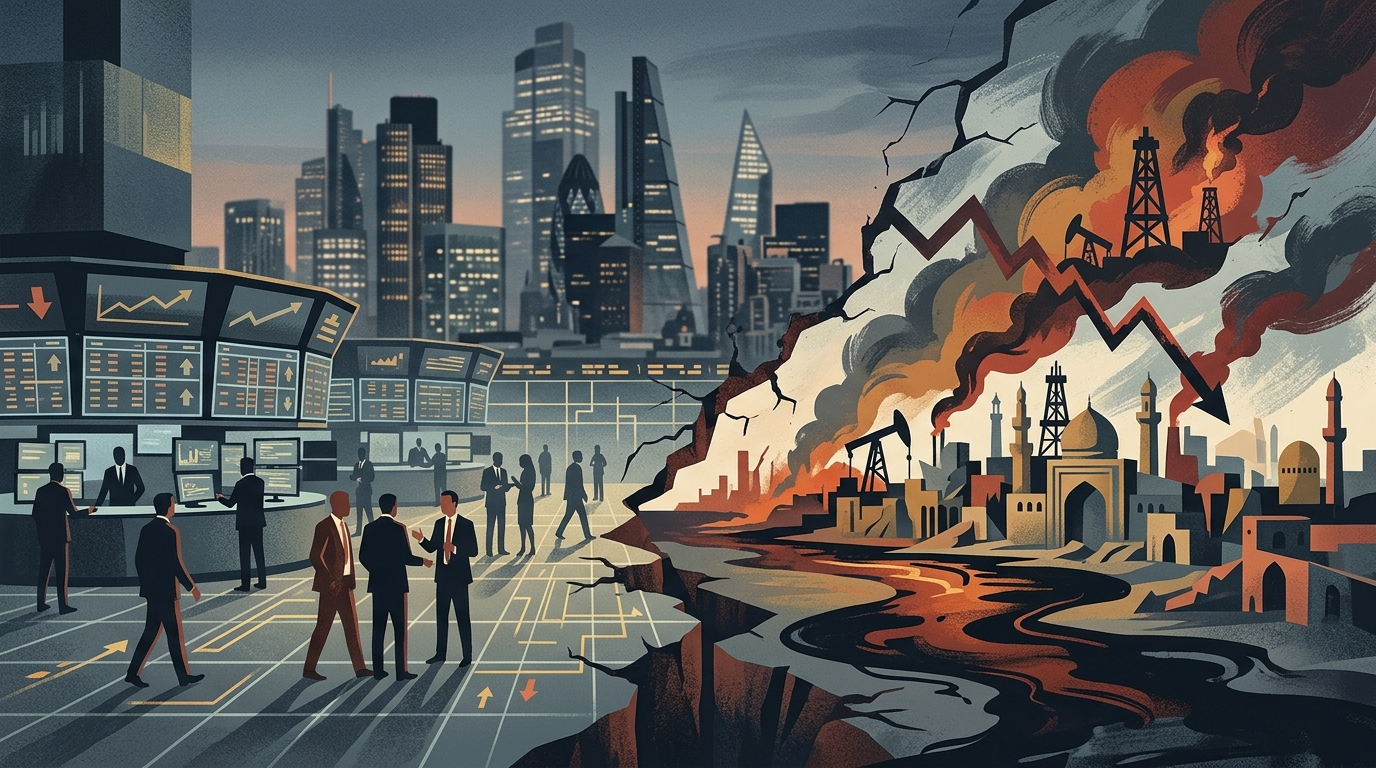
At a time when the global economy is struggling to heal its wounds from the pandemic crisis and the energy turmoil of the Russia-Ukraine war, a new, darker threat is emerging from the heart of the Middle East. Kristalina Georgieva, Managing Director of the International Monetary Fund (IMF), has delivered an ominous assessment that changes the landscape for markets and economic policymakers: the conflict in the region, centered on Iran, can no longer be considered a "controlled risk."
This statement, made during recent economic forums, reflects a deep concern about the changing nature of geopolitical crises. While in the past local conflicts were treated as "noise" that markets could absorb, current dynamics suggest a systemic threat that could derail global growth and ignite a new wave of inflation, just as central banks were preparing for a long-awaited "soft landing."
The Shift from Local Crisis to Systemic Threat
For decades, IMF and World Bank analysts used the term "controlled risk" to describe tensions that, while tragic on a human level, had a limited economic footprint outside the borders of the involved nations. However, Georgieva points out that the direct involvement of Iran and the escalation of retaliatory strikes with Israel have shattered this protective framework. Uncertainty is no longer about "if" there will be an impact, but "how deep" it will be.
The IMF chief emphasizes that the duration of the crisis is the most critical factor. A prolonged conflict affects not only oil production but also investor confidence, commodity insurance costs, and the stability of supply chains. As she noted, "the longer the uncertainty lasts, the more the foundation of global economic activity is eroded."
Oil as a Weapon and the Threat of Stagflation
The primary transmission channel of the crisis remains energy. The Middle East remains the lung of global energy supply, and any disruption in the Strait of Hormuz—through which one-fifth of global oil consumption passes—could send prices into triple digits. Georgieva warns that a 10% increase in oil prices could lead to a 0.15% reduction in global GDP and a 0.4 percentage point increase in inflation.
This scenario is a nightmare for central bankers. If energy prices spike, the Fed and the ECB will face a dilemma: keep interest rates high to tame inflation, risking a deep recession, or cut them to support growth, allowing inflation to run rampant. The danger of stagflation—low growth with high inflation—is returning to the discussion table with greater intensity than ever.
The Impact on Global Trade and Shipping
Beyond oil, the crisis has already begun to reshape trade routes. Attacks in the Red Sea have forced ships to bypass the Suez Canal, opting for the longer and more expensive route around Africa. This increases shipping costs and delays the delivery of goods, putting further pressure on consumer product prices.
Georgieva emphasizes that these "frictions" in global trade are not temporary. If the Middle East remains in a state of ignition, companies will be forced to permanently revise their strategies, moving production closer to end markets (near-shoring) or to friendly nations (friend-shoring). This geoeconomic fragmentation, while offering security, increases production costs and reduces global efficiency.
The Resilience of Developing Nations Under Pressure
Finally, the IMF expresses particular concern for developing and low-income countries. Many of these economies are already burdened with high debt, and rising food and fuel import costs could spark social instability. Georgieva calls on the international community to strengthen safety nets, warning that an economic collapse in the Middle East or North Africa neighborhood would have direct implications for migration flows and European security.
In conclusion, Georgieva's message is clear: the global economy can no longer rely on the hope that geopolitical crises will remain "local." The need for diplomatic de-escalation is not just a matter of humanitarian concern but a fundamental prerequisite for economic survival in an increasingly volatile world.





