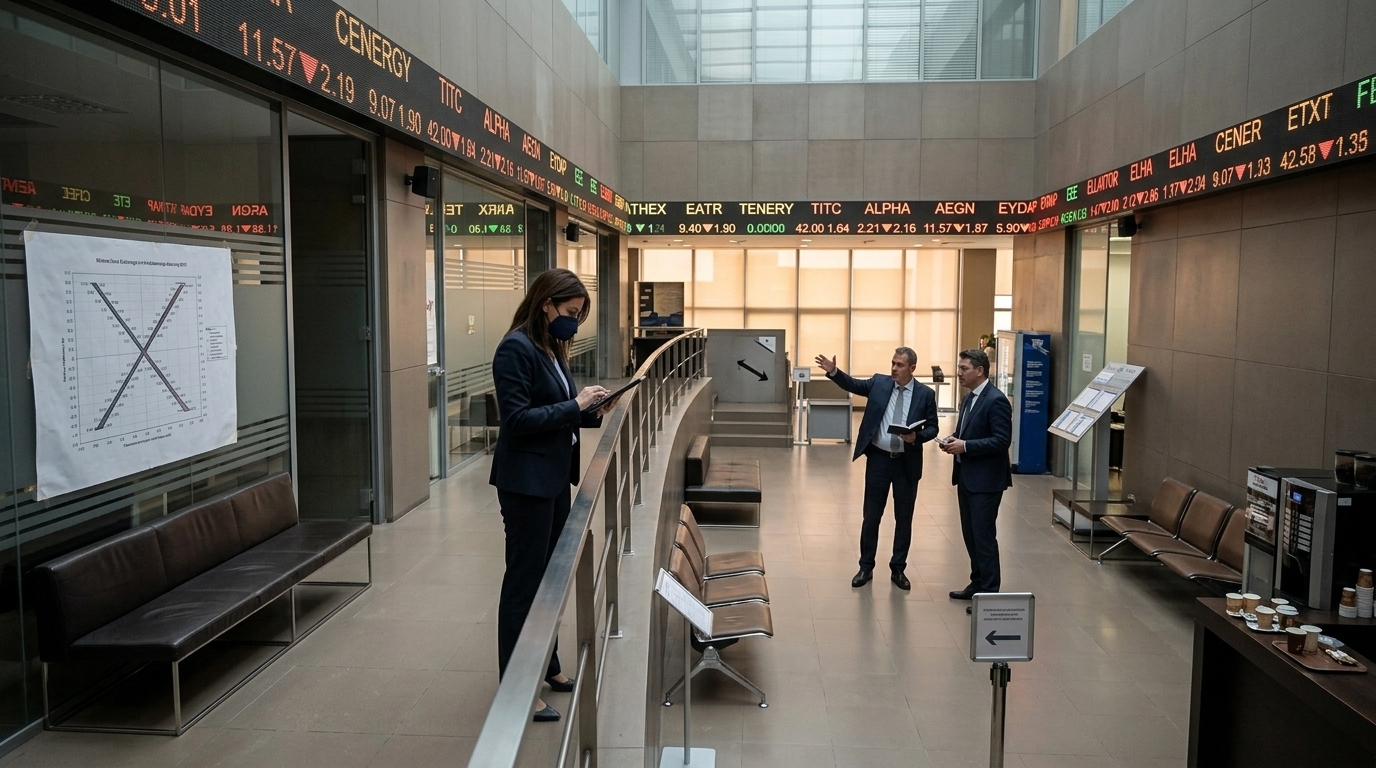
The history of financial markets is replete with moments where logic seems to yield to the instinct for survival and speculation. Today, as we navigate through May 2026, the Athens Stock Exchange (ASE) provides a prime example, exhibiting a remarkable resilience that many analysts term the "war paradox." Despite ongoing conflicts keeping oil prices steadily above the psychological and economic threshold of $100 per barrel, the General Index in Athens remains anchored near the 2,300-point mark, bracing for its next major move.
Market Psychology in a Conflict Environment
Why do markets rise while bombs fall? The answer lies in the concept of "discounting." Investors tend to price in fear long before a crisis peaks. Once uncertainty transforms into a harsh but predictable reality, capital begins searching for value. In Greece's case, the market no longer functions as a peripheral "casino" but as a destination offering value in a world of limited returns. Rising energy prices, while burdening production costs, have simultaneously boosted the revenues of major energy groups dominating the board, creating a safety net for the General Index.
The MSCI Milestone and Institutional Strategy
The eyes of the investment community are now fixed on the MSCI announcements. The index rebalancing is not merely a procedural formality; it is the "ticket" for fresh capital inflows from passive funds (ETFs) that strictly track these benchmarks. A potential increase in the weighting of Greek stocks or the addition of new titles to the MSCI Standard Greece index could trigger a new rally. Athens has successfully upgraded its profile, moving from the category of "emerging" problems to that of "developed" opportunities, with banks leading the charge due to robust profitability and the return of dividends.
- The General Index's resilience above 2,250 points is considered a critical technical signal.
- Banking stocks lead the rally, supported by the ECB's sustained high interest rates.
- The energy sector acts as a "natural hedge" against inflationary pressures.
- Political stability in Greece serves as a comparative advantage over other European markets.
Challenges and the Ghost of Inflation
However, optimism must be tempered with skepticism. The cost of living and the pressure on households represent the flip side of the expensive oil coin. If consumption drops dramatically, the corporate profits currently supporting the Stock Exchange will take a hit in the second half of the year. Furthermore, the geopolitical chessboard remains fluid. A sharp escalation could trigger a flight to "safe havens" like gold or the US dollar, leaving Athens exposed. The MSCI hour is a moment of responsibility for fund managers, who must weigh geopolitical threats against domestic economic performance.
"The market does not reward optimism, but the ability to discern value amidst the noise of destruction," notes a veteran City analyst.
In conclusion, the Athens Stock Exchange stands at a crossroads. The momentum at 2,300 points is the result of a multi-year restructuring effort, but sustaining it will depend on international liquidity and the Greek economy's capacity to absorb the shocks of a prolonged war. MSCI will provide the direction, but the real economy will provide the duration.