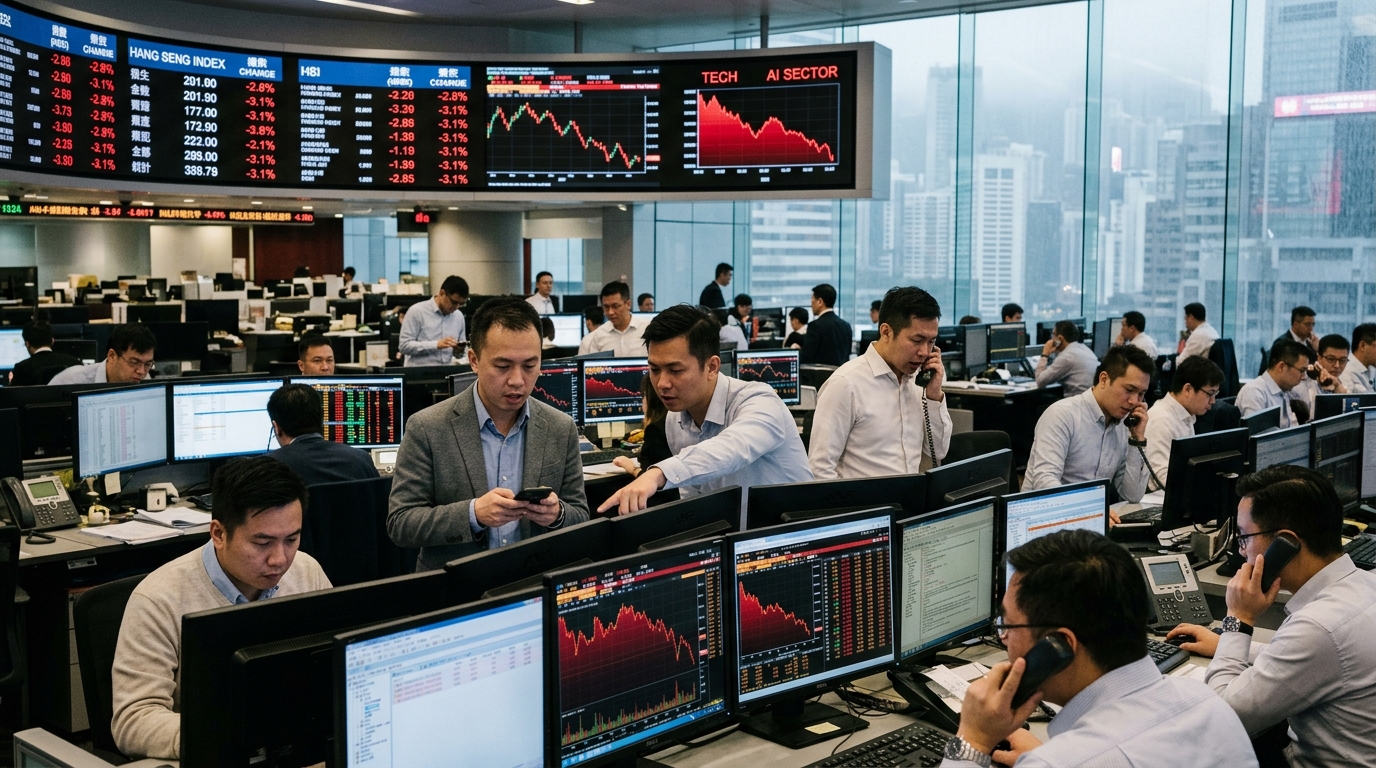
The global investment community is watching Asian markets with bated breath as the initial euphoria surrounding Artificial Intelligence (AI) appears to be yielding to a harsh reality. The Nikkei 225 index in Tokyo recorded losses of 1.5%, dragging other major regional indices down, while Brent crude prices retreated to $72 per barrel, reflecting concerns over global demand and economic deceleration.
The Transition from Promise to Performance
For over two years, markets were fueled by a narrative of a revolution that would transform every facet of the economy. However, the summer of 2026 is proving to be a moment of truth. Investors are no longer satisfied with promises of future productivity; they are demanding concrete results and profitability. The sell-offs observed in tech stocks, particularly in the semiconductor and cloud infrastructure sectors, suggest that the market now views valuations as excessively bloated.
The Nikkei's decline is not coincidental. Japan, home to giants that supply the equipment for chip manufacturing, such as Tokyo Electron, serves as the "canary in the coal mine." When orders for AI equipment begin to stabilize or decline, it is clear that the first cycle of massive investment has reached its zenith. The market is entering a phase of "digestion," where companies are called upon to prove they can convert expensive algorithms into sustainable business models.
Energy Costs and the Geopolitical Chessboard
Alongside the technological correction, the retreat of Brent oil to $72 adds an extra layer of complexity. Although AI requires vast amounts of energy for data centers, the general slowdown in industrial activity in China and uncertainty in Europe are pushing crude prices down. This creates a paradoxical situation: the operating costs of AI systems remain high due to energy needs, but the purchasing power of consumers and businesses expected to adopt these solutions is threatened by economic stagnation.
- Semiconductor stocks are leading the decline, with losses exceeding 3% in some instances.
- Investors are shifting toward defensive positions, abandoning high-risk growth stocks.
- Geopolitical tensions surrounding chip control continue to cause tremors in Asian supply chains.
The "Bubble" and the Future of Innovation
Is this decline the end of AI? Most analysts agree it is not the end, but a necessary purging. Much like the dot-com bubble of the early 2000s, the technology that survives will be that which offers real value. Companies that simply added the "AI" suffix to their names to attract capital are now facing the exit. Conversely, players who have integrated AI into their production processes in ways that reduce costs will emerge stronger from this crisis.
"The market is rediscovering that technology cannot defy the laws of economics indefinitely. Profitability remains the ultimate judge," says a leading analyst in Tokyo.
In conclusion, the current correction in Asian markets serves as both a warning signal and an opportunity. The removal of speculative capital will allow truly innovative forces to emerge, away from the noise of inflated expectations. The next six months will be critical in determining which countries and companies can navigate the choppy waters of the new economic reality.