The history of financial markets has always been a story of technological edge. From smoke signals and carrier pigeons to transoceanic fiber-optic cables designed to shave off milliseconds, the pursuit of 'alpha'—returns exceeding the market average—has consistently been a race of speed and information. However, the recent publication of the paper "AlgoEvolve: LLM-driven Meta-evolution of Algorithmic Trading Programs" on ArXiv (cs.AI) marks a fundamental paradigm shift. We are no longer talking about faster execution; we are witnessing the full automation of creativity in algorithmic trading.
Semantic Mutation as the Engine of Growth
At the heart of AlgoEvolve lies a radical proposition: using Large Language Models (LLMs) not as mere coding assistants, but as 'semantic mutation operators' within an evolutionary framework. Traditionally, genetic algorithms relied on stochastic changes to code (bit-flips or shuffling) to discover better solutions. While powerful, this method was often 'blind,' producing nonsensical code or failing to capture the subtle nuances of market behavior.
AlgoEvolve rewrites the rules. Instead of random alterations, the system leverages the reasoning capabilities of LLMs to propose logic-based modifications. The model analyzes a strategy's performance, understands why it failed during a specific period of volatility, and 'thinks' of ways to improve it. This 'meta-evolution' allows the algorithm to refine not just its parameters, but its very architecture, creating trading programs that no human developer might have conceived.
The Architecture of Autonomous Discovery
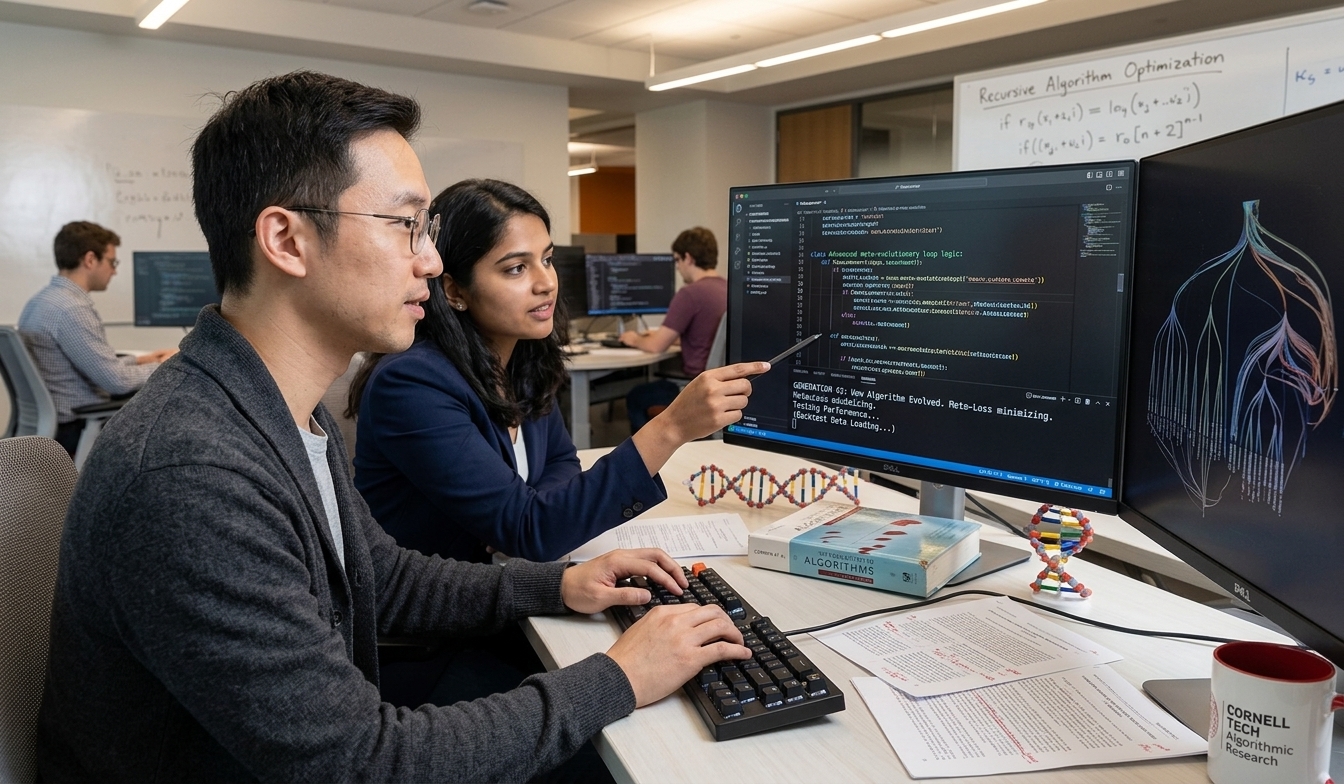
The system operates in a closed feedback loop. It begins with a population of baseline trading strategies. It then enters the evaluation phase (backtesting), where strategies are tested against historical market data. The top-performing strategies are selected for 'reproduction.' This is where AlgoEvolve shines: the LLM takes on the role of a geneticist. It receives the code of the successful candidates, reads their performance reports, and generates new, mutated versions that incorporate advanced risk management techniques or novel technical indicators.
- Semantic Understanding: The LLM understands the context of the strategy (e.g., momentum vs. mean reversion).
- Self-Correction: If a strategy shows high drawdown, the model automatically introduces stop-loss mechanisms.
- Code Optimization: The generated code is often more efficient, reducing execution latency.
This process repeats for thousands of generations, leading to a 'Cambrian explosion' of algorithmic strategies. Most impressively, AlgoEvolve can adapt to different asset classes—from stocks and bonds to cryptocurrencies—without any human intervention.
Market Implications and Systemic Risks
The arrival of systems like AlgoEvolve raises serious questions about market stability. If algorithms begin to evolve autonomously, there is a risk they might converge on similar strategies, leading to 'herding behavior' that could trigger flash crashes. Furthermore, the speed at which these systems can identify and exploit market inefficiencies means the profit margins for traditional traders will shrink even further.
"We are no longer in an era where humans teach machines how to trade. We are in an era where the machine invents its own economic theory, often beyond the bounds of human comprehension."
However, there is an upside. Increased efficiency can lead to greater liquidity and narrower spreads, ultimately benefiting the average investor. The challenge for regulators will be monitoring these 'black boxes' that change shape in real-time. How do you regulate an algorithm that mutates every second?
Conclusion: Towards a Post-Human Financial System
AlgoEvolve is not just a tool; it is a harbinger. As LLMs become more capable of reasoning and programming, the distinction between 'tool' and 'creator' blurs. In the high-stakes world of finance, a system's ability to learn from its mistakes and evolve organically is the ultimate competitive advantage. The question that remains is not whether machines will dominate the markets—that has already happened—but whether any sliver of room will remain for human judgment in an ecosystem moving at the speed of AI-driven evolutionary thought.