As we navigate the first half of 2026, the stock market landscape increasingly resembles an exclusive club with a very selective membership. The surge in Wall Street and European indices is not driven by a broad economic recovery, but by the explosive profitability and hype surrounding a handful of companies leading the Artificial Intelligence (AI) revolution. This narrowing of market leadership has ignited intense debate among economists, who are drawing parallels with the notorious dot-com bubble of the late 1990s.
The Narrowing of Leadership and Concentration Risk
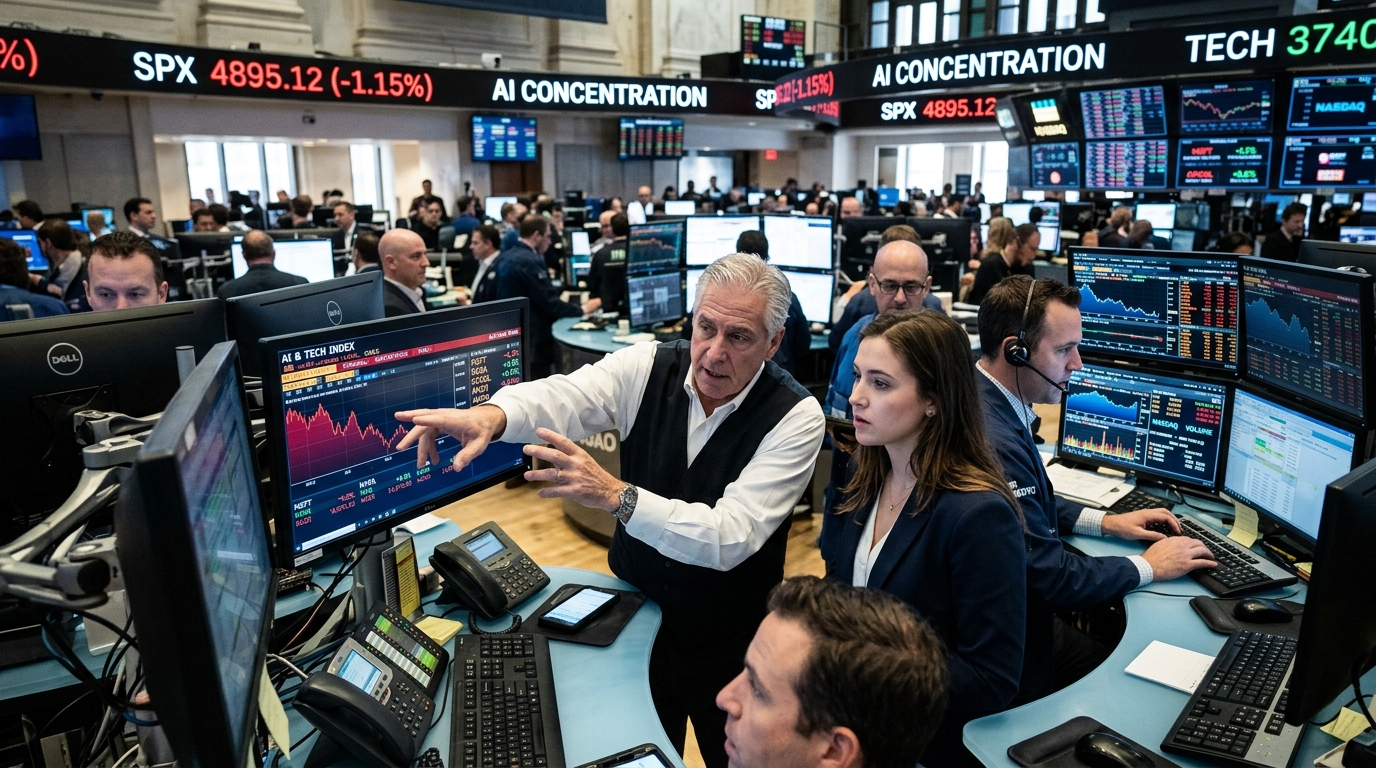
The phenomenon we are witnessing today is extreme capitalization concentration. Companies like Nvidia, Microsoft, and Alphabet (Google) account for a disproportionately large share of S&P 500 gains. When market leadership narrows, systemic vulnerability increases. If one of these pillars falters, the entire structure risks a significant tremor. Analysts from Yahoo Finance and other major institutions point out that current concentration levels have reached points that historically precede major market corrections.
However, there is a crucial distinction compared to the year 2000. Back then, many internet companies boasted astronomical valuations without ever having turned a profit, relying solely on 'eyeballs' and promises. Today, the AI protagonists are cash-generating machines. Nvidia, for instance, isn't just selling a vision; it provides the essential hardware upon which the global digital infrastructure is being built. Their profit margins are real, and their cash reserves are colossal. Yet, this does not negate the risk of excessive optimism regarding how quickly AI will translate into actual productivity for the broader economy.
The Ghost of 2000 and Investor Psychology
The comparison to the dot-com era isn't just about the numbers; it's about psychology. FOMO (Fear Of Missing Out) drives investors to pile into tech stocks regardless of their price. History teaches us that when everyone agrees on an investment, the peak is often near. In 1999, the internet was thought to change everything overnight. It did eventually change everything, but it took 15 years for stock prices to recover from the subsequent crash.
- Price-to-Earnings (P/E) ratios are at historical highs for the technology sector.
- The global supply chain's dependence on semiconductor production creates significant geopolitical risks.
- Central bank monetary policy remains the wild card that could drain liquidity from the market.
In Europe, the situation is slightly different. The lack of domestic AI giants leaves European markets watching from the sidelines, raising concerns about the Old Continent's long-term competitiveness. The concentration of power in American hands is not just an economic issue but also a matter of national security and regulatory policy.
The Challenge of Real-World Implementation
The big question for 2026 is whether the companies purchasing AI technology—the customers of Nvidia and Microsoft—will see a return on investment (ROI). If banks, manufacturers, and service providers fail to reduce costs or increase revenues through AI, the demand for chips and cloud services will drop sharply. This would be the tipping point that turns the 'revolution' into a 'bubble'.
"Technology is always overestimated in the short run and underestimated in the long run. The problem is that markets live in the short run."
In conclusion, while AI represents a structural shift in the global economy, the current market concentration serves as a warning signal. Investors should remain cautious, as history doesn't always repeat itself, but it often rhymes. Portfolio diversification remains the only defense against a potential sharp correction triggered by the disappointment of overinflated expectations.