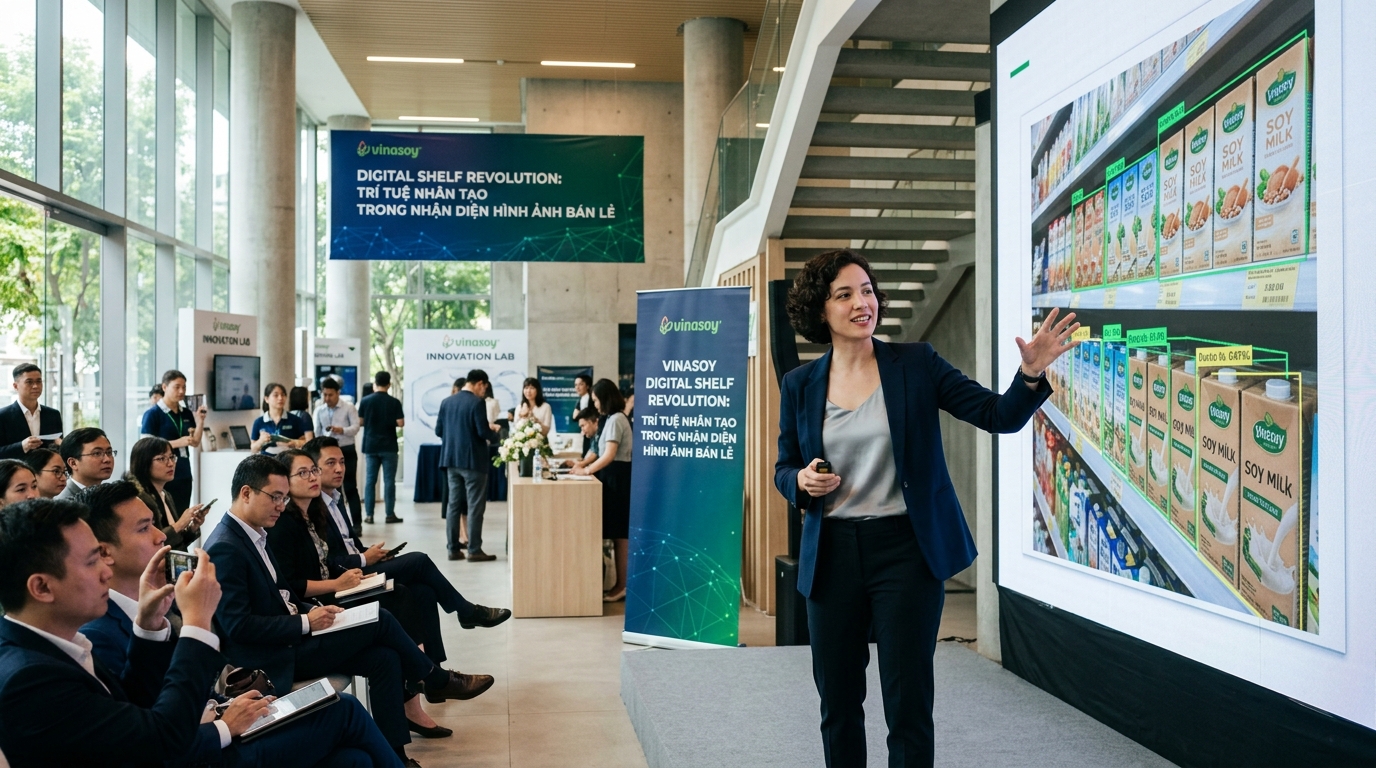
In the heart of Southeast Asia, one of the most traditional food industries—soy milk—is turning to cutting-edge technology to secure its dominance on retail shelves. Vinasoy, Vietnam's leading soy milk producer, has announced the full integration of Artificial Intelligence (AI) systems for evaluating and analyzing product display images. This move is not merely a technical upgrade but a strategic shift toward what is known as "Smart Retail."
The Quest for the "Perfect Shelf"
For a Fast-Moving Consumer Goods (FMCG) company like Vinasoy, the battle for consumer attention is won or lost at the shelf. Proper positioning, On-Shelf Availability (OSA), and adherence to agreed-upon Planograms are vital. Traditionally, this monitoring was done manually: sales representatives would visit stores, record inventory, and take photos of the displays. These photos then had to be reviewed by supervisors—a time-consuming, subjective, and error-prone process.
With this new technology, Vinasoy is automating the process using Computer Vision. Sales reps simply snap a photo of the shelf via a mobile app. The AI instantly recognizes every Stock Keeping Unit (SKU), counts the "facings" on the shelf, verifies that prices are correct, and compares the image against the master planogram. Within seconds, the rep receives feedback on necessary corrections, while management gains a crystal-clear, real-time view of market execution.
The Technology Behind the Image
Implementing such systems requires advanced Deep Learning models. The AI must be capable of recognizing products even in low-light conditions, at odd angles, or when packaging is partially obscured. For Vinasoy, which boasts a wide range of products from the classic Fami brand to specialized soy drinks, recognition accuracy is paramount.
According to company sources, the use of AI has reduced the audit time per store by at least 50%, while data accuracy has soared above 95%. This allows the company to reallocate resources from bureaucratic record-keeping to sales strategy and enhancing relationships with retailers.
"Artificial Intelligence does not replace our sales force; it gives them the eyes of an expert and the speed of a computer," state digital transformation executives in Vietnam.
Vietnam as an AI Testing Ground
The Vinasoy case is indicative of a broader trend in Vietnam, a market that is growing rapidly and digitizing at an incredible pace. Retail in the country is highly fragmented, with hundreds of thousands of small "mom-and-pop" stores coexisting with modern supermarkets. Applying AI in such a chaotic and diverse environment demonstrates the technology's versatility and robustness.
Furthermore, collecting this data enables Vinasoy to perform Predictive Analytics. By analyzing display and sales trends across different regions, the company can predict when a product is at risk of going out of stock or which display locations yield the best ROI, thereby optimizing its supply chain and promotional activities.
Challenges and Future Outlook
Despite the success, the transition is not without hurdles. Training staff to use new tools and ensuring data quality in areas with poor internet connectivity remain challenges. However, Vinasoy is leading the way for other industries in the region.
In the future, the use of AI in image evaluation is expected to expand into competitor analysis. AI will be able to inform Vinasoy not only about its own products but also about competitors' shelf moves, price changes, and new packaging launches, offering an unprecedented strategic advantage in a crowded marketplace.