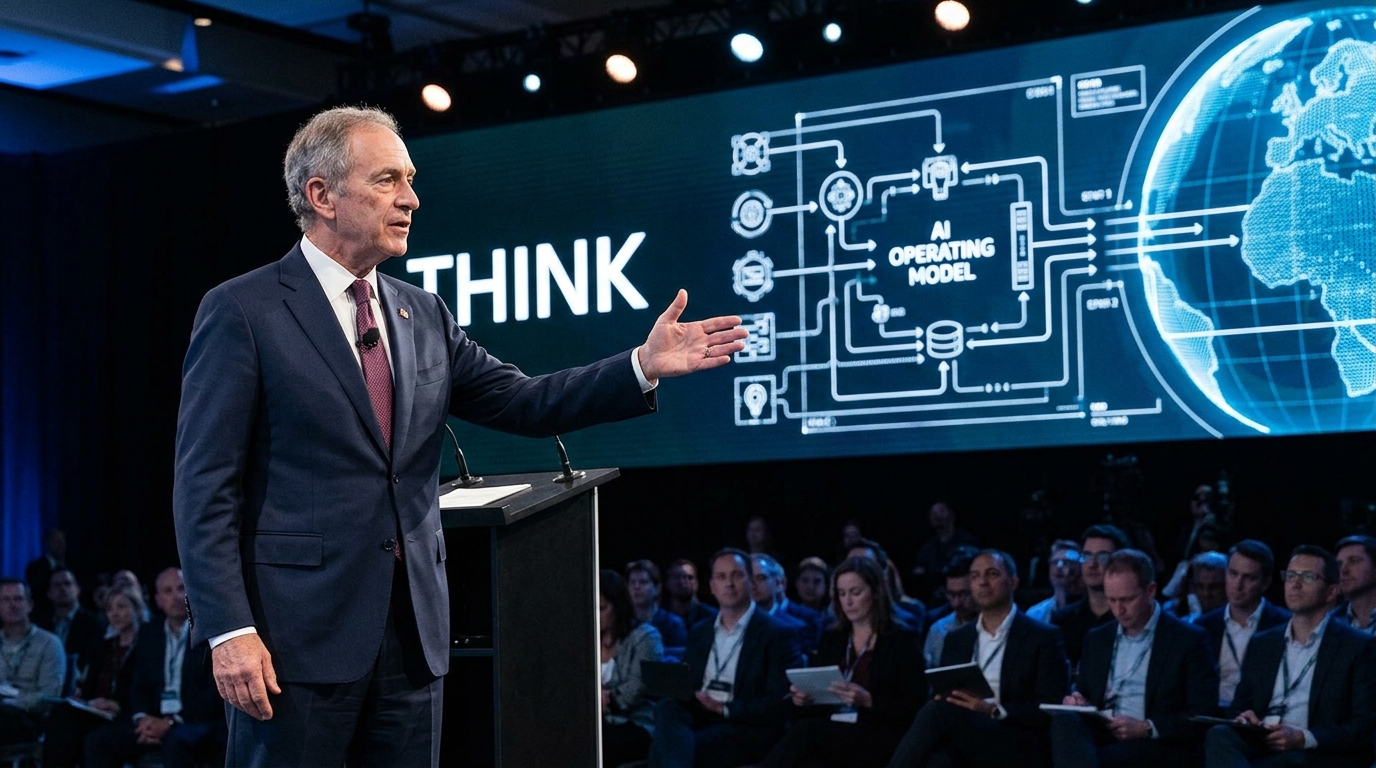
At the landmark Think 2026 conference, IBM did not settle for mere announcements of new models. Instead, it unveiled what CEO Arvind Krishna termed "the Operating Model for the Age of Intelligence." As we navigate the second half of the 2020s, the technology industry has grown weary of the promises of simple chatbots. The market now demands results, scalability, and, above all, a structural integration of artificial intelligence into the very fabric of business operations. IBM seems to understand this need better than its competitors, focusing less on the "wow factor" and more on the heavy infrastructure required for enterprise survival.
The End of Experimentation and the Birth of the AI Operating Model
IBM's central message for 2026 is clear: the era of "pilot purgatory" is over. The new AI Operating Model proposed by the American giant is built on three pillars: Agentic AI, real-time data governance, and Hybrid Cloud computing. IBM argues that enterprises can no longer treat AI as an add-on tool but must redefine it as the central processor of their operations.
The watsonx platform has evolved into a complete ecosystem where "agents" (AI Agents) do not just follow commands but make decisions within predefined ethical and operational boundaries. This shift toward Agentic AI allows companies to automate complex supply chains, legal processes, and customer service without the need for constant human oversight, reducing operating costs by up to 40% in some cases.
The 'AI Divide': A Risk to the Global Economy
One of the most sobering realizations from Think 2026 was the emergence of the "AI Divide"—a widening gap between companies that have fully embraced AI and those still struggling with legacy systems. IBM warns that this chasm is no longer just technological; it is existential. Companies on the "right" side of the divide are enjoying exponential productivity gains, while the rest face the prospect of obsolescence.
- Data Governance: Leaders possess clean, structured data that fuels their models effectively.
- Talent: Attracting AI specialists is becoming increasingly difficult for smaller firms as giants consolidate talent.
- Infrastructure: The cost of specialized compute remains prohibitive for many, despite price drops in general cloud services.
According to IBM’s analysis, the top 20% of global enterprises now control 80% of the value derived from AI. This concentration of power creates new challenges for regulators, particularly in the European Union, where the balance between fostering innovation and protecting competition is increasingly delicate.
Quantum-Safe AI and the Road Ahead
Beyond AI, IBM placed significant emphasis on Quantum-Safe AI. With the advent of utility-scale quantum computing drawing closer, protecting the data used to train AI models is paramount. IBM’s blueprint includes encryption protocols that are resilient to quantum attacks, ensuring that corporate intellectual property remains secure through the next decade.
"AI is no longer an option; it is the operating system of the modern enterprise. Those who fail to grasp this now will find themselves in a permanent state of technological debt," an IBM executive stated during the keynote address.
In conclusion, Think 2026 marks the transition to a more mature, yet more ruthless phase of the digital revolution. IBM is positioning itself as the trusted partner to guide large enterprises through the minefield of the AI Divide, offering not just code, but a comprehensive survival strategy for the 21st century.