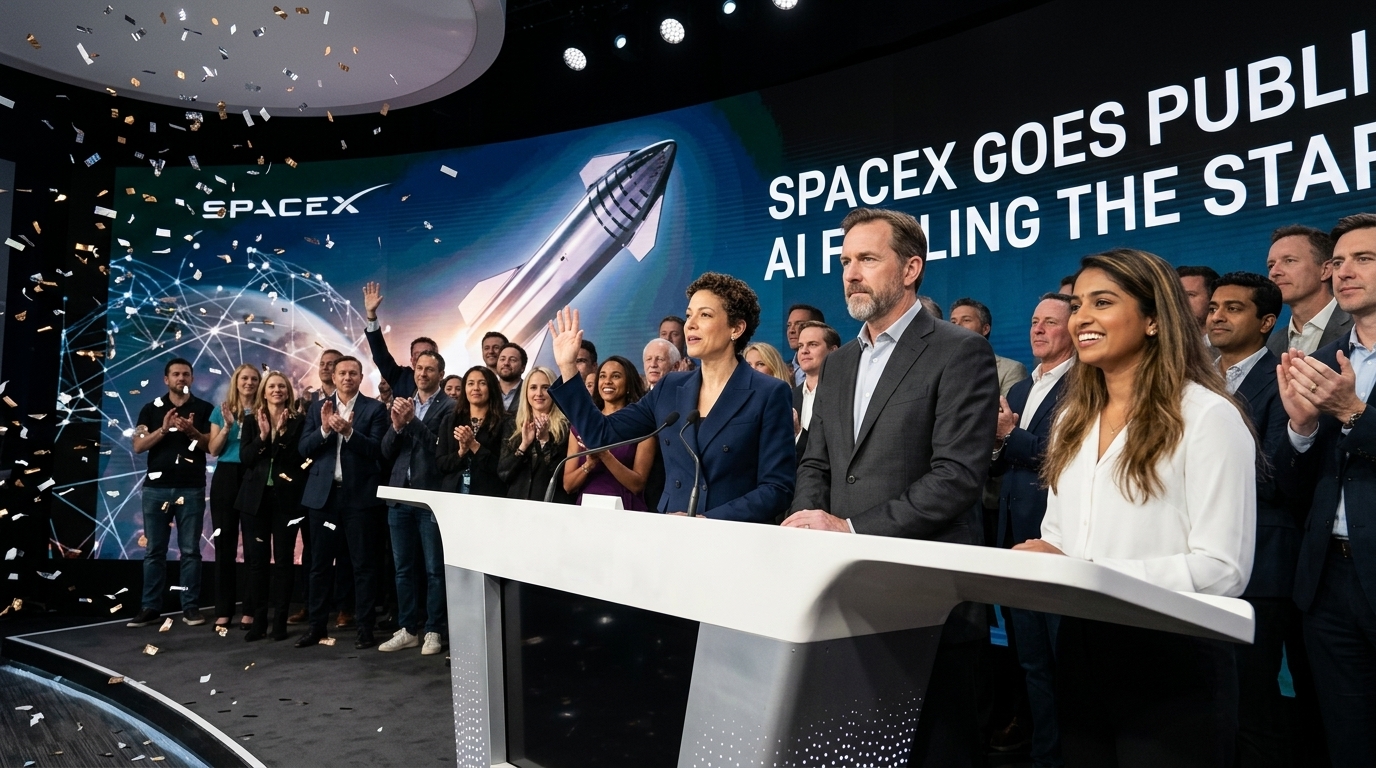
June 13, 2026, will be remembered as the day the gravity of Wall Street finally met the escape velocity of private ambition. SpaceX, the company that redefined the aerospace industry, is no longer the private sandbox of Elon Musk; it is a public entity with thousands of shareholders hungry for returns. Yet, the staggering valuation accompanying its public debut is not merely rooted in its ability to launch payloads. The true engine driving investor euphoria is Artificial Intelligence (AI).
Starlink as the Global Neural Network
To the average investor, Starlink is a satellite internet service. To technology analysts, however, it is the world's most extensive data collection infrastructure. With thousands of satellites in low Earth orbit (LEO), SpaceX now possesses what amounts to a global neural system. The integration of advanced AI algorithms allows the company to process vast amounts of data in real-time, ranging from climate patterns and maritime logistics to military movements in denied areas.
The implementation of edge computing in space enables these satellites to perform complex analyses before transmitting information back to Earth. This drastically reduces latency and positions SpaceX as the ultimate data provider for autonomous systems, from self-driving vehicles to industrial robotics. The market is no longer valuing SpaceX as a transportation firm, but as a Big Data and AI powerhouse that happens to operate its own rockets.
Autonomy and Starship: Next-Generation Robotics
Starship, the largest flying object ever constructed, is effectively a giant robot. The complexity of landing and reusing such massive systems requires levels of autonomy that far exceed human intervention. SpaceX has developed some of the world's most sophisticated computer vision and machine learning models internally, which are now beginning to find applications outside the space sector.
With its IPO, the company is expected to accelerate its synergy with xAI, Musk’s other venture, creating an ecosystem where space infrastructure meets generative AI. Imagine swarms of robots on the Moon or Mars that do not wait for instructions from Earth but make autonomous decisions using models trained on SpaceX’s proprietary supercomputers. This vision justifies the astronomical price-to-earnings multiples we are seeing on the trading floor today.
The Conflict Between Vision and Quarterly Earnings
However, becoming a public company brings the "tyranny" of quarterly reporting. Until now, Musk could ignore short-term losses in favor of the long-term goal: colonizing Mars. Now, institutional investors will demand results. Will the dream of the Red Planet be sacrificed at the altar of Starlink’s profitability?
Analysts suggest that SpaceX will attempt to maintain a delicate balance by framing Starship not just as a transport vehicle for Mars, but as the primary platform for deploying the next generation of AI-heavy satellite constellations. Commercializing space through AI is how the company plans to fund its exploratory ambitions. Nevertheless, the pressure to cut costs may lead to friction with regulators, particularly regarding safety protocols and environmental impact.
Geopolitics and National Security
Finally, we cannot ignore SpaceX’s role as a strategic partner to the United States. In a world where AI dominance equates to geopolitical power, SpaceX serves as the "railroad" to digital supremacy. The ability to launch rapidly and provide uninterrupted communications via AI-optimized networks makes the company indispensable for national defense.
The IPO provides SpaceX with the capital to expand this dominance, but it also exposes the company to scrutiny from foreign investors and international bodies. Managing this balance will be the primary challenge for leadership in the coming years. One thing is certain: SpaceX is no longer just a company "reaching for the stars"; it is a technological behemoth building the digital future of humanity, both on and off this planet.