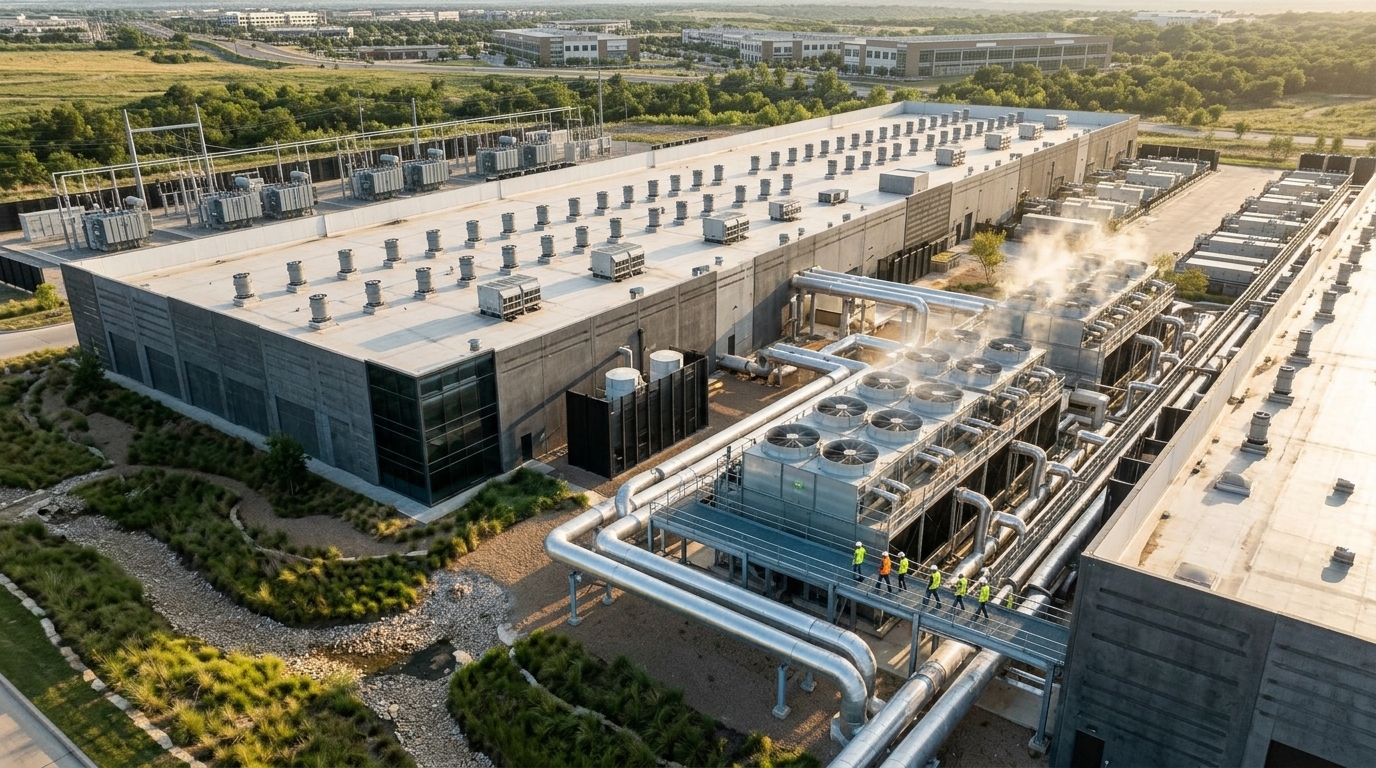
The meteoric rise of artificial intelligence has brought an uncomfortable truth to light: the data centers powering large language models are incredibly energy-hungry and, more importantly, thirsty. As local communities from Arizona to Ireland push back against the massive consumption of natural resources, Nvidia, the dominant force in the AI chip market, has unveiled a radical solution. With its new 'Rubin' reference architecture, the company claims it can virtually eliminate water usage, allowing systems to run at higher temperatures while maintaining efficiency.
The Physics of Heat: Why Running Hotter is Better
For decades, data center cooling has relied on evaporation. Traditional systems use cooling towers where water evaporates to remove heat from the air circulating between servers. This process consumes millions of gallons of potable water annually. Nvidia is now proposing a shift to full liquid cooling directly at the chip level. The key to the Rubin proposal is operating the cooling liquid at higher inlet temperatures.
When the fluid reaching the processors is already 'warm' by computing standards, the temperature differential with the outside environment remains large enough that heat can be dissipated through simple heat exchangers (radiators) and fans, without the need for water evaporation. This 'dry cooling' approach turns the data center into a closed-loop system, much like a car's radiator but on a gargantuan scale. According to Nvidia, this method not only saves water but also reduces overall power consumption, as liquid pumps are far more efficient than massive air-moving fans.
Political and Social Pressures
This move is not merely technological; it is deeply political. Nvidia recognizes that future AI infrastructure expansion is at risk from regulatory constraints. In drought-stricken regions, the construction of new data centers has become a flashpoint for protests. Municipalities are often forced to choose between providing water to citizens and supporting tech giants. The Rubin architecture's promise of 'near-zero water usage' serves as a powerful bargaining chip for cloud providers (such as Microsoft, Google, and Amazon) to secure building permits in environmentally sensitive areas.
- Elimination of evaporative cooling that wastes precious water resources.
- Reduction of PUE (Power Usage Effectiveness) through more efficient heat transfer.
- Ability to deploy data centers in hotter climates without the overhead of water costs.
- Increased computational density per square foot of floor space.
"We can no longer treat water as an infinite resource for cooling our chips. The Rubin architecture proves that thermodynamics can work in favor of sustainability if we are willing to redesign the system from the ground up," company representatives stated during the unveiling.
The Challenges of Transition
Despite the promises, transitioning to liquid cooling is not straightforward. It requires a radical overhaul of building architecture. Traditional data centers are designed for airflow, not for liquid piping running through every rack. Installing liquid cooling systems increases initial capital expenditure (CAPEX) and introduces new risks, such as fluid leaks near sensitive electronics. However, Nvidia is betting that operating expenses (OPEX) and social license to operate will outweigh these hurdles.
Furthermore, running at higher temperatures means that semiconductor materials must be more resilient to thermal stress. Nvidia appears to have addressed this with advanced materials in the Rubin platform, ensuring that chip longevity is not compromised by the 'hotter' operating environment. In conclusion, Nvidia's move signals the end of the era of 'cheap and wasteful' cooling, pushing the industry toward a model where computational power must coexist with ecological reality.