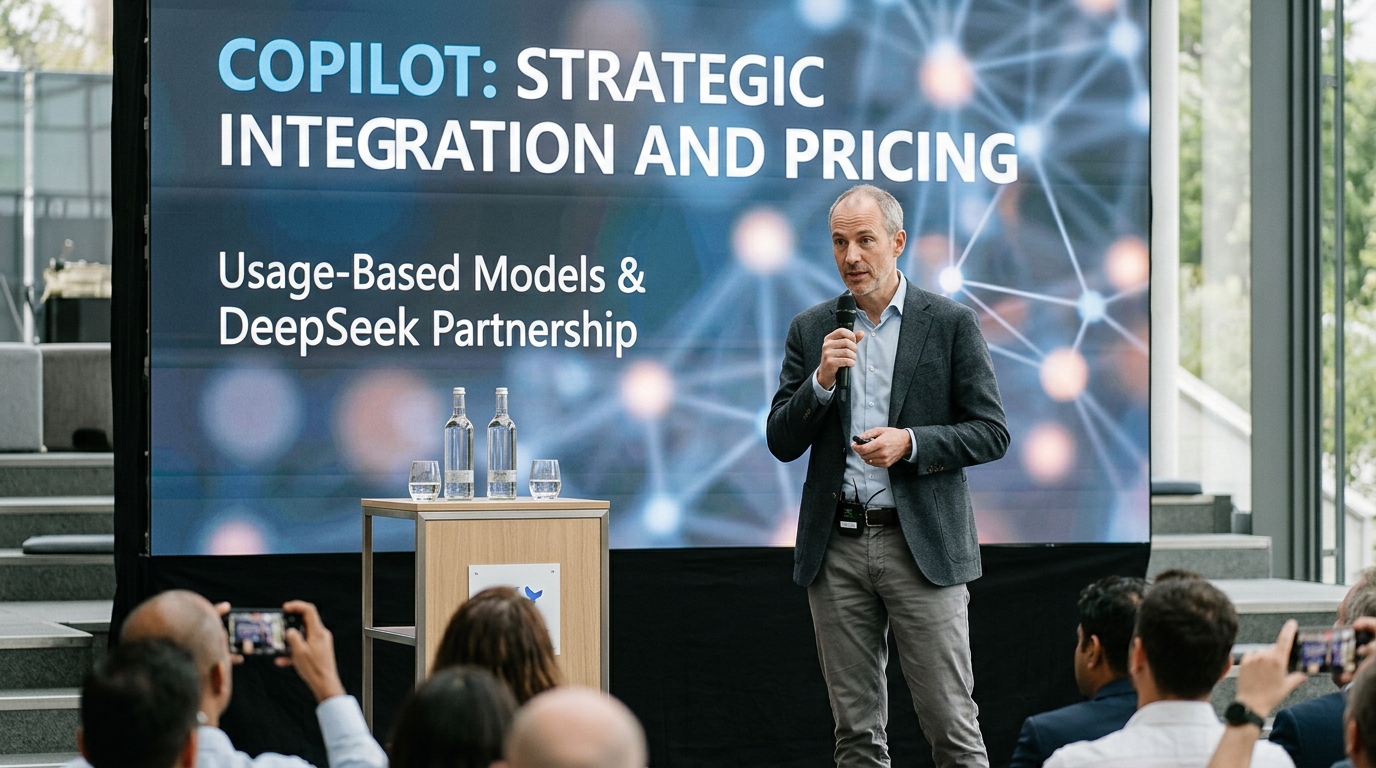
In a move that signals the end of the "unlimited" AI era for enterprises, Microsoft has announced a radical restructuring of its Copilot Cowork pricing policy. The transition from a flat monthly fee per user to a consumption-based (usage-based) model is not merely an accounting change but a strategic admission: AI inference remains a costly endeavor that demands precise resource management. Simultaneously, news that the Redmond-based tech giant is seriously considering integrating models from China's DeepSeek into its ecosystem is sending ripples through the market, raising questions about the future of its exclusive relationship with OpenAI.
The End of "All-You-Can-Eat" AI
Until recently, the $30 per user/month model was the gold standard for Microsoft 365 Copilot. However, usage patterns have proven to be extremely uneven. While some employees use AI for simple email summaries, others exhaust it on complex coding tasks and data analysis that consume massive amounts of compute power. Shifting to usage-based pricing allows Microsoft to align its revenue with the actual operational costs of its data centers.
This shift reflects a broader trend in the Software-as-a-Service (SaaS) industry. Enterprises, for their part, have been demanding greater transparency. Under the new model, organizations will pay only for the tokens they consume, allowing CFOs to exercise better control over spending, while simultaneously forcing IT managers to set strict usage caps to avoid unpleasant surprises at the end of the billing cycle.
The DeepSeek Factor: Efficiency from the East
Perhaps the most intriguing aspect of this development is the pivot toward DeepSeek's models. The Chinese AI lab has stunned the global community with models like DeepSeek-V3 and R1, which offer performance comparable to GPT-4 at a fraction of the training and inference costs. For Microsoft, adding DeepSeek to the Azure and Copilot catalog is a move of pure pragmatism.
- Operational Cost Reduction: DeepSeek's models are engineered for extreme efficiency, which could significantly boost Microsoft's margins on Copilot services.
- Model Diversification: Over-reliance on OpenAI is increasingly viewed as a strategic risk. Microsoft aims to provide a "toolbox" of models where customers choose the most cost-effective one for each specific task.
- Geopolitical Nuance: Despite ongoing US-China tensions, the adoption of high-performing open-weights models from China proves that technology knows no borders when economic superiority is at stake.
Strategic Decoupling from OpenAI?
It is becoming clear that the Microsoft-OpenAI relationship is entering a new, more complex phase. While Microsoft remains Sam Altman’s primary backer, the integration of rival models suggests that Microsoft has no intention of being held hostage by a single provider. Azure's "Model-as-a-Service" (MaaS) strategy aims to position Microsoft as the ultimate AI middleman, regardless of who builds the underlying algorithm.
"Artificial Intelligence is transforming from an exotic product into a basic commodity. In this new economy, the winner is the one who offers the best price-to-performance ratio, not necessarily the one with the most famous brand," market analysts observe.
For developers and enterprises, this evolution means more choices. They can utilize OpenAI’s high-reasoning models for mission-critical tasks and switch to DeepSeek’s more economical models for routine automation. However, challenges remain regarding data security and regulatory compliance, especially when using models originating from jurisdictions with different data protection frameworks.
Conclusion: The Realism of 2026
As we navigate through 2026, the initial AI hype is being replaced by fiscal discipline. Microsoft’s move to alter pricing and embrace DeepSeek is a response to the urgent need for sustainability. Copilot is no longer an experiment; it is a productivity tool that must prove its ROI for every dollar spent. The market is maturing, and with it, our understanding of the value of intelligence as a metered service.