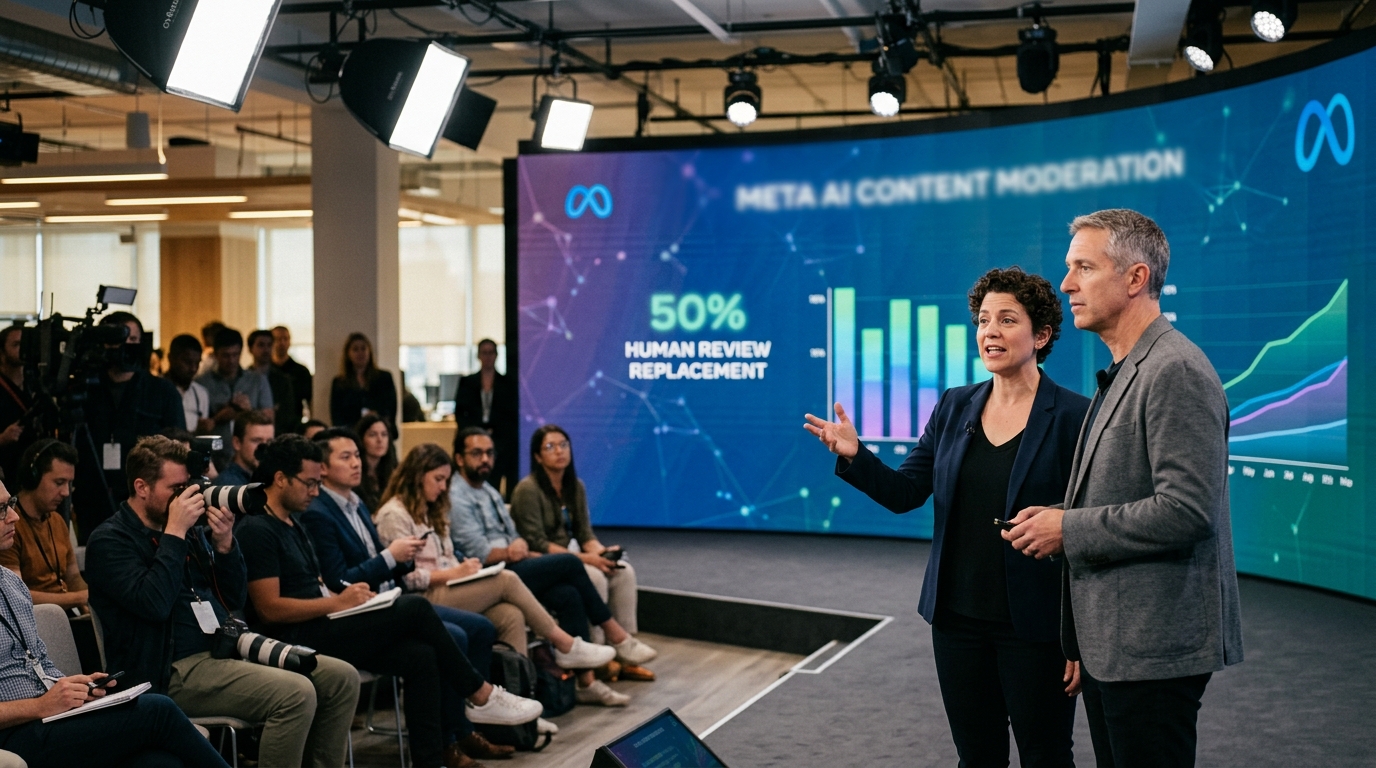
Meta, the social media titan behind Facebook, Instagram, and WhatsApp, has issued an announcement that marks the end of one era and the dawn of a fully automated reality. According to recent reports and leaked internal data, the company has successfully replaced 50% of traditional human content reviews with advanced Artificial Intelligence (AI) models. This development is not merely a technical upgrade; it is a fundamental restructuring of how "safety" is defined and enforced in the digital realm.
For years, Meta relied on an army of tens of thousands of third-party contractors—often located in low-wage regions—who spent their shifts reviewing harrowing content, ranging from hate speech to violent imagery. Today, the advent of Large Language Models (LLMs), such as the Llama 4 series, allows the company to analyze the context of posts with a level of precision that approaches, and in some cases exceeds, human judgment.
The Technological Shift: From Filters to Semantic Understanding
Traditional content moderation relied on simple classification algorithms that looked for specific keywords or visual patterns. This frequently led to errors, as irony, sarcasm, or political satire were lost in translation. Meta’s new approach utilizes "reasoning engines" capable of understanding the nuanced difference between a direct threat and a piece of artistic expression.
According to the company, the use of AI has slashed response times for user reports from hours to mere seconds. Furthermore, the ability of these models to operate across hundreds of languages simultaneously addresses the chronic shortage of moderators for rare dialects—a gap that in the past led to tragic consequences in regions like Myanmar and Ethiopia.
- Speed: Immediate removal of content that violates terms of service.
- Scalability: The ability to monitor billions of posts daily without incremental costs.
- Consistency: Elimination of the subjectivity and fatigue that plague human reviewers.
The Human Cost and "Invisible" Labor
Despite the technological advantages, this transition raises profound questions about the fate of the internet’s human gatekeepers. The 50% reduction in human reviews translates to thousands of lost jobs in hubs like Kenya, India, and the Philippines. These workers, who often suffered from Post-Traumatic Stress Disorder (PTSD) due to the nature of their work, now face unemployment without adequate social support from the corporation that employed them.
"Replacing humans with AI is not just a matter of cost; it is a matter of accountability. AI cannot feel the moral weight of a decision," argue digital rights activists.
Meta maintains that the remaining human moderators will focus on high-stakes, complex cases, such as state-sponsored propaganda and sophisticated influence operations, where human intuition remains irreplaceable. However, criticism persists: if the AI makes a mistake, who is held responsible? The "black box" nature of these algorithms makes the appeal process for users more opaque than ever.
Regulatory Scrutiny and the European Challenge
Meta’s move comes at a time when the European Union, through the Digital Services Act (DSA), demands greater transparency and accountability. The replacement of humans by algorithms must prove that it does not lead to arbitrary censorship or the strengthening of echo chambers. Meta claims its new systems are fairer, having been trained to recognize and neutralize inherent biases.
In conclusion, the acceleration of AI in content moderation is a double-edged sword. On one hand, it promises a cleaner and safer internet, free from human slowness and fatigue-induced errors. On the other, it centralizes immense power within automated systems, stripping human empathy from the digital public square. The challenge for 2026 is whether Meta can maintain the balance between profitability and social responsibility in a world governed by code.