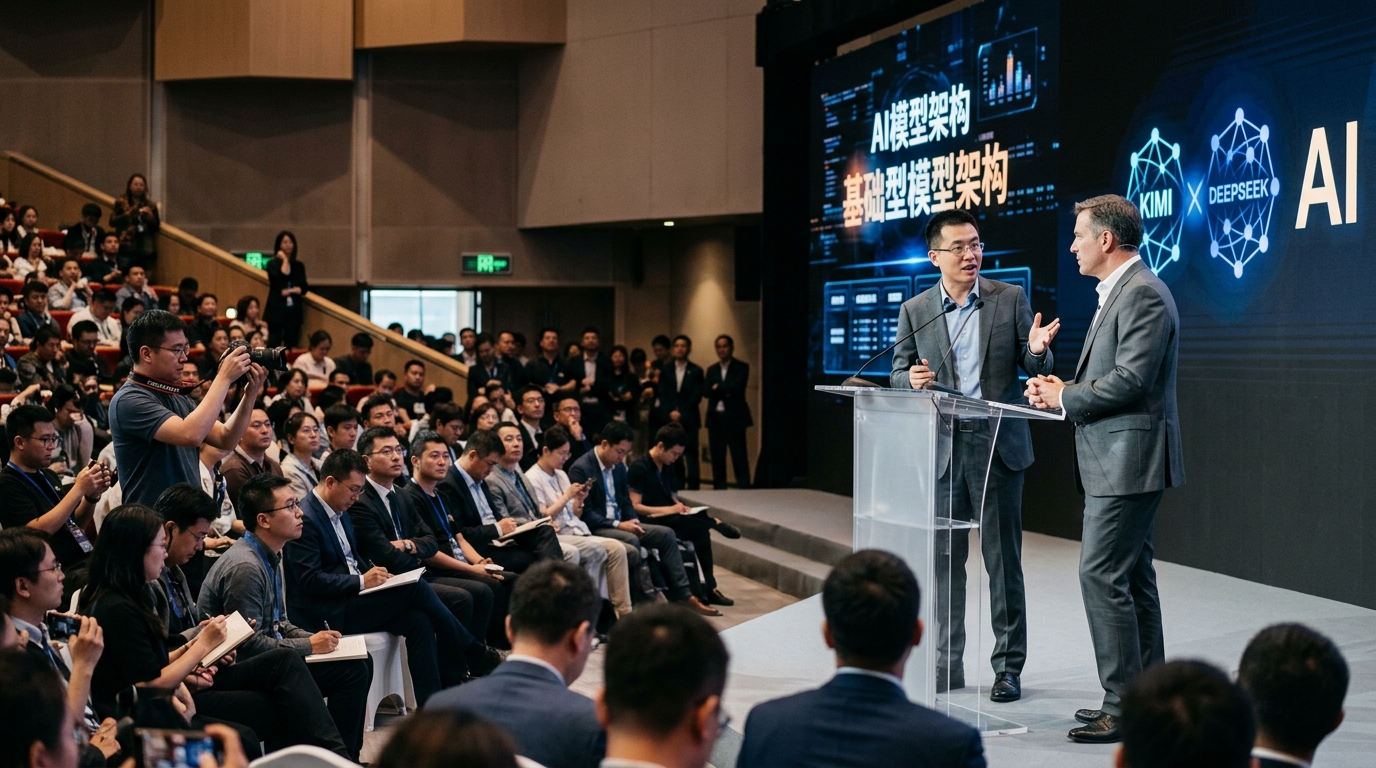
In the ever-shifting landscape of Chinese technology, the battle for AI supremacy is no longer confined to the laboratories of giants like Alibaba and Tencent. Today, the spotlight has shifted to two emerging powerhouses: Moonshot AI (creator of Kimi) and DeepSeek. As we navigate May 2026, the comparison between these two is not merely a technical standoff but a case study in the divergent philosophies that will define the next decade of the digital economy.
Kimi: The King of Content and Long Context
Moonshot AI, led by the charismatic Yang Zhilin, has captured the Chinese public's imagination with Kimi. Kimi's primary competitive edge from its inception has been its staggering 'context window.' Its ability to process millions of Chinese characters in a single prompt has made it an indispensable tool for lawyers, analysts, and students. In China, Kimi is not viewed simply as a chatbot, but as a 'digital partner' capable of assimilating entire libraries in seconds.
Moonshot's strategy is laser-focused on user experience (UX). The Kimi app is sleek, fast, and remarkably intuitive, echoing Apple’s approach to software design. Backed by billions from the likes of Alibaba and HongShan, the company has ensured its model remains at the vanguard of linguistic understanding, emphasizing high-quality training data and cultural resonance within the Chinese market. It aims for the 'white-collar' demographic, prioritizing utility over raw technical experimentation.
DeepSeek: Technical Ingenuity and Model Economics
On the opposite side, DeepSeek, emerging from the High-Flyer Quant ecosystem, follows a radically different trajectory. If Kimi is the 'poet' of AI, DeepSeek is the 'engineer.' Their approach is rooted in the Mixture of Experts (MoE) architecture, which allows models to be exceptionally efficient by utilizing only a fraction of their parameters for any given task. This translates to dramatically lower inference costs and speeds that often outpace Western rivals.
DeepSeek has earned the respect of the global developer community through its commitment to open-source (or open-weights) models. DeepSeek-Coder and its subsequent iterations have set new benchmarks for code generation, directly challenging OpenAI’s GPT-4. For enterprises looking to integrate AI into their infrastructure without spending a fortune on proprietary APIs, DeepSeek is the logical choice. Its value lies not in marketing gloss, but in raw computational prowess and efficiency.
The Clash of Values: Which One Is More Valuable?
When asking which company is more valuable, the answer depends entirely on the metric of value. If value is measured by consumer market penetration and brand recognition, Kimi takes the lead. Moonshot AI has successfully built a 'super-app' ecosystem where Kimi serves as the central pillar. Its valuation, exceeding $2.5 billion, reflects investor confidence that it can become the 'WeChat of the AI era.'
However, if value is measured by strategic autonomy and technological infrastructure, DeepSeek may hold the upper hand. In a world where NVIDIA GPUs are scarce due to US export controls, DeepSeek’s ability to train top-tier models with fewer resources is priceless. DeepSeek doesn't just sell a service; it provides the blueprint for how AI can thrive in a resource-constrained environment.
- Kimi dominates office applications and long-form document processing.
- DeepSeek leads in programming, logic, and computational efficiency.
- Moonshot AI relies on massive external funding, while DeepSeek leverages internal capital from the quant-trading sector.
- Kimi’s success is tied to user retention; DeepSeek’s success is tied to developer adoption.
Conclusion: A Bipolar Chinese AI Map
By 2026, the Chinese AI market is no longer a chaotic arena but a mature ecosystem where specialization pays off. Kimi and DeepSeek are not necessarily enemies destined to destroy one another. Instead, they represent two sides of the same coin: the human interface and the productivity engine. The true 'winner' will be the one that survives the brutal API price wars currently raging in China while maintaining innovation levels that challenge global leaders like OpenAI and Anthropic.