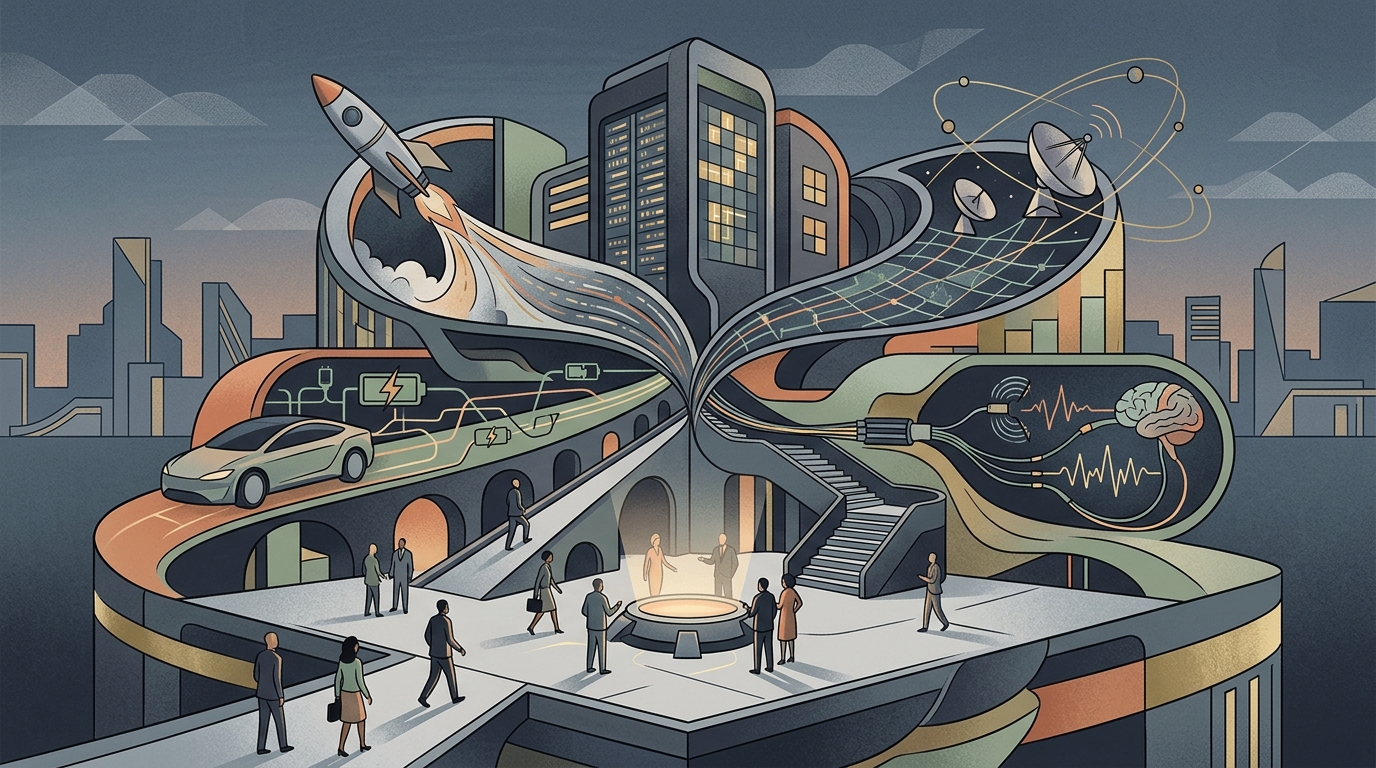
By mid-2026, the corporate landscape surrounding Elon Musk no longer resembles a collection of independent companies, but rather a massive, interdependent 'keiretsu'—a Japanese term describing a network of businesses with shared interests and tight-knit links. A recent report by Fortune AI highlights a growing trend: Musk's companies—Tesla, SpaceX, X, xAI, Neuralink, and The Boring Company—now share everything from top-tier talent and massive computing power to proprietary data and long-term strategic goals. This concentration of power under a single individual is unprecedented in modern industrial history, eliciting both awe and intense skepticism from regulators and shareholders alike.
xAI as the Connective Tissue
The creation and rapid ascent of xAI in 2024 and 2025 served as the catalyst for this new era of integration. While initially presented as an independent effort to 'understand the universe,' xAI now functions as the cognitive core behind the rest of the ventures. Tesla utilizes xAI’s large language models to accelerate its progress toward Full Self-Driving (FSD) and the development of the Optimus humanoid robot. Simultaneously, the X social media platform provides the essential real-time dataset required to train these models. This triangular relationship creates a closed-loop innovation cycle where information flows freely between entities, often bypassing the traditional 'firewalls' that should exist between a publicly traded company like Tesla and private ventures like xAI or X.
The construction of the 'Colossus' supercluster in Memphis is the most tangible example of this synergy. Featuring hundreds of thousands of Nvidia H100 and H200 chips, Colossus does not merely serve the needs of the Grok AI; it is reportedly offering compute cycles to Tesla for vision-based training. Critics argue that this reallocation of resources—including the redirection of chip shipments from Tesla to xAI—constitutes a breach of Musk’s fiduciary duty to Tesla shareholders. However, the market appears to be 'buying' Musk's vision, operating on the premise that xAI’s success is intrinsically linked to Tesla’s survival in the age of artificial intelligence.
The Migration of Talent and Technology
Another critical pillar of this integration is the fluid movement of human capital. It is no longer rare to see SpaceX engineers pivoting to Tesla to solve complex material science issues, or Tesla software engineers working on the backend infrastructure of the X platform. This 'talent liquidity' allows Musk to deploy the best minds exactly where the most pressing bottleneck exists. For instance, SpaceX’s expertise in thermal management and advanced alloys has found direct applications in the manufacturing of the Cybertruck and the structural integrity of the Optimus robot.
Furthermore, The Boring Company isn't just digging tunnels; it is building the subterranean transportation network that could serve as the exclusive testing ground for Tesla’s Robotaxi fleet. Neuralink, while still in the early stages of clinical trials, aims to create the ultimate human-machine interface, which could eventually control everything from a Tesla vehicle to a Mars-based habitat. All these pieces form a puzzle where Musk owns every stage of the value chain: from energy (Tesla Solar) and transportation to communication (Starlink) and even human consciousness.
Challenges and the Regulatory Microscope
However, this 'confederation' of companies is not without significant risk. The US Securities and Exchange Commission (SEC) and the Department of Justice are closely monitoring cross-entity transactions. The primary question remains: how are services provided by one company to another being priced? When Tesla lends engineers to X, who covers the payroll? When xAI utilizes Tesla’s proprietary data, what is the compensation? The lack of transparency in these internal dealings is a potential ticking time bomb for Tesla’s stock price, as any judicial ruling mandating a full separation of activities could disrupt the entire ecosystem.
Despite these concerns, Musk continues to push his vision of the 'Everything App' through X, which aspires to become the financial and social hub of his empire. By integrating payments and linking directly with Starlink’s satellite constellation, Musk is targeting a global infrastructure that does not depend on traditional banks or government-controlled providers. Ultimately, Musk’s empire is a high-stakes bet on his personal ability to manage chaos and synthesize disparate technologies into a future that feels more like science fiction than our current reality.