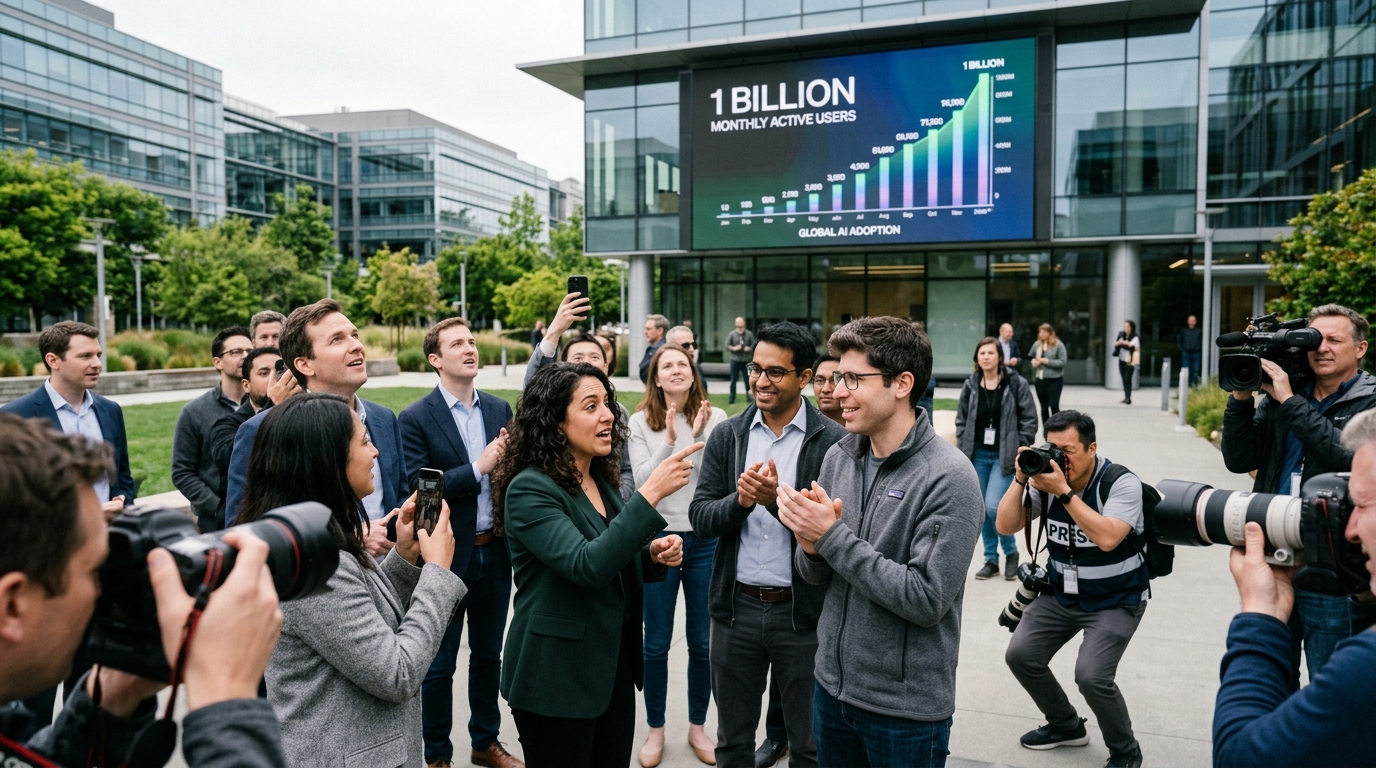
In a milestone that once felt like a scene from science fiction, OpenAI's ChatGPT has officially recorded over one billion monthly active users (MAUs). This development is not merely a corporate victory for Sam Altman’s firm; it signals humanity's transition into a new era where artificial intelligence ceases to be an experimental novelty and becomes a fundamental global utility, akin to electricity or the internet.
The ascent of ChatGPT has been the fastest in the history of technology. While it took Facebook nearly a decade to reach the billion-user mark, ChatGPT achieved it in a fraction of that time, demonstrating a global appetite for tools that enhance productivity, creativity, and problem-solving. Today, in 2026, its usage spans from students in Athens seeking help with their studies to developers in Silicon Valley and corporate executives in London.
The Strategy of Ubiquity and Daily Integration
How did we reach this astronomical figure? OpenAI's success was not built solely on the technological superiority of the GPT models but also on a brilliant integration strategy. Through partnerships with giants like Apple and Microsoft, ChatGPT became the "invisible hand" behind millions of devices. Integrating AI into smartphone operating systems made accessing artificial intelligence as simple as sending a text message.
Furthermore, the introduction of "Custom GPTs" allowed thousands of developers and companies to build specialized applications on top of OpenAI's platform. This created an ecosystem similar to Apple's App Store, where the platform's value increases exponentially with every new user and every new application. AI is no longer a website you visit; it is the environment within which you work.
Economic Implications and the Competitive Landscape
Reaching one billion users brings immense economic challenges. The cost of maintaining and operating the servers required to support such scale is staggering. OpenAI, despite revenues from Plus and Enterprise subscriptions, is in a constant race to secure capital and develop more energy-efficient models. The energy crisis and the need for sustainable development are now the primary hurdles for further expansion.
"We are no longer in the adoption phase, but in the dependency phase. When a billion people rely on an algorithm for their daily decisions, the responsibility shifts from profit to social stability," market analysts note.
At the same time, competition from Google’s Gemini and Meta’s Llama remains fierce. Google, with the advantage of Android and the Workspace ecosystem, is fighting to regain lost ground, while Meta bets on open-source software to democratize access and undermine OpenAI’s closed model. However, ChatGPT maintains the "first-mover advantage" and a brand name that has become synonymous with the category itself.
Social Concerns and the Path Ahead
The mass adoption of ChatGPT brings critical questions about information quality and human judgment to the forefront. With a billion users generating and consuming AI-created content, the risk of "digital uniformity" and hallucinations is real. Educating users in critical thinking has never been more necessary.
Looking toward the future, the question is not whether ChatGPT will continue to grow, but how it will evolve. The transition from text-based interaction to multimodal communication (real-time voice, image, and video) promises to make AI interaction even more natural. The one-billion milestone is just the beginning of a journey that will radically change how we learn, work, and communicate.
- The adoption rate of ChatGPT has surpassed any previous technological achievement.
- Integration into mobile devices and OS was the catalyst for this massive growth.
- Energy costs and sustainability remain the biggest challenges for OpenAI's scaling.
- The market is shifting from casual usage to a total dependency on AI tools.