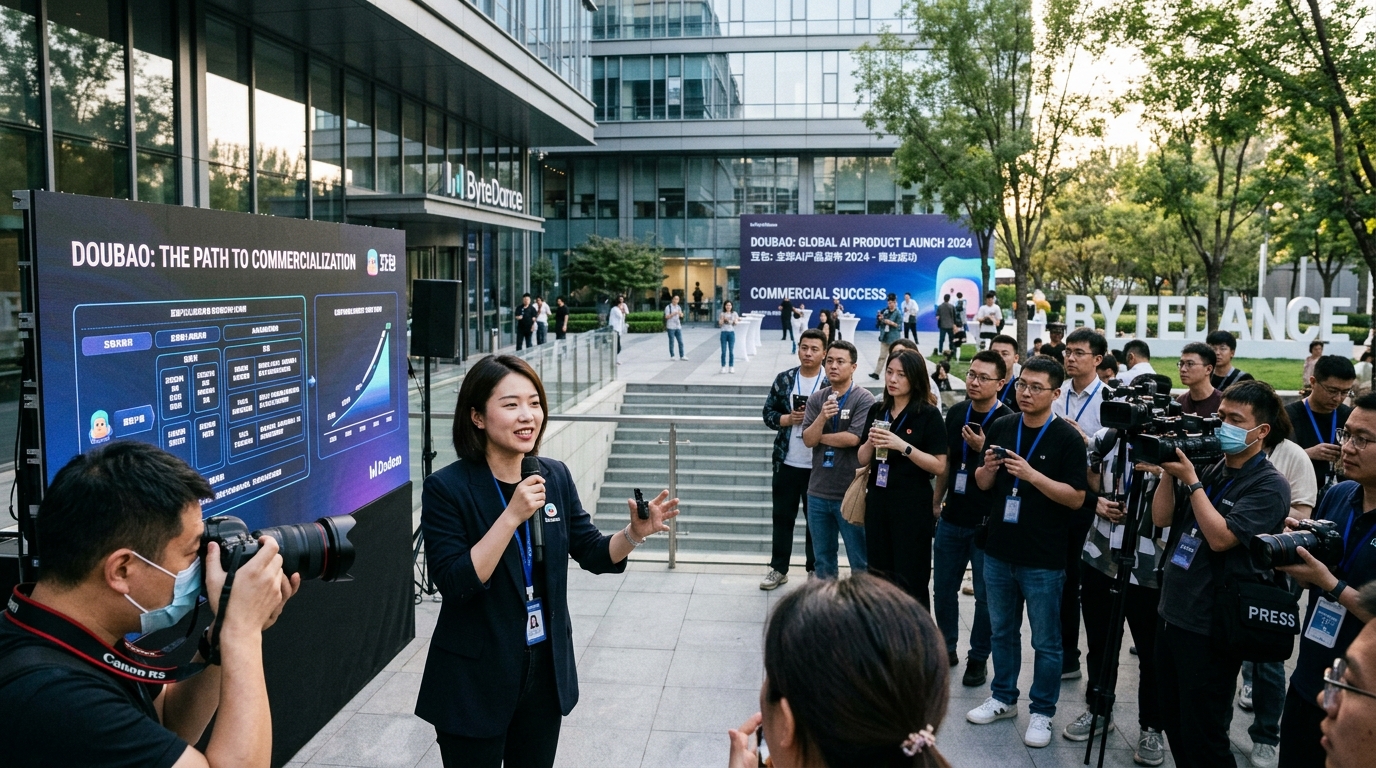
In a move that underscores the maturation of the artificial intelligence market in China, ByteDance, the parent company of TikTok, has announced the launch of a paid version for Doubao, its flagship AI assistant. This development, first reported by Caixin Global, is more than just a business decision; it is a strategic statement about the future of Generative AI in an era where computational costs and the need for sustainable revenue dominate the agenda of tech giants.
Doubao, launched last year, quickly managed to displace its competition, overtaking Baidu's Ernie Bot in downloads and active users. Its success is attributed to its seamless integration into the ByteDance ecosystem and its ability to provide a highly personalized user experience, drawing from the company's vast expertise in recommendation algorithms.
The Transition to the Freemium Model: Why Now?
ByteDance's decision to introduce a subscription model comes at a time when the AI industry is facing what many analysts call "the reality of costs." Operating Large Language Models (LLMs) requires immense resources in terms of GPUs and electricity. To date, competition in China has focused on gaining market share through free services and aggressive price cuts on APIs for businesses.
However, ByteDance appears to believe that its product has reached a level of utility that justifies a price tag. The paid version promises faster response times, priority access during peak hours, and access to more advanced models capable of handling complex tasks such as coding and large-scale data analysis. This move sets the stage for a new phase in the "AI wars," where value will be measured not just in user count, but in average revenue per user (ARPU).
Competition and the "Scorched Earth" Strategy
The AI market in China is perhaps the most competitive in the world. With players like Alibaba, Tencent, and Baidu, as well as dynamic startups like Moonshot AI, ByteDance had to move carefully. A few months ago, the company initiated a price war in cloud services (Volcengine), slashing the prices of its AI models by up to 99% for developers. This "scorched earth" strategy aimed to squeeze out smaller players who lack ByteDance's capital reserves.
- Baidu: Ernie Bot remains the primary rival, focusing more on enterprise applications.
- Alibaba: The Tongyi Qianwen model is deeply integrated into e-commerce and cloud services.
- Moonshot AI: The rising star focusing on massive context windows for long-document analysis.
The introduction of a subscription for Doubao suggests that ByteDance is confident in the "stickiness" of its user base. If users are willing to pay, it signifies that AI is no longer a novelty or a toy, but an essential productivity tool.
Geopolitical Challenges and Computational Sovereignty
No analysis of ByteDance is complete without mentioning the geopolitical context. US restrictions on the export of advanced Nvidia chips to China have forced Chinese firms to become exceptionally inventive. ByteDance has invested billions in developing its own chips and optimizing its algorithms to run efficiently on less powerful hardware.
"The shift to paid services is also a way to manage limited computational resources. By setting a price, the company ensures that precious processing power is allocated to the users who provide the highest economic value," notes a Beijing-based market analyst.
In conclusion, ByteDance's move with Doubao serves as a litmus test for the entire Chinese AI industry. If the experiment succeeds, we will see a rapid shift toward monetization across the sector. If it fails, it will raise serious questions about whether Generative AI can ever become a truly profitable business without the subsidies of parent conglomerates.