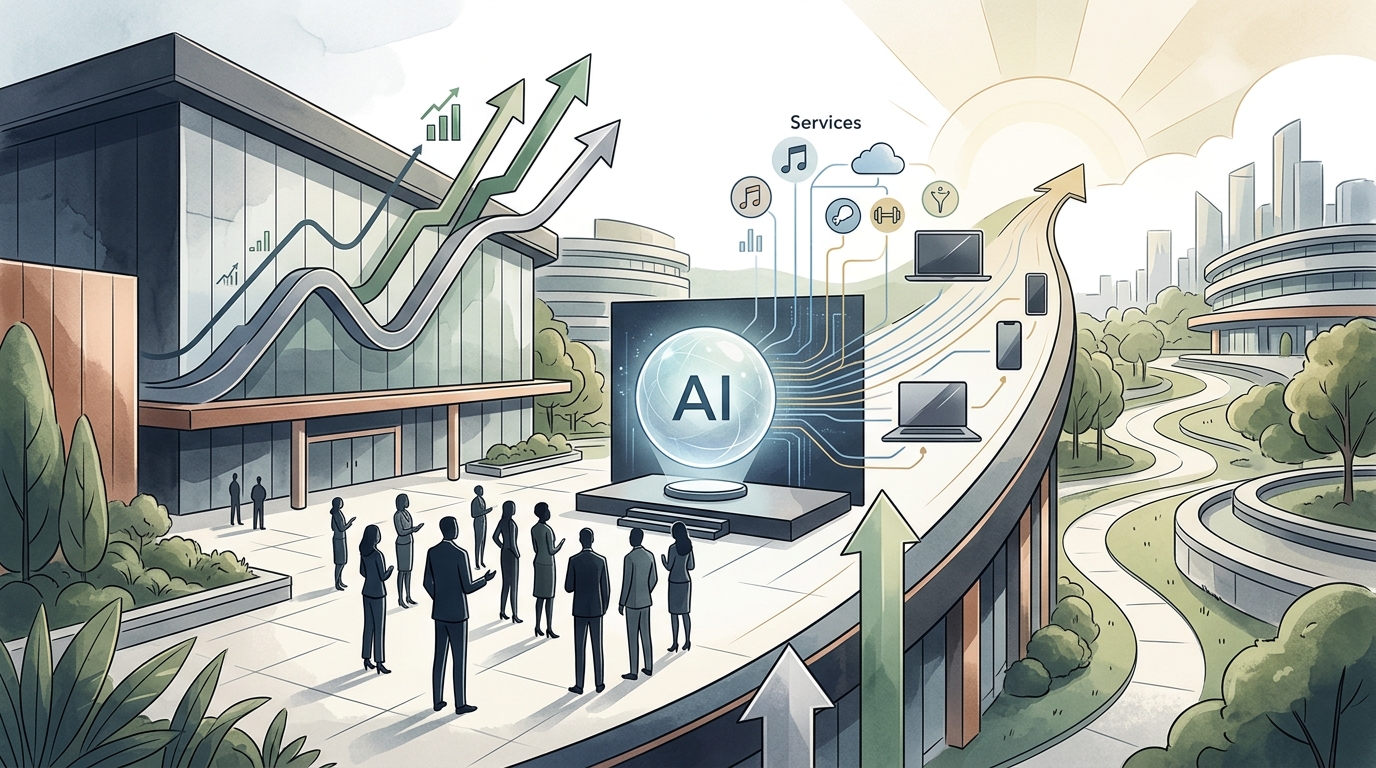
In a period where the global tech landscape oscillates between AI euphoria and geopolitical uncertainty, Apple has once again demonstrated why it remains the undisputed trendsetter of the market. The announcement of its Q3 2026 forecast was not merely a financial update; it was a statement of power. With expected revenue growth ranging between 14% and 17%, the Cupertino giant surpassed Wall Street analysts' expectations, sending a resounding message of confidence to investors.
The AI Catalyst
The driving force behind this optimism is none other than Apple Intelligence. As we move through 2026, the integration of advanced AI models directly into hardware (on-device AI) has transitioned from a luxury to a necessity for the average consumer. Apple has successfully convinced its user base that upgrading to newer iPhone and Mac models is no longer just about the camera or speed, but about accessing a personal, secure, and highly intelligent digital ecosystem.
According to Bloomberg Intelligence's Matthew Bloxham, Apple's ability to maintain high margins while investing billions in AI infrastructure is remarkable. "We are seeing a device refresh cycle unlike anything since the introduction of 5G," market analysts note. The company's strategy of controlling both the software and its own silicon (Apple Silicon) gives it an almost unfair advantage over competitors who rely on third-party providers for their AI capabilities.
Supply Chain Challenges: The Memory Thorn
However, the road to the top is not without obstacles. Apple management explicitly warned that the cost of memory chips (NAND and DRAM) is expected to rise significantly in the coming months. This increase is driven by global demand for AI data centers, which consume vast amounts of memory, leaving consumer electronics manufacturers in a constant battle for inventory.
Furthermore, shortages in Mac computers appear set to persist. Demand for new models featuring M5 processors has exceeded all expectations, resulting in lengthened delivery times. "The demand is there, but the physical reality of production remains constrained," a company executive stated. This creates a paradox: Apple has the products the world wants, but is struggling to place them on shelves fast enough.
"Apple is no longer just selling devices; it is selling the ticket to the next phase of human productivity through AI. And consumers seem willing to pay the price."
Services: The Silent Goldmine
While hardware always steals the show, the Services sector continues to be the steady foundation of profitability. With over 1.5 billion active subscriptions, the App Store, iCloud, and Apple Music/TV+ services provide recurring revenue with profit margins reaching 75%. The integration of subscription-based AI models within applications (AI-as-a-Service) is expected to further bolster this sector.
The geopolitical dimension also remains at the forefront. Despite tensions between the US and China, sales in the Greater China region showed signs of recovery, debunking fears of a permanent loss of market share to domestic players like Huawei. At the same time, aggressive expansion in India, both as a production base and a market, is beginning to bear fruit, offering much-needed diversification from Chinese dependency.
Conclusion: A Company in Constant Transformation
The 14-17% growth forecast is not just a number; it is confirmation that Apple has successfully navigated the transition into the AI era. Despite increased component costs and production difficulties, brand strength and ecosystem loyalty allow it to maintain its dominance. The question for the remainder of 2026 is not whether Apple will grow, but whether the global supply chain can finally keep up with its pace.