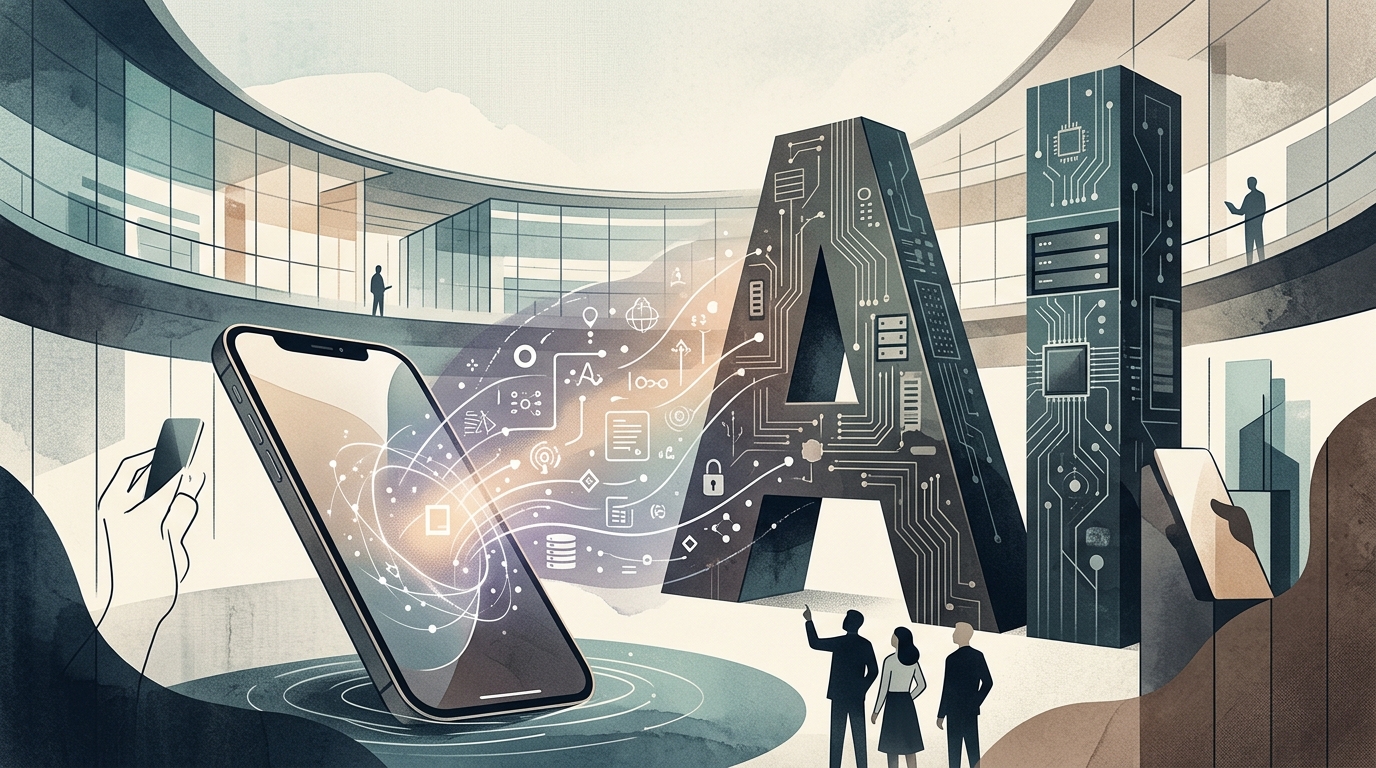
In the fluid landscape of the tech industry, Apple typically follows a strategy of "controlled anticipation." While Silicon Valley was ablaze with the fever of Large Language Models (LLMs) as early as 2023, the Cupertino giant chose to remain silent, preparing its move with characteristic meticulousness. Today, in mid-2026, Apple Intelligence is no longer a promise but a reality reshaping our relationship with the iPhone and, by extension, the balance of power in the global AI market.
The Strategy of "Quiet Power" and Privacy Protection
Apple's approach to AI differs radically from that of Google, Microsoft, or OpenAI. While its competitors rely on massive server clusters in the cloud to process user data, Apple has prioritized on-device processing. This was made possible by the vertical integration of hardware and software, with the A-series and M-series chips now featuring Neural Engines capable of running billions of parameters locally on the device.
Apple Intelligence introduced the concept of "Private Cloud Compute." When a task requires more computational power than the iPhone can provide, the device communicates with specially configured servers running on Apple Silicon, ensuring that data is never stored and is inaccessible even to Apple itself. This commitment to privacy is not just a moral advantage but a powerful commercial weapon against companies whose business models rely on data collection for advertising purposes.
Siri 2.0: From Misunderstanding to Real Assistance
For years, Siri was the subject of ridicule in the tech community due to its limited capabilities. With the integration of generative AI, Siri has been transformed into a true personal assistant with "context awareness." Now, Siri can understand complex commands involving different applications: "Find the email George sent me about the contract and summarize the main points in a message to the team on Slack."
This ability to act within the app ecosystem (App Intents) is what gives Apple the edge. While ChatGPT remains an excellent text interface, Apple Intelligence is integrated into the operating system. It has access to your photos, your calendar, your messages, and your notes, acting as a digital secretary that knows everything about you without "telling" your secrets to third parties.
Competition and Shifting Balances
Apple's move to initially partner with OpenAI to integrate ChatGPT as an optional feature, and subsequently develop its own models, shows a flexibility many did not expect. Google, with Gemini, is trying to respond through Pixel devices, but Apple holds the advantage of a massive user base willing to pay for premium devices. Microsoft, on the other hand, dominates the corporate sector, but the iPhone remains the primary personal device for most of the Western world.
The question now is whether Apple can maintain this pace of innovation. Artificial intelligence requires vast resources and continuous model training. However, Apple has a unique advantage: data derived from the actual use of its devices, which it uses to optimize user experiences without violating anonymity. This creates a "virtuous cycle" of improvement that is difficult to replicate.
The Ecosystem as a Fortress: Why Apple Wins
Apple's success in AI is based not only on technology but on the ecosystem. When you buy an iPhone, you buy access to a seamless experience that extends to the Mac, iPad, and Apple Watch. Apple's AI "travels" with you. A text summary started on the iPhone is available on your MacBook via iCloud, with the same security and speed.
Furthermore, Apple has managed to turn AI into a feature that "just works." Users don't need to know what a Large Language Model is or how a diffusion model works to create a Genmoji or clean a photo of unwanted objects. Simplifying technology has always been Apple's greatest strength, and in the age of AI, this ability is more valuable than ever. The threat to other giants is clear: Apple is not trying to build the best AI in the world, but the most useful AI for humans.