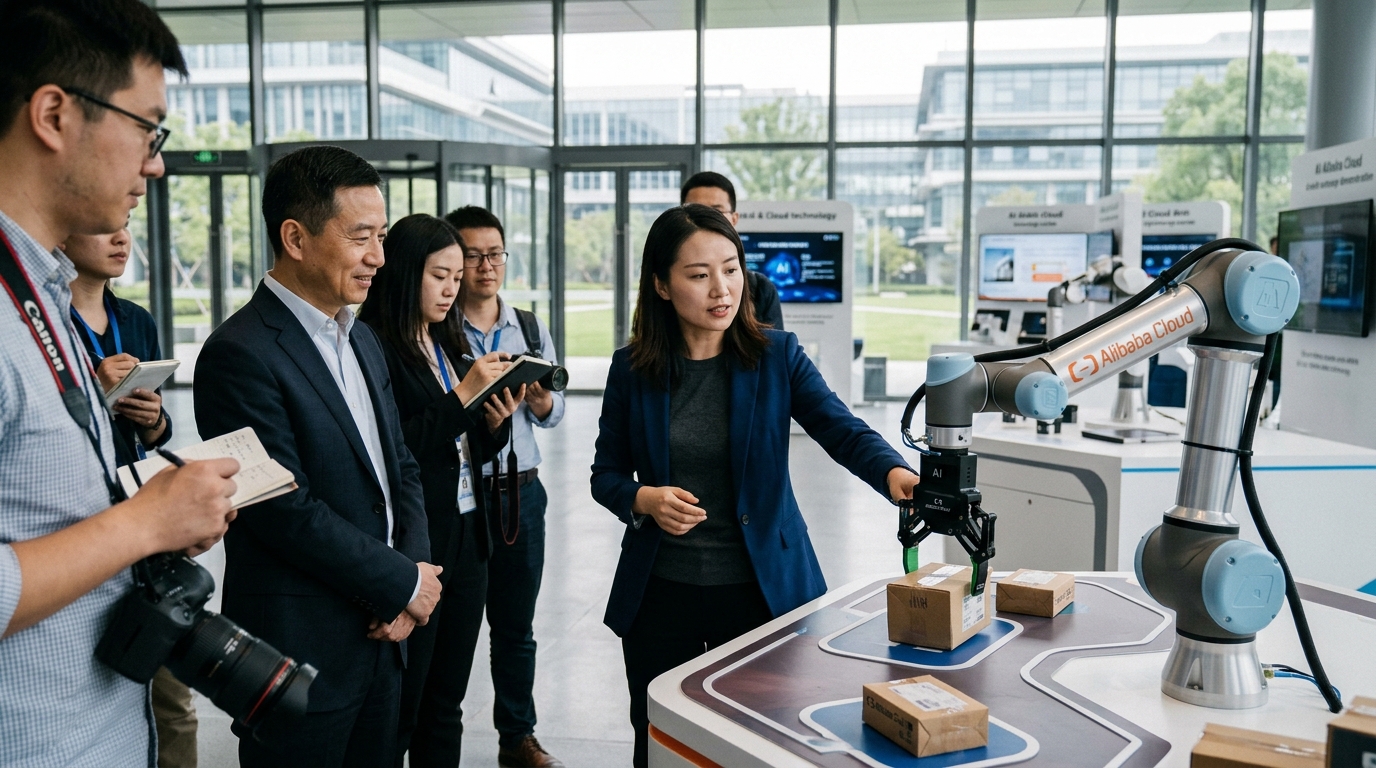
In the heart of Hangzhou, Alibaba’s vision for the future of global commerce is undergoing a radical transformation. As we navigate through May 2026, the Chinese giant no longer defines itself merely as an e-commerce platform, but as an “AI-first” entity. The company’s recent push into artificial intelligence and robotics is not just a technological upgrade; it is a strategic survival maneuver against domestic competition from PDD Holdings and international pressure from Amazon.
The Strategic Pivot to Generative AI
Alibaba has integrated its proprietary large language model, Tongyi Qianwen, across its entire ecosystem. For merchants on Taobao and Tmall, AI is no longer an abstract concept but a daily utility. From automated product description generation and marketing videos to real-time personalized customer service, AI is drastically reducing operational costs. According to analysts, the use of these tools has increased conversion rates by 15-20% for small and medium-sized merchants, providing them with capabilities previously reserved for large multinationals.
However, the challenge remains scaling these solutions globally. AliExpress, the group's international arm, now utilizes AI for automated translation and localization of listings in dozens of languages, accounting for local cultural nuances. This “cultural intelligence” of the algorithms is what gives Alibaba an edge in its quest to conquer markets in Europe and Southeast Asia.
Robotics and Logistics: The Cainiao Backbone
Parallel to software, Alibaba is investing billions in hardware. Its logistics subsidiary, Cainiao, has deployed a fleet of thousands of autonomous delivery vehicles, known as “Xiaomanlv.” These robots have already completed millions of deliveries across campuses and residential complexes in China, reducing last-mile delivery costs by 30%. The next phase involves the full automation of warehouses with AI-guided robotic arms capable of handling millions of parcels a day with minimal human intervention.
The integration of robotics is not limited to transport. Alibaba is experimenting with robotic systems in its Freshippo physical stores, where order preparation is almost entirely mechanized. This convergence of the physical and digital worlds represents the “holy grail” of New Retail, and Alibaba appears to be holding the reins of innovation in this sector.
The Valuation Paradox and the “China Discount”
While Alibaba’s technological progress is undeniable, its stock market valuation tells a different story. The stock trades at earnings multiples reminiscent of utility companies rather than tech giants. This “China Discount” is driven by a combination of factors: geopolitical tensions between the US and China, export restrictions on advanced semiconductors, and uncertainty surrounding the regulatory landscape in Beijing.
“The market is punishing Alibaba not for its lack of innovation, but for its geography,” notes a prominent market analyst.
The company has responded with aggressive share buyback programs and dividend payments, attempting to convince investors of its intrinsic value. Yet, as long as the specter of sanctions and trade wars remains, the gap between the true value of its AI assets and its share price remains vast. Alibaba’s AI success will ultimately depend on whether it can decouple from the image of an “old” Chinese platform and be recognized as a global leader in artificial intelligence.
Conclusion: A High-Stakes Bet
The Alibaba of 2026 is a company in transition. The push into AI and robotics is impressive in both scale and execution. If investors begin to look past geopolitical risks, the current valuation could prove to be one of the greatest investment opportunities of the decade. However, on the global chessboard, technology is often a hostage to politics, and Alibaba must navigate these turbulent waters with extreme caution.