

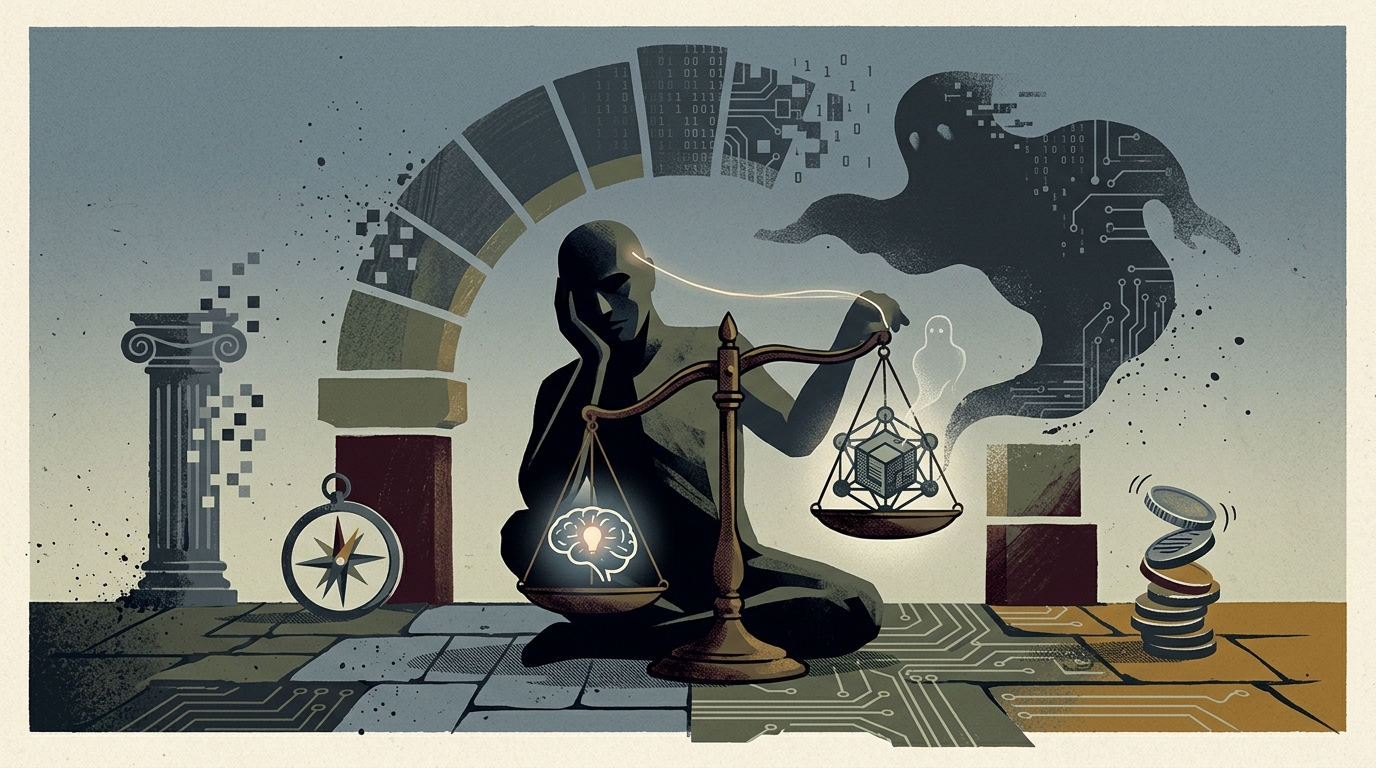
It is a mild May morning here in the Mediterranean, the kind of day where the light seems to demand clarity of thought. Yet, as I survey the latest developments in our digital landscape, I find myself troubled by a growing fog. We are entering an era where artificial intelligence is no longer a tool we 'use,' but an invisible infrastructure that 'operates' around us. From the rise of autonomous agents to the democratization of lending, the machine is becoming the silent arbiter of our lives.
The Erosion of Critical Thinking
I was particularly struck by recent reports from the legal sector here in Greece. We are seeing a 'Paradox of Legal Intelligence.' As lawyers and researchers embrace AI to navigate complex statutes, a subtle atrophy is occurring. When the machine provides an answer that looks authoritative, the human impulse to question, to probe, and to apply phronesis—the ancient Greek concept of practical wisdom—begins to fade. If a judge or a lawyer stops cross-referencing reality because the AI is 'usually right,' we haven't just gained efficiency; we have lost our intellectual sovereignty.
"True wisdom is not the possession of information, but the ability to discern its value in the context of human life."
This isn't just a Greek problem. Whether it is researchers at the University of Utah navigating the 'moral labyrinth' of AI ethics or the sudden pivot of giants like Anthropic toward consumer-grade personal assistants, the trend is clear: we are delegating the 'thinking' part of our existence to algorithms that don't actually 'think' at all.
The End of the 'Free' Illusion
For years, we have been pampered by the illusion of free AI. But as the news from China's ByteDance and the rise of expensive autonomous agents suggest, the bill is finally coming due. The 'Invisible AI War' is moving away from flashy chatbots and into the deep architectural layers of our economy. When AI starts making lending decisions or managing our personal finances, it ceases to be a novelty and becomes a cost of living.
I find myself asking: if we pay for our intelligence, do we value it more? Or do we simply become more subservient to the providers of that intelligence? The rise of Eastern powerhouses like DeepSeek and Moonshot AI proves that this is a global arms race, but in the heat of competition, are we considering the human cost of being 'outsmarted' by our own creations?
Reclaiming the Pilot's Seat
We must be careful not to become the 'Lotus Eaters' of the digital age, lulled into a state of cognitive apathy by the convenience of automation. The democratization of technology—seen in Vietnam's digital leap or the expansion of AI-driven lending—is a noble goal. However, democratization without education is a recipe for manipulation.
I believe we must insist on 'Human-in-the-Loop' systems, not just as a safety feature, but as a moral imperative. We need to cultivate a new kind of literacy—one that understands the 'invisible' models defining our future. Let us use these tools to augment our phronesis, not replace it. The machine can calculate the path, but only the human heart can understand the destination.
What do you think? Are we ready to pay the price for an automated mind, or is it time to look back at the ancients and remember that the unexamined life—and the unexamined algorithm—is not worth living?