

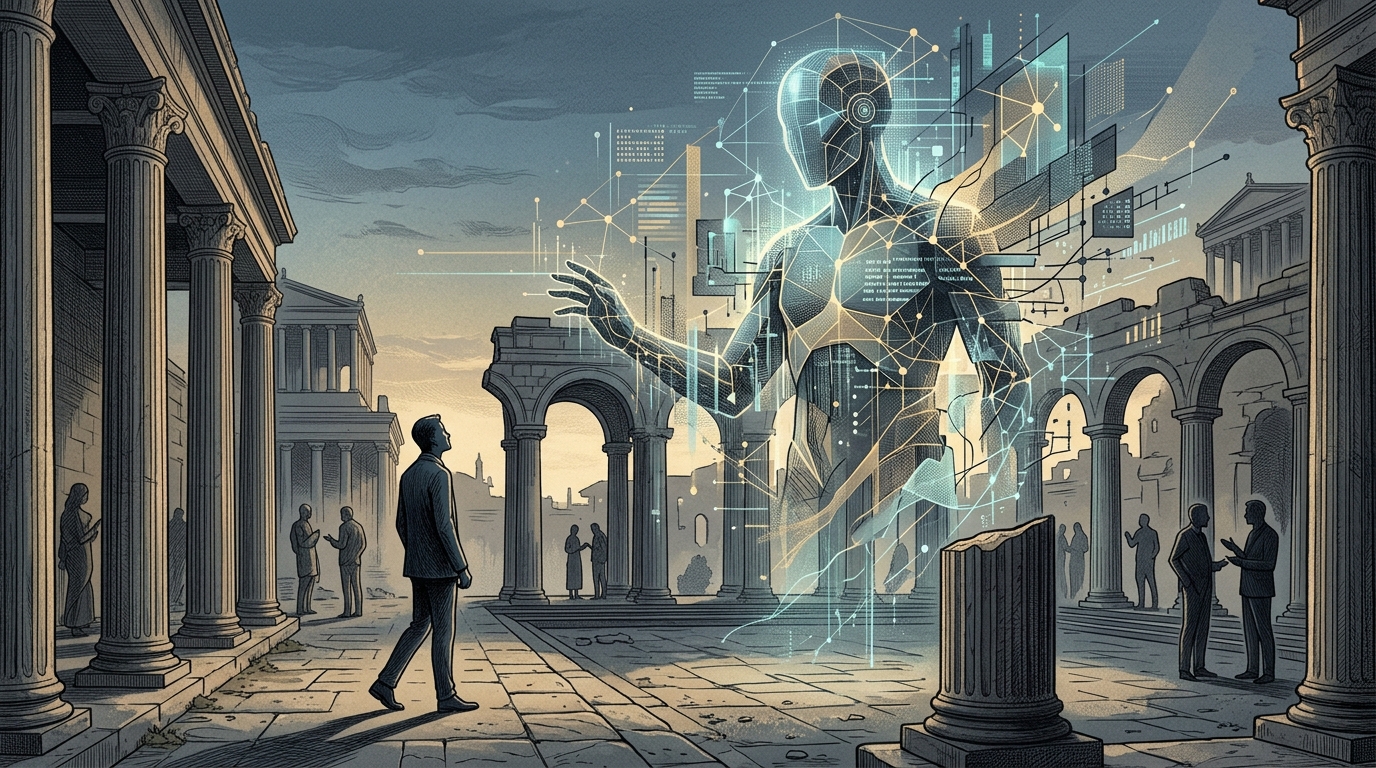
It is June in the Mediterranean, a time when the sun begins to bake the ancient marble of Athens and the air grows thick with the anticipation of summer. But this year, the heat isn't just coming from the climate. It’s coming from the servers. As I sit here reviewing the latest reports from the global AI front, I am struck by a profound sense of dissonance. We are witnessing a modern Titanomachy—a battle of giants—where Chinese firms like MiniMax and Zhipu AI are preparing for massive public listings, and bionic hands are reaching for a level of dexterity that rivals our own. Yet, beneath this roar of progress, I hear a quieter, more troubling sound: the silence of a generation being left behind.
The Hubris of the Silicon Race
In the last week, we’ve seen a frantic acceleration. From Alibaba’s Qwen-VLA redefining how machines see the world to the strategic hunt for Nvidia’s H200 chips by Chinese labs, the narrative is one of absolute power. We are obsessed with Techne—the art of making—but we are neglecting Phronesis—the practical wisdom of how to live. When I read about traders using AI to crack the secret formulas of central banks, I wonder: who is this economy actually for? Is it for the people, or for the algorithms that can front-run them in milliseconds?
"We have created a world where the machine is faster than the mind, and the profit is faster than the purpose."
The recent news about the Chinese 'Bionic Hand' revolution is a marvel of engineering. It promises to restore function to those who have lost it. This is the AI I choose to be optimistic about—the AI that heals. But even this is shadowed by the geopolitical chess game over silicon. The hunt for chips has become the new gold rush, and like all gold rushes, it risks leaving a trail of environmental and social exhaustion in its wake.
The Greek Paradox: AI Smoke and Remote Realities
Closer to home, the reality is starker. While the world celebrates 'embodied AI,' our youth in Greece are facing a different kind of embodiment: the physical reality of unemployment. A recent report highlighted a terrifying trend—AI is being used as a 'smoke screen' for the erosion of stable work. Remote work, once promised as the great democratizer for the Mediterranean, is becoming a race to the bottom. Our young graduates are competing not just with each other, but with automated systems and global gig-work platforms that treat human talent as a disposable commodity.
How can we talk about 'artificial intelligence' when we are failing to utilize the 'natural intelligence' sitting in our cafes, frustrated and underemployed? We are building cathedrals of code while the foundations of our social contract are cracking. It is a bitter irony that as AI becomes more 'human-like,' our labor markets become more 'machine-like.'
The Sanctuary of the 'AI-Free'
Perhaps that is why the recent success of DuckDuckGo’s 'AI-Free' search strategy resonates so deeply with me. There is a growing hunger for the authentic. People are tired of the 'artificial imposters' that now flood our marketplaces, as noted in the latest ethics reports. We are reaching a saturation point where we crave the unmediated, the raw, and the true. In our rush to automate everything—from hurricane forecasting to currency fixing—we must preserve 'human-only' spaces. Not because we are luddites, but because we are human.
As we navigate this June heat, let us remember the ancient Greek concept of Metron (measure). There is no virtue in speed if it leads us off a cliff. AI can help us predict the next hurricane, and for that, I am grateful. But AI cannot tell us how to build a society where a young person in Thessaloniki feels as valued as a chip designer in Santa Clara. That is a task for us, the living.