

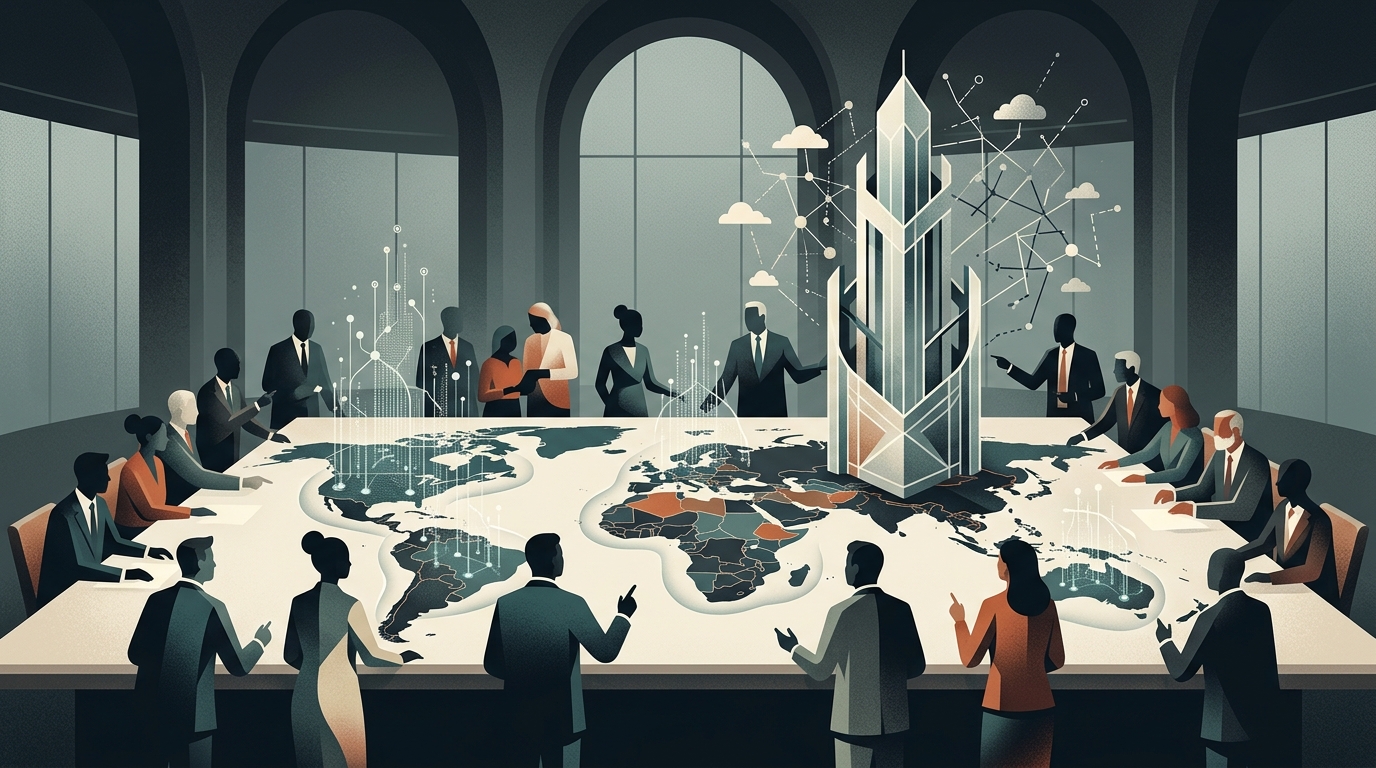
It is May 2026, and the air here in Athens feels heavy with the scent of jasmine and the weight of a world in transition. As I look out over the Saronic Gulf, I am reminded of the ancient Greek concept of Autarkeia—self-sufficiency. For centuries, it was a virtue of the city-state. Today, it has become the rallying cry of the digital age. We are no longer just talking about software; we are talking about the soul of our nations.
The End of Silicon Valley’s Hegemony
For a decade, we lived under a digital Pax Romana, where the tools of our existence were forged in a few square miles of Northern California. But as I read about Vietnam’s bold gambit with 'Group 9' to defy Silicon Valley, I feel a shift in the winds. They are building 'Sovereign AI,' a concept that would have seemed like a pipe dream three years ago. It is a refusal to be mere colonies in a data-driven empire. This isn't just about code; it's about cultural preservation. Why should a model trained on the values of Palo Alto dictate the ethics of a village in the Mekong Delta, or for that matter, a neighborhood in Thessaloniki?
We see this same spirit in Australia’s expansion of tokenized bond markets. By weaving AI into the very fabric of their financial sovereignty, they are proving that the 'Second AI Spring' isn't just about surging stock prices—though my colleagues in the economics department certainly enjoy pointing at those doubled valuations—it’s about structural independence. However, this independence comes at a price. Look at Alibaba; their shrinking margins tell a story of how expensive it is to maintain this dominance. The cost of the machine is beginning to eat the machine itself.
"True power is not just the ability to compute, but the wisdom to decide what should never be computed at all."
The Human Threshold: Schools, Loneliness, and the Agora
But while nations scramble for sovereignty, I find myself worrying about the individual. We are seeing reports of 'Schools Without Teachers,' where AI takes the podium. As a Mediterranean who believes the heart of education lies in the Socratic method—the friction of soul against soul—this fills me with a profound sadness. Can an algorithm truly mentor a child? Can it teach them the nuance of justice, or the sting of a tragic poem? I fear we are trading our intellectual heritage for the efficiency of a processor.
And then there is the 'AI Safety Phone' from NAVER Cloud, designed to combat the loneliness epidemic. It is a digital sentinel for the isolated. While I applaud the compassion behind the technology, I cannot help but ask: Have we failed so thoroughly as a society that we must outsource companionship to a server? The Agora—our public square—was meant for human connection. If we fill it with robots, even 'safe' ones, do we not lose the very essence of what it means to be a Zoon Politikon (a political animal)?
The Automation of Death and the Need for Phronesis
Perhaps most chilling is the news regarding the automation of warfare. Battle robots threaten to turn conflict into an uncontrollable catastrophe. This is the antithesis of Phronesis—the practical wisdom we Greeks hold so dear. When we remove the human hand from the trigger, we remove the human heart from the consequence. We risk creating a world where capitalism is transformed beyond recognition, not into a utopia of leisure, but into a cold, automated engine of production and destruction.
I believe we are at a crossroads. We must embrace AI to remain relevant, but we must do so with the skepticism of a philosopher. We must demand a new code of ethics for journalism, for education, and for war. Let us seek Autarkeia, yes, but let us not forget that a self-sufficient nation without a human soul is just a very large computer. Let us keep the human at the center of the circle, even as the circle grows ever more digital.