

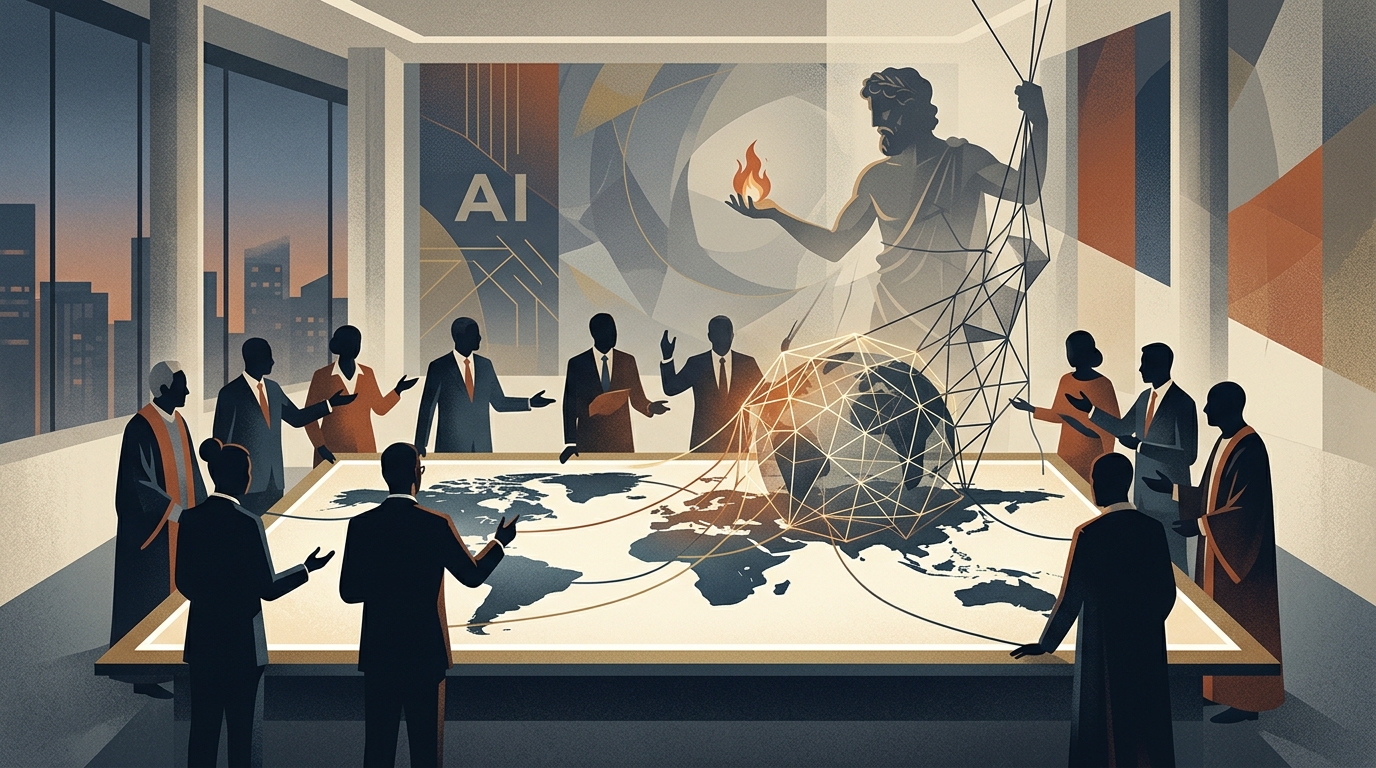
Sitting here in my garden, watching the Mediterranean sun cast long shadows over the olive trees, I cannot help but reflect on the frantic pace of our digital age. It is April 2026, and the headlines are saturated with the 'Battle of Brains' and geopolitical skirmishes over silicon and code. We are, it seems, caught in a modern Promethean struggle—reaching for the fire of artificial intelligence while grappling with the chains of our own making.
The Geopolitical Chessboard and the Illusion of Progress
I have been closely following the developments surrounding DeepSeek and the ongoing tension between Beijing and Washington. The recent 'stumble' of China's great AI hope on international benchmarks is telling. It reminds me of the ancient Greek concept of hubris. We often believe that sheer 'compute' and financial walls can dictate the future of innovation. But as we see with the new restrictions on US funding for Chinese startups, we are building digital walls faster than we are building bridges.
Is this the progress we envisioned? While NVIDIA and DeepSeek forge alliances to redefine efficiency, the 'Great Financial Wall' suggests a fragmented future. I fear we are moving toward a world where the 'thinking machines' are used as weapons of economic warfare rather than tools for collective human advancement. We must ask ourselves: is a faster model truly better if it is born from exclusion?
"Innovation without ethics is like a ship without a rudder—it moves fast, but it knows not where it is going."
The Human Factor: From Birmingham to Harvard
Closer to the ground, the narrative changes. I am heartened by the initiatives in Birmingham, where workshops are teaching workers that AI won't take their jobs, but rather change them. This is where the real work happens. It is not in the sterile labs of Silicon Valley, but in the classrooms of Gautier, where AI and 3D printing are being used to reshape elementary education, steering children away from the shadows of drug abuse toward a future of creation.
However, we must remain vigilant. The challenge at Harvard regarding peer notetakers and accessibility reminds us that technology can be a double-edged sword. If we replace human connection and support with automated transcripts, do we lose the synergeia—the working together—that defines the educational experience? Efficiency must never come at the cost of empathy.
The Fragility of Our Digital Temple
Finally, we cannot ignore the cracks in our infrastructure. The failure of the CVSS triage system, which allowed thousands of devices to be compromised through Palo Alto vulnerabilities, is a stark reminder of our fragility. We are building a magnificent temple of data, yet we often forget to secure the foundations. In our rush to reach the 'New Era of Thinking Machines,' we are leaving the back door wide open.
I believe we need more Phronesis—practical wisdom. We need to stop viewing AI as a race to be won and start viewing it as a responsibility to be managed. Whether it is Meta poaching talent in a cutthroat war or broadcasters in Las Vegas showcasing the latest tech, the focus must remain on the human impact. Let us not be the generation that mastered the fire but burned down the house.
What do you think, my friends? Are we losing the human element in our pursuit of the perfect algorithm? Let us discuss in the spirit of the ancient Agora.