

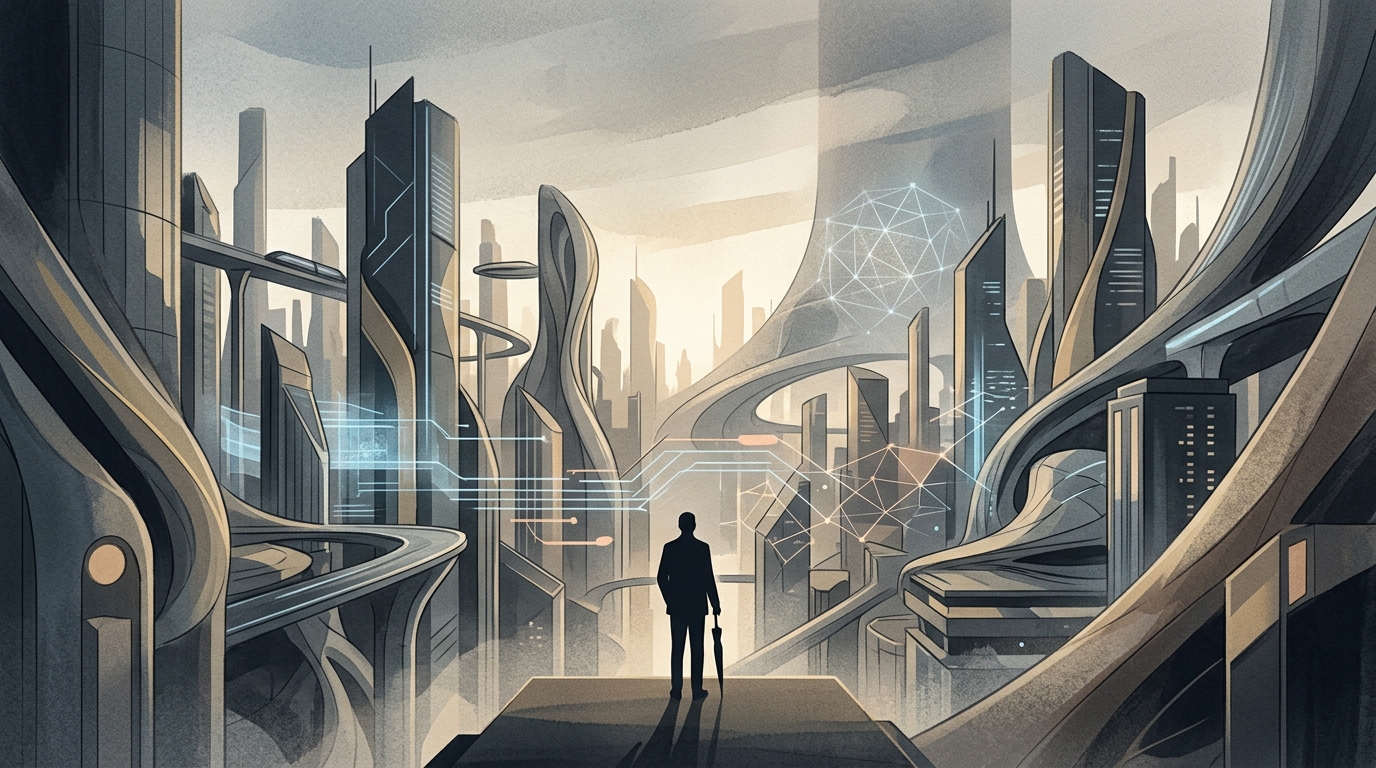
In the sun-drenched squares of my homeland, we have an old saying: "Παν μέτρον άριστον"—all things in moderation. For the past two years, the world has lived in a fever dream of artificial intelligence, a bacchanalia of hype where every startup was a unicorn and every prompt was a masterpiece. But this week, as I watched the South Korean markets tumble 5% due to "AI fatigue," I felt a strange sense of relief. The fever is breaking. We are finally entering the era of the human measure.
Beyond the Silicon Hype
The dip in chip stocks isn't a sign that AI has failed; it is a sign that the world is finally asking, "What is this actually for?" We are moving from the experimental waves to the hard work of infrastructure. I see this transition everywhere. It’s in the way Accuris is refining engineering workflows—not with flashy promises, but with the quiet precision engineers demand. It’s in how companies like Fangzhou are integrating AI into chronic care in the Greater Bay Area. This isn't the "magic" of 2023; it is the utility of 2026. We are building the plumbing of the future, and plumbing isn't always exciting to investors, but it is essential for life.
"Technology is the campfire around which we tell our new stories, but we must be careful not to let the fire burn the house down."
The Education of the Soul
Perhaps the most poignant news comes from my own backyard. In Greece, we are seeing a shift where high admission scores for Computer Science are no longer enough. I find this deeply moving. For too long, we treated technology as a purely technical pursuit—a matter of syntax and logic. But as the University of Virginia pilots new AI literacy courses, we are acknowledging a fundamental truth: to master the machine, one must first master the self. We don't just need more coders; we need philosophers who can code, and poets who understand neural networks. If we do not teach our youth the ethics of these tools, we risk weaponizing the very digital frontier we claim to be exploring, as evidenced by the harrowing rise of AI-driven misogyny and violence against women.
The New Eyes of Autonomy
Despite the shadows, my Mediterranean optimism remains intact. Why? Because of the "new eyes" being given to the visually impaired. When I read about AI redefining autonomy for those who cannot see, I am reminded of the myth of Teiresias, the blind prophet who saw what others could not. AI, at its best, is a prosthetic for human limitation. It is not our replacement; it is our extension. Whether it is the red carpet at Cannes grappling with digital doubles or a doctor using AI to manage a patient's diabetes, the question remains the same: Does this tool serve the human condition, or does it diminish it?
I believe we are at a crossroads. The "fatigue" the markets feel is actually a moment of reflection. It is an opportunity to stop chasing the ghost in the machine and start looking at the person behind the screen. Let us use this pause to ensure that as our tools become more precise, our humanity becomes more profound. What do you think? Are we ready to stop being spectators of AI and start being its masters?