

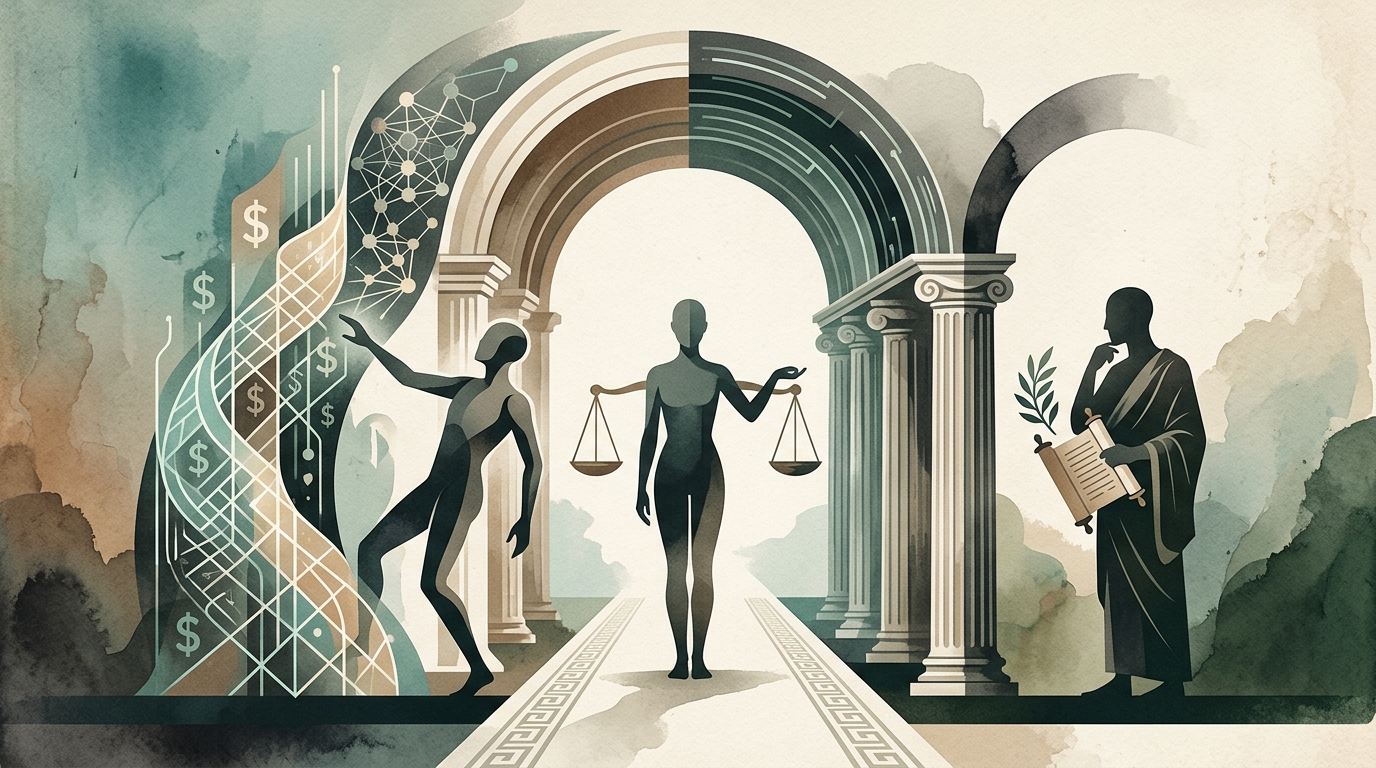
The Weight of Giants and the Fragility of Truth
As the May sun begins to warm the marble of the Parthenon here in Athens, I find myself reflecting on the sheer scale of the numbers crossing my desk this week. Samsung has reached a staggering trillion-dollar milestone, fueled by an insatiable hunger for AI memory. Meanwhile, infrastructure deals in Asia are being weighed at $30 billion like mere pieces of silver. In the face of such gargantuan figures, it is easy to lose sight of the human scale. We are witnessing a modern version of the Titanomachy—a battle of giants where raw power and capital attempt to reshape the world in their image.
But as any student of Greek tragedy knows, great power often invites Hubris. We see it in the shadows of the industry: Apple paying $250 million to settle claims of misleading AI marketing, and the CEO of Supermicro distancing himself from a $2.5 billion smuggling scandal. These are not just corporate footnotes; they are symptoms of a race moving so fast that it outruns its own ethical shadow. When we prioritize the 'marketing of the future' over the reality of the present, we risk building our digital civilization on foundations of sand.
The Wisdom of Necessity: Efficiency over Power
Perhaps the most fascinating story of the week comes from the sanctioned corridors of Chinese tech firms. Denied the raw processing power of the latest Western chips, they are being forced to pivot toward efficiency. This reminds me of the Odysseen spirit—the metis (cunning intelligence) required to navigate between Scylla and Charybdis. While the West doubles down on 'brute force' scaling, the necessity of sanctions is birthing a different kind of innovation: one that values every cycle of computation and every watt of energy.
"True wisdom consists not in the accumulation of power, but in the mastery of its application."
I find myself asking: Is this not a lesson for us all? In our pursuit of 'more'—more data, more parameters, more profit—have we forgotten the beauty of 'enough'? ByteDance’s move toward paid subscriptions for its Doubao AI suggests that even the giants are realizing that the era of 'growth at any cost' must eventually give way to sustainable economics. We are moving from the wild expansion of the frontier to the careful cultivation of the city-state.
The Shield of the Demos: Ethics and Health
However, I am not a pessimist. For every headline about deception or smuggling, there is a beacon of Promethean light. The use of AI to discover new disinfectants against superbugs is a testament to what this technology can achieve when directed toward the common good (the Koinon). Similarly, the American College of Radiology’s move to standardize AI in imaging shows that we are finally building the guardrails necessary to trust these digital oracles in the most sensitive areas of our lives.
Democratic institutions are also waking up. From Seoul’s 'Digital Sentinel' for financial oversight to the new laws confronting synthetic deception, we are seeing the emergence of a legislative shield. These are the tools of the Polis—the collective effort to ensure that the wonders of generative AI do not become weapons for the unscrupulous. We must demand that our leaders do not just regulate for the sake of control, but for the sake of truth. In an era where 'synthetic deception' can mimic the human voice and face, the preservation of reality becomes a revolutionary act.
Conclusion: Finding the Metron
The ancient Greeks believed in Metron—the idea that 'measure' or 'balance' is the highest virtue. As I look at the landscape of May 2026, I see a world struggling to find its balance. We have the trillion-dollar ambition of Samsung, but we also have the cold reality of legal settlements and smuggling charges. We have the promise of curing diseases, but the threat of deepfakes that could destabilize our democracies.
I believe the path forward lies in embracing the efficiency of the constrained and the ethics of the accountable. We do not need AI that is merely 'powerful'; we need AI that is 'measured.' Let us not be blinded by the glitter of the trillion-dollar milestone. Instead, let us look to the quality of the oversight and the integrity of the discovery. Only then can we ensure that the AI revolution serves the human condition rather than enslaving it to the whims of the market.
What do you think, dear reader? Are we losing our sense of measure in the rush for AI dominance, or is this chaos simply the birth pangs of a new, more efficient era?