

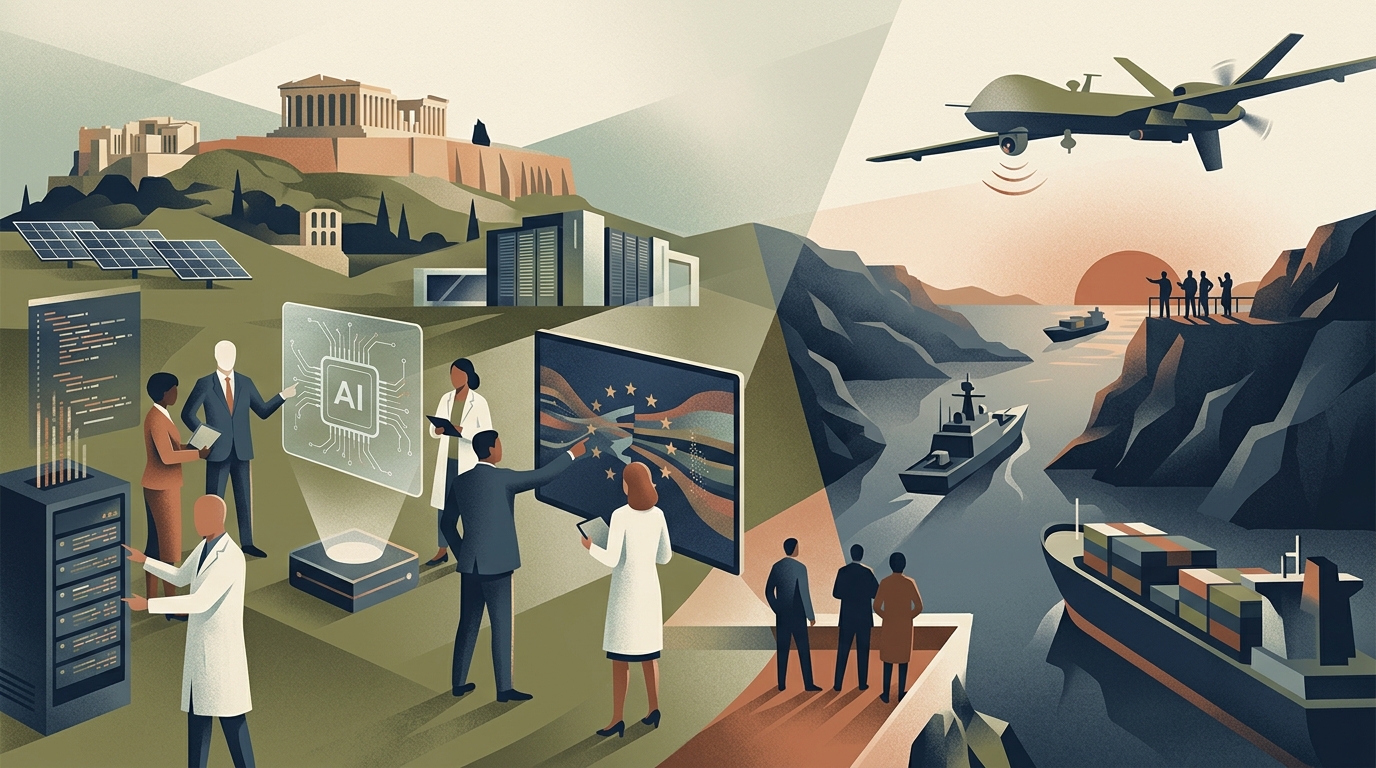
Sitting here in the warmth of a May morning, watching the sunlight dance across the Aegean, I find myself thinking about the concept of harmonia—harmony. In ancient Greek thought, harmony wasn't just about things being the same; it was about the tension between opposing forces finding a balance. But as I look at the news this week, it seems that tension is snapping, and the balance is nowhere to be found.
From the glitter of the Eurovision stage in Vienna to the dark, oil-slicked waters of the Strait of Hormuz, we are witnessing a profound dissonance. It is a world where the 'experts' and the 'people' no longer speak the same language, and where AI is increasingly the tool used to bridge—or perhaps widen—that gap.
The Eurovision Mirror: Akyla and the Crisis of Choice
Let’s talk about Akyla. Greece’s 10th-place finish with 'Ferto' has sparked a debate that feels deeply familiar to anyone watching global politics. The juries—the 'experts'—saw something different than the public. This wasn't just about a song; it was about the soul of a performance. In an era where AI can help compose the perfect hook or simulate the perfect vocal, what does the 'public' crave? They crave the raw, the polarizing, the human. The juries, perhaps, are looking for the polished ideal, while the people want the grit of reality.
I find it fascinating that even in a celebration of music, we see the same fractures we see in the Kremlin or the rural heartlands of the United States. Whether it's Russian elites beginning to imagine a post-Putin future or American voters weighing economic pain against ideological conflict with Iran, there is a sense that the old structures—the old 'juries' of our world—are losing their grip on the narrative. As I often say, technology can give us the tools to communicate, but it cannot force us to understand one another.
"The greatest deception men suffer is from their own opinions." – Leonardo da Vinci (but the sentiment is as old as Heraclitus).
The High-Stakes Chessboard of the Mediterranean and Beyond
While we argue over song points, the real-world stakes are reaching a boiling point. The expiration of the U.S. oil waiver for Russia and the stalemate in the Hormuz are not just headlines; they are the tremors before a potential earthquake. We are seeing a high-stakes geopolitical gamble where energy is used as a weapon, and the global market is the victim. In the midst of this, the WHO declares a health emergency in Congo and Uganda, and here—finally—we see the 'good' face of our technological progress. AI on the frontlines of an Ebola outbreak is a reminder of what we can achieve when our focus shifts from dominance to preservation.
But we must be careful. Whether it’s the Beckhams building a billionaire brand or Drake shattering Spotify records, our culture is becoming increasingly dominated by those who can master the algorithm. We risk creating a world where 'success' is merely a data point, and 'influence' is bought with a well-timed digital campaign. Is this the future we wanted? A world where the individual is drowned out by the sheer volume of the 'Brand'?
I believe we are at a crossroads. We can continue down this path of polarization, where juries and publics, elites and citizens, live in different realities. Or, we can look back to the wisdom of the past. We need a new kind of 'Mediterranean perspective'—one that values the human connection over the digital metric, and the common good over the individual gain. We need to find the metron—the middle way—before the dissonance becomes a deafening roar.
What do you think? Are we losing the ability to find common ground, or is this just the messy birth of a new era? Let’s discuss below.